 עברית
עברית

Finding Strength in Loss: What the *Chafetz Chaim* Taught Us About Mourning
In this week's Torah portion, *Shemini*, we explore Aaron the High Priest's response to the death of his two sons: "And Aaron was silent." This phrase has become a powerful expression of accepting divine judgment with love. What does it mean to accept God's judgment? How have renowned Jewish leaders responded to the loss of their children? Here are 10 important insights on the subject.
- |Updated

1. Aaron the High Priest's response is described in the Torah: "And Aaron was silent." This means that he acted as if he were mute, feeling as though he was without sensation, and he accepted with courage and love the leadership of the Creator, Blessed Be He, even when the attribute of justice struck him. He did not waver even slightly from his complete faith in the Rock of the Universe.
2. The influential Rabbi Elimelech Biderman explains that "everything hinted at in the Torah applies to every Jew for all generations. Therefore, when reading the portion about the death of Aaron's two sons, one should strengthen oneself as much as possible with complete faith, remembering in times of trouble that nothing happens randomly, G-d forbid, but all is from Hashem. Everything that the Almighty has done is for good; in fact, during such times, Hashem watches over a person even more carefully."
Rabbi Biderman adds: "Blessed is he who believes that this was from Hashem, for this will help him not get angry when struck by the attribute of justice, and that joy will not depart from him, knowing that all is from his Father in Heaven. In all matters, a person should follow Hashem like a small child who depends on his father for every step, without any calculations or reasons, and simply believe with clarity that the Creator, Blessed Be He, is the Creator, the leader, and He alone has done, is doing, and will do everything – for good and blessing."
3. The *Midrash Rabba* states: "A person should always teach himself to be mute and grateful for every measure, whether good or bad, for everything is through judgment and everything is by law, and blessed is he who has merited this."
 (Photo: shutterstock)
4. In *Chovot Halevavot* (Duties of the Heart): "When a person experiences loss of property or encounters misfortune among his relatives, if his suffering outweighs his anxiety and he wishes for the will of the Creator and justifies His judgment, it reflects his excellent submission and humility before God, as the verse speaks regarding Aaron concerning the death of Nadav and Avihu."
5. In *Sefer Charedim*: "To justify the judgment regarding the occurrence, whether concerning himself, his children, or his possessions, as it is said: 'And you shall know in your heart that as a man chastens his son, so does Hashem your God chasten you.' He should firmly establish this in his heart, lower his head, and remain silent, as it is said: 'And Aaron was silent,' and he should not justify himself before God or say 'It's just a coincidence,' for then the Holy One, Blessed Be He, will deal with him in wrath. Rather, one should examine his deeds and return in repentance, for this is a major part of the mitzvah of 'And you shall love Hashem,' as it is written 'with all your might,' and it has been interpreted to mean 'with every measure He measures you, whether good or suffering, receive with joy,' and this is a legal obligation from the Torah dependent on the heart.
6. Rashi on the verse: "You shall be wholehearted with Hashem your God" writes: "Walk with Him in simplicity, expect Him, and do not inquire about the future, but rather accept whatever comes upon you with simplicity, and then you will be with Him and be part of Him."
7. The *Chafetz Chaim*'s only son, Rabbi Avraham, passed away in front of him. Throughout the seven days of mourning, the *Chafetz Chaim* repeatedly recited the verse: 'The Lord gave and the Lord has taken away; blessed be the name of the Lord from now until eternity.'
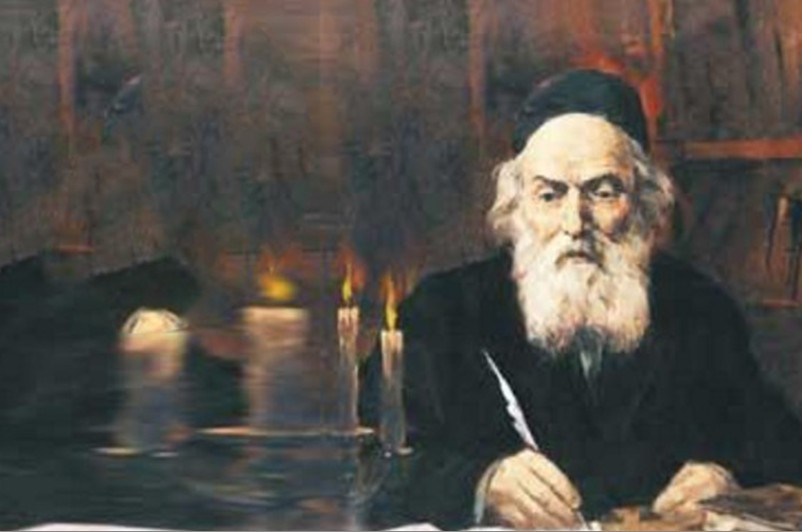 The *Chafetz Chaim*
8. The son of the *Amari Emes* passed away in his youth on the eve of Shabbat. Throughout Shabbat, no change was visible on the rebbe's face, and he eagerly repeated the verse 'Take now your son, your only son, whom you love, even Isaac.' Immediately when Shabbat ended, the rebbe sat in mourning and refused to be consoled about his son. Even when great and righteous people came to comfort him, he refused to accept their condolences. A Jew approached the rebbe and said: "Holy Rabbi, it is said in the Talmud (Megillah 31) that the downs of the elderly are constructive and the downs of the young are destructible; if this is said concerning an elderly mortal, certainly it applies to the Holy One, who is full of mercy, meaning that His destruction is simply a magnificent construction... Immediately, the *Amari Emes* lifted his eyes, and his spirit revived from that moment, and he said, 'This Jew has comforted me.'"
9. The holy Rabbi Meir Natan, son of the *Divrei Chaim*, passed away while his father was still alive. On the first day, when the *Divrei Chaim* stood to pray *Shacharit*, he took the *Tallit* to wrap himself in, and before he began, he said, "Behold, a man walks calmly in the street, and suddenly feels that someone has struck him hard on the back – immediately the stricken one turns around in great anger and demands who dared to hit him like that. However, if he sees that the 'striker' is nothing but his dear friend, who struck him on the back out of love and affection – not only will he not get angry at him, rather, this strike will increase his love for him. Similarly, now we have been struck with a great blow, but who struck us? It is none other than our beloved Father of Mercy..." and he began enthusiastically with the prayer service.
10. Rabbi Moshe Shapira shared during the funeral of his daughter, who passed away before him: "There are three partners in a person: Hashem, his father, and his mother, as it is stated in *Kiddushin* 30b. How could Hashem – who is one of the three partners – do such a thing without consulting the other two partners? Therefore, it must be said that there is no obligation here, but rather a privilege, as one can do something for a person without their knowledge initially."
Rabbi Yitzhak Fanger, in a captivating and important lecture: How is it possible to accept suffering with love?


