

Magazine
Zion Golan: The Legendary Yemenite Singer Keeping a Musical Tradition Alive
Zion Golan shares his life story, faith, family, charity, and deep commitment to preserving Yemenite Jewish music
- Avner Shaki
- | Updated
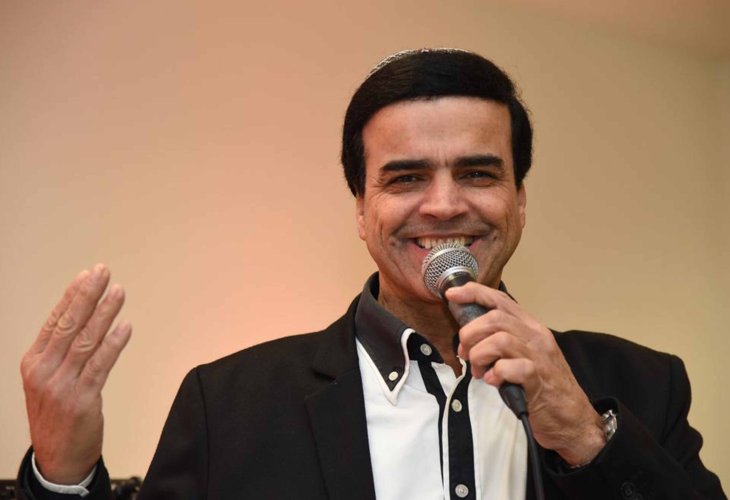 Zion Golan (Photo: Avi Et Avi)
Zion Golan is married and father of four, who lives in Merkaz Shapira. He is a singer and songwriter.
A childhood story that has stayed with you?
“I was born in Israel, in a Yemenite neighborhood in Ashkelon. In our neighborhood people spoke almost only in Yemenite Hebrew. My parents were born and married in Yemen and immigrated to Israel in the 1950s. We are ten siblings, five sons and five daughters. Every day after I came back from school, my mother sent me to the mori (traditional Yemenite teacher), and with him I learned the precise Yemenite pronunciation.
“From a very young age I felt a strong connection to music, and the people around me loved my singing. There were many events in our neighborhood, and of course the prayers in the synagogue, and many times they would ask me to sing.
“In general, many things back then were different. For example, in our neighborhood a wedding was celebrated for an entire week, from Saturday night to the following Saturday night. The celebrations began on the first night, then an evening at the groom’s house, an evening at the bride’s house, a henna celebration for the groom and a henna celebration for the bride, and on Thursday the wedding itself.
“Many well known singers would come to our celebrations and would also invite me up to sing with them. Besides singing, I also loved very much to drum on metal cans, and I still do that to this day.
“That is how I started, in the neighborhood. Later on I took part in the Festival HaDarom and won first place, which gave me the strength to continue and become more professional in the field. Afterwards I won additional festivals, but that was the first one.
“I sang in a variety of styles, but very quickly I understood that my strongest connection is to Yemenite music. I knew that this is my life’s mission. After high school I auditioned for an army entertainment troupe, and thank God I was accepted. I was a soloist in the troupe and sang with talented artists such as Moshe Giat and Dudu Fisher. After being discharged from the army I formed a group called ‘Tzlilei Golan,’ and we performed a great deal together. We were very much in demand then, mainly in the Yemenite community, and thank God it has continued that way until today.”
 (צילום: אבי את אבי)
What does an average day look like for you?
“No matter what time I get back from a performance, and many times it is very late at night, I wake up at five in the morning and pray Shacharit. After that I eat something. Many times I take my grandchildren to kindergarten and school, and then I go to sleep.
“After I wake up I deal with performances and with everything that needs to be arranged. I do not have a manager today, and in fact I have never had one. Later, toward the evening, I go out to perform. I perform almost every evening, and not only for Yemenites. I try to adapt myself to the audience and sing Chassidic, Mizrahi, Yemenite, whatever fits the crowd.”
Tell us about a learning experience that was especially meaningful for you
“Every week, on one of the days, I invite a few friends from the synagogue to my home and we read together Shnayim Mikra veEchad Targum (twice the Torah text and once the translation). I began learning the weekly Torah portion at a very young age, already when I was with the mori.
“Today my grandchildren are already being called up to the Torah, and that is very moving. I hope that I will merit to learn more and that I will continue to be as I am today, that God will give me health and that I will be able to continue bringing joy to the entire Jewish people, and especially to members of the Yemenite community.”
Share something interesting and or emotional connected to your family
“As a young man I performed at events, and at one of them my future mother in law saw me and invited me to come to their home so she could play some songs. She writes songs and wanted to give me a few.
“I came to their house, and that is where I met her daughter, Kochava. The moment I saw her I knew she would be my wife. I immediately saw her good character and the respect she shows others. That is how I was blessed with a wonderful wife and also a wonderful mother in law. By the way, Kochava also loves music very much. She understands it deeply, and I consult with her a lot.”
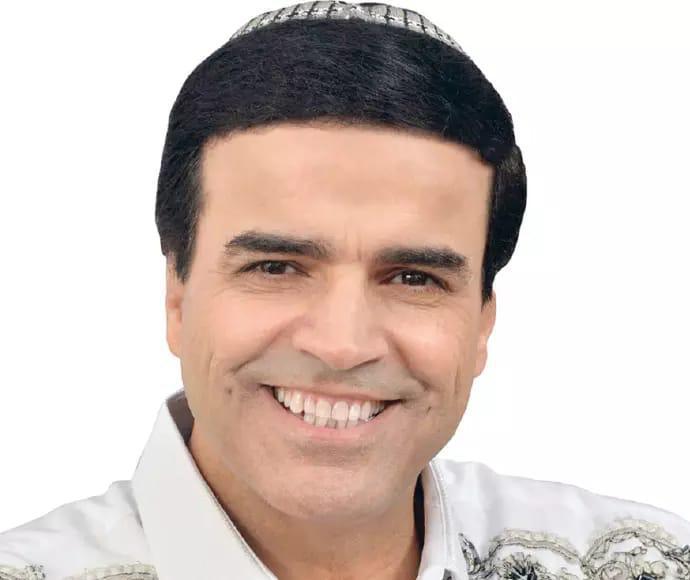 (צילום: אבי את אבי)
How present is God in your life, and how does He influence what you do?
“I feel that I have blessing and constant protection from God, that He accompanies me in all my ways. There are songs that I sing in performances, where I feel that I am really praying.
“And in general, thank God, I am always progressing spiritually. Unlike in the past, when people call to book me for performances, I say in advance that I do not perform mixed dancing.
“In my life I have brought three Torah scrolls into synagogues, and at the third dedication I announced that I was stopping mixed dancing. Rabbi Barda, to whom I am very connected, told me for several years, very gently, that it would be good for me to stop performing at mixed dancing events. He promised that thanks to this I would see very great blessing. It took time for it to happen, but in the end it did, at Teddy Stadium, at a huge Shas gathering. Rav Ovadia was there, and in front of thousands of people I announced that I was stopping to perform at events with mixed dancing.”
Tell us about a prayer that was especially meaningful to you
“I am very, very moved at the beginning of Yom Kippur. I serve as shaliach tzibur (prayer leader) in our synagogue, and it is a great responsibility. People rely on me, and it is very powerful.
‘Lecha Eli,’ ‘Yeraim Shelachuni,’ ‘Kol Nidrei,’ and others. ‘Yeraim Shelachuni’ is a Yemenite piyut that is recited on Yom Kippur. For me this is the peak moment of my prayers for the entire year. Every year I am moved to tears. I cry, and it is really hard for me to continue. I feel that I am literally standing before the Creator of the world.”
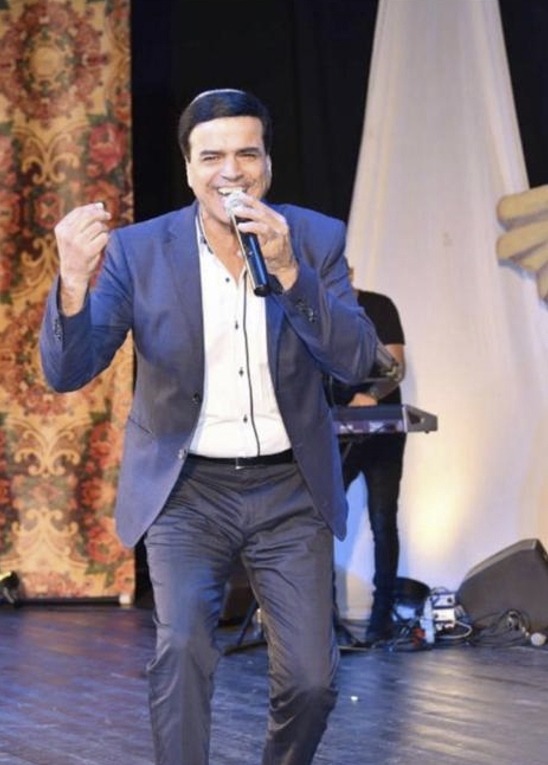 (צילום: אבי את אבי)
A song that especially influenced you?
“Of course it is very hard to choose, but I think ‘Abba Shimon’ is a very special song. The lyrics were written by my dear mother in law, Naomi Amrani, and the melody is mine. By the way, my talented mother in law wrote many more songs for me.
“‘Abba Shimon’ was a very successful song. To this day it is a big hit, and it is also a song that crosses communities. People from all backgrounds and communities love us.
“‘Abba Shimon’ is actually the nickname of Rabbi Shalom Shabazi. One of his sons was named Shimon, and he was very wise, and when people saw Rabbi Shalom, many times they would say ‘Abba Shimon,’ meaning ‘Shimon’s father.’ That is the practice in our community.
“During my career I published two books, ‘Zmirot Zion’ volumes one and two, and in them I included all my songs, with musical notes, vowel markings, and translation. The books I published of course also include ‘Abba Shimon,’ so anyone who wants to delve into the lyrics can find it there.”
An interesting story that happened to you
“A few years ago, in one of the luxury hotels in Jordan, a very large wedding took place. It was the wedding of the son of the former Vice President of Yemen. One of the most successful singers in Yemen, Hussein Mahib, performed there, and since we are in contact and he also plays my songs, he invited me to perform at the wedding. I agreed, and he said he would check with the family because in the end I am a Jew.
“The family was very happy about the invitation and said they did not believe he would succeed in bringing Zion Golan. I decided to travel, but I definitely had some fear. After all, it is an Arab country, and I did not know what and how things would be. I even replaced my regular kippah with a black one so it would not stand out. At the entrance to the hotel the guard asked me to remove it. He said one is not allowed to enter with a kippah.
“I was very emotional when I entered the hall, and Hussein was on stage in the middle of a song, but as soon as he saw me he immediately stopped everything and came over to me. I was very surprised by the love I received there. The audience recognized me, wanted to take photos with me, and showed me my songs on YouTube that they like to listen to.
“After a few minutes Hussein invited me onto the stage, and as soon as I began to sing my songs I saw that everyone was singing along with me. I gave a full hour performance, and afterwards I stayed to take pictures with the guys. They honored me greatly. It was one of the most emotional performances I have ever had in my life. The next day all the media outlets in Israel wanted to interview me about it. It made a very big splash.”
Tell us about a mitzvah you feel especially connected to
“I am very connected to the mitzvah of charity. I really love helping people. Many years ago I was driving home late at night after a performance. It was a very stormy night. I was driving through the streets of Ramat Gan, and suddenly I saw an elderly woman who seemed to be in distress. I stopped next to her and told her to get into the car, and I promised I would take her wherever she needed.
“She told me the name of the street, but I did not know the area, and at that time there was no Waze, but in the end, thank God, we found the house.
“When we came into her home, she took out a large sum of money and asked me to take it, but I refused. She asked how she could repay me, and I told her to bless me that I should win a singing competition that was taking place a few days later. That is exactly what happened, and I won first place by a huge margin over second place.
“A few days later people told me that she had gone on air on the radio and told this story. We stayed in contact, and I even invited her to my wedding. I felt so good that night after helping her. I believe that these things were among those that helped me to see blessing in my work.”
What is the thing that makes you happiest?
“Thank God there are many things that make me happy, but this time I will talk about the revival and continuity of Yemenite music. There were years when Yemenite music dozed off, but in recent years it is flourishing. There are quite a few new singers and modern bands that make Yemenite music, and that makes me very happy.
“In general, Yemenite music is the foundation of many songs in Israeli music. It has contributed greatly to Israeli culture. Speaking of new songs, I can share that I recorded two duets with Idan Raichel that have not yet been released. I hope they will come out soon and be loved by the public.”
Professionally, are you where you imagined you would be?
“My beginning in this field was not easy. I come from a family with few means. My father was a kerosene delivery man, and many times I would work with him and see how hard it was for him. At the same time, my mother saw how much I love music, and she would borrow money from the neighbors so that I could continue learning and becoming professional in the field.
“This made me aspire to make her proud, to work hard and practice properly. It advanced me tremendously, and it is very moving for me to remember it. I will never forget what my mother did for me.
“And yes, thank God, I have done quite a lot. I thank God for every step, for every album, and for every performance. I love music so much that I do not stop creating, not even for a moment. Thank God, I have released thirty two albums so far, and I am still going. Every year and a half to two years I release an album.
“In my most recent album there are duets with Avihu Medina and Ishay Levi. I am consistent about this, and it is really not simple, especially in my style, in Yemenite music. In Western and Mizrahi music there are many writers and composers, but in our style it is much harder. Many of the songs I have released have succeeded, and that gives me great satisfaction.”

