עברית
עברית

Magazine
From Curiosity to Commitment: One Man’s Journey Back to Judaism
Dror Yahav’s personal story of identity, faith, and a gradual return to Jewish life in a modern world
- Avner Shaki
- |Updated
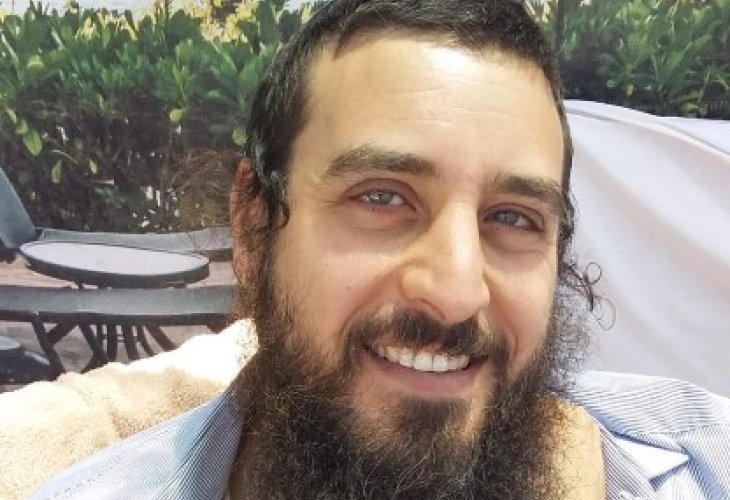
Sometimes a person finds himself in what seems like an ordinary situation, only to be caught completely off guard when something suddenly happens that changes the course of his life, says Dror Yahav candidly. He then falls silent for a few moments, like someone trying to travel back through time to those seconds that repainted his life in entirely new colors.
“I studied at a secular high school, and as part of our studies we participated in a youth exchange program with German teenagers. We traveled to Germany, and later they came to Israel. From our perspective as Israelis, the visit to Germany was mostly about having fun. Seeing beautiful streets, visiting pubs, experiencing life. Still, the trip also had a serious side, and we went together to concentration camps. Of course, we all cried there.
“Another experience that was planned for us was a joint visit, on Shabbat morning, to a local synagogue. We Israelis were not particularly interested, but the Germans were genuinely curious. In the middle of the prayer, one of the German boys, a devout Catholic, suddenly approached me and asked where we were holding in the prayer.
“Before I even had time to understand what was happening, he placed a prayer book in my hands, one that included a German translation, and asked me to show him where we were. I will never forget the shame that flooded me in that moment. He was waiting for an answer, and I slowly realized that I had no idea what to say. I suddenly understood just how disconnected I was from my own tradition.
“As if that were not enough, during those moments that felt endless, I remembered the things we had said at the concentration camp, about representing the Jewish people throughout the generations. The shame only deepened. I felt so embarrassed that at that very moment I swore to myself that never again would someone ask me something so basic about my heritage and I would not know how to answer. Thank God, years later I began to observe the commandments, but in a certain sense the seeds of the transformation I would later undergo were planted right there, in a small synagogue on German soil.”
Psychology, Buddhism, Philosophy
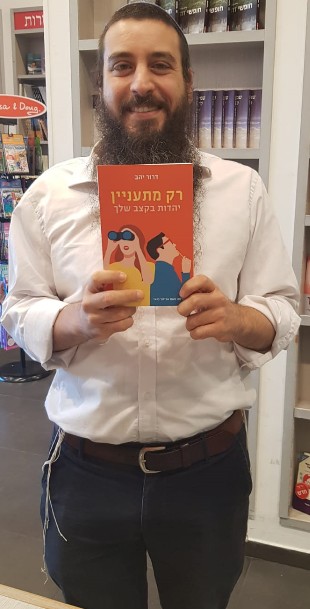
Dror Yahav is married and a father of four and lives in Ramat Gan. He is a writer and editor, and mentor to those returning to Judaism. I meet him in the entrance hall of Yeshivat Nehora in his city, where most of his Torah activity takes place. His life story and its messages are compelling in any case, but our meeting has an additional reason. A few weeks ago, his first book was published, titled Just Curious: Judaism at Your Pace. It serves as a deep and detailed guide for those taking their first steps into the world of Judaism, as well as for rabbis, educators, family members, and friends who accompany them.
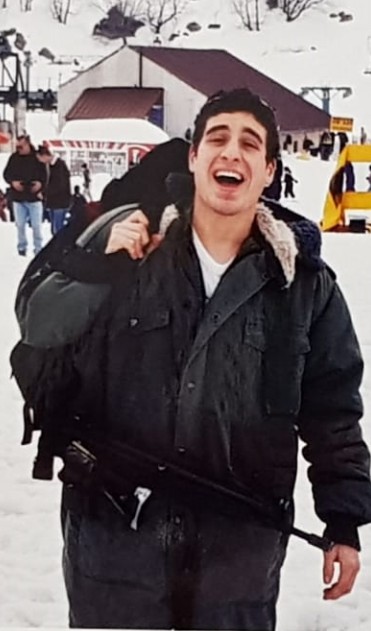
“I was born in Ramat Aviv Gimel to a typical secular Israeli family,” Yahav says, “with only a minimal connection to Judaism. There was some tradition around the holidays, but we did not make Kiddush on Shabbat, for example. My paternal grandparents were Holocaust survivors who fled east into the Soviet Union and later immigrated to Israel, and like many of their generation, they left behind a life of Torah and mitzvot. My mother’s family immigrated from Egypt. They had a strong Jewish identity, but not necessarily one tied to religious observance.
“A few years later we moved to Yavne, and I studied in a state school. Still, I remember that even at my bar mitzvah I began to take some interest in Judaism and learned the haftorah with the rabbi. A more serious interest developed in high school. I was always a curious, thoughtful type, and already at sixteen I spent a lot of time grappling with questions about the meaning of life. My uncle is a psychologist, and I borrowed books from him about the psyche, Buddhism, and philosophy. I spent long hours in the library instead of in class.”
How did that exposure affect you?
“It was a very powerful experience. One book that particularly influenced me was The Power of the Subconscious Mind. It was a major revelation for me because for the first time I understood that ‘the force of the world’ hears me. At the time, I did not yet know that this force is called the Master of the World.
“These experiences were intense, and at the same time my enjoyment of parties and nightlife gradually faded. I remember that many times a ride would come to pick up my friends and myself to go to a party at night. After an hour I would be bored, waiting outside the club until morning for the ride back, meanwhile thinking about the questions that occupied me. Still, because I came from a home so disconnected from Judaism, it never even occurred to me to look for answers in the Torah. I always associated Judaism with the ultra Orthodox, as I understood them then. Despite reading extensively about other religions, Judaism was simply not an option.”
Why do you think that was the case?
“At that time I was searching for truth and meaning, and it never crossed my mind that Judaism could hold those answers. I thought religious people keep commandments, but what does that have to do with the purpose of life or with truth? When the media presents religious Jews, what do they talk about? Money, politics. Does anyone talk about their meaning in life, about their inner truth?
“In fact, it goes even deeper than that. Even when you hear about certain practices, you do not connect them to values or meaning. For example, when a friend’s mother started keeping Shabbat and they bought a hot plate, I saw it as something primitive. I had no idea what stood behind it. Today, by contrast, I understand that every aspect of Judaism expresses a value. Behind the hot plate stands recognition of a Creator who rested on the seventh day, along with social values like rest, calm, and a pause in the race after money and materialism. And this is true, of course, for all the laws of prayer, sanctity, family purity, and more.”
You describe a kind of profound blindness. Who do you think is responsible?
“In secular society, Judaism is identified in a very political and sectorial way, largely because the media chooses to portray it that way. From its perspective, saying that the Torah expresses the meaning of life is not even an option. But beyond that, with all due respect to those who invest in outreach, part of the responsibility also lies with segments of the religious world that do not always know how to translate Judaism to people unfamiliar with it. Even those who hand out Shabbat candles, for example, do not always explain their meaning.
“That is why one of the greatest challenges today is translating the core ideas of the Torah into a modern, Western language for the general public. That is what I try to do in practice. For example, last Shavuot I decided to take on a positive commitment related to Torah study. I began recording five minute Torah insights each day in contemporary language and sharing them in WhatsApp groups. We started with Duties of the Heart and moved on to other books. Thank God, the responses have been wonderful. Just this morning my sister wrote to tell me that a non religious friend said one of the lessons she heard has not left her mind.”
How did your military service affect your inner process?
“In general, during my army service I continued to explore Judaism. I served in Unit 8200, including time in the Hermon area, and later went to officers’ course. During the Second Lebanon War I was a career officer, with missiles flying overhead. That sparked an inner dialogue. I asked myself why they were firing missiles at us, and assumed it was because they believed this land was theirs. At the same time, I knew and felt that it was our land. Suddenly I asked myself how I know that, and the answer came immediately: because it is written in the Torah.
“At that moment, an inner voice echoed and said, ‘Since when do you care so much about what the Torah says? Maybe it is time to actually check what is written there.’ Alongside that came questions like, ‘Maybe I could live somewhere without missiles, but if there is a real reason to live here, I need to understand it and take everything more seriously.’ And that is exactly what I did.
“A few months later,” Yahav continues, “a friend suggested we attend an Arachim seminar. That is where the explosion happened, in the best sense of the word. I felt this was exactly what I had been searching for all my life. It was Simchat Torah, so there was intense dancing, powerful classes, and deep conversations. I was ready for it when it came. When I returned, I decided to start keeping Shabbat.
“At that time I lived in Givatayim with the woman who would later become my wife. I had no idea how to tell her what was happening inside me. On Thursday before Shabbat I bought a hot plate and placed it in the apartment. When she came home and asked what it was, I told her I had decided to keep Shabbat. A very difficult argument erupted, and eventually she went to her parents. I understood what had happened, so I prayed to God. I said, ‘I want to keep mitzvot, and I want to marry her. Please make things work. I do not know how You will do it, but please do.’
Were your prayers answered?
“Yes, thank God. During that time my friend and I continued attending Arachim lectures. One evening he told me he could not come. My girlfriend saw how down I was and asked if she could come instead. Of course I said yes. She wanted to understand what was going on with me, why I was no longer traveling on Shabbat, why I had stopped eating certain foods.
“We left the lecture, and she said she found it very interesting and felt it touched a familiar place inside her, something she felt connected to. Out of curiosity, we began attending weekly classes, I to a men’s class and she to a women’s class. The classes strengthened us greatly. I already knew I wanted to observe mitzvot. For her, the content spoke on an intellectual and emotional level, not yet a practical one.
“We separated geographically for a time. I went to study Torah, and she traveled east. Two weeks after she left, she suddenly called me from a trek in Nepal and said she was on her way home. She had a powerful spiritual experience there and understood that we needed to get married, no matter what.
“Beyond that, I knew that whatever would happen religiously, things would be okay. She felt the same. Half a year later we got married and continued our journey toward a life of Torah and mitzvot together. Today, thank God, we have four children who are part of this journey with us, a journey that never truly ends.”
Driving Without the Radio on Shabbat
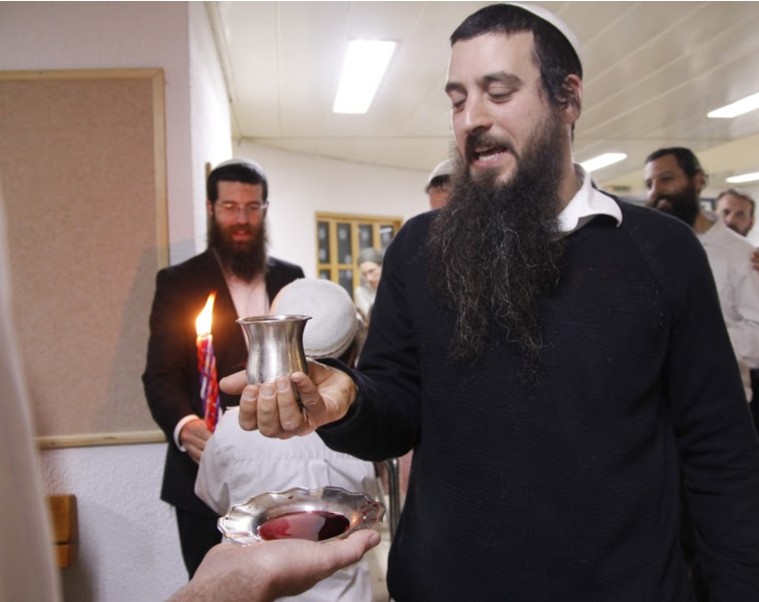
Like many people returning to Judaism, Yahav initially gravitated toward the ultra Orthodox world. “I studied in several ultra Orthodox yeshivot,” he says, “but we did not find our place there. In the end we joined the Nehora community in Ramat Gan, a Torah based Hasidic community of people returning to Judaism. We connected quickly and felt encouraged and guided in a way we had not experienced elsewhere.
“At that time I worked in a Tel Aviv high tech company with army friends and managed to combine that with kollel studies. After several years I realized I wanted to focus more on writing and Torah learning. I taught a weekly Torah portion class at work, and when I noticed I was more excited about the class than the job, I understood the direction I needed to take.
“After leaving, I began a master’s degree in Jewish studies and am currently writing a thesis on halachic decision making for people returning to Judaism, with hopes of continuing to a doctorate. My studies and my role mentoring returnees at Yeshivat Esh Kodesh in Nehora led me to write Just Curious, a book I invested in deeply over several years.”
A Map to the Treasure
“At the beginning of my journey I made many mistakes, and today I know how much I would have appreciated a book like this back then. At first you hear something from one rabbi and are convinced it is the absolute truth. Over time you realize Judaism has many faces, and you can find your own place within it. That is why the book includes an entire chapter called ‘Religious Society,’ offering close familiarity with different sectors.
“The book comes out during a period of aggressive campaigns against what is called religious coercion. My goal is not to impose Judaism on anyone, but to allow those who want to explore it to do so in a healthy way. Graduates of Israel’s state education system suffer from a lack of knowledge about their Jewish identity, often without even realizing it. Even those who are curious usually encounter Judaism through academic or secularized lenses and never really understand what it is.
“At the same time, I see an enormous thirst among many secular Israelis to reconnect with their roots. For them I wrote this book, which is essentially a map to the treasure.
“When I mentored people returning to Judaism, I developed an approach based on Nehora’s calm, non coercive spirit. Someone taking first steps encounters an overwhelming amount. Shabbat laws alone are an entire universe, and people can give up before they start. That is why everything must be gradual. Even the Jewish people received the commandments gradually.
“This is a process that religious children go through naturally. They do not learn everything at once. Yet many people returning to Judaism want everything immediately, even the external symbols, and that often causes harm because the inner process has not happened. That is why I recommend a gentle, gradual pace.
“Everyone needs a guide to help them understand what is right for them. You can say morning blessings? Great. You cannot keep all of Shabbat? Stop doing one thing, such as driving. I once knew someone who wanted to strengthen but could not keep Shabbat fully. He still drove, but he did not turn on the radio. That was his Shabbat. Today he is a serious Torah scholar. His journey began with driving on Shabbat without the radio.
“One reason each person needs a unique path is that people return to Judaism for different reasons. A Midrash says that when Kayin wanted to kill Hevel, he struck him all over because he did not know where the soul exits. A rabbi once said that similarly, we do not know where the soul enters.
“One person is drawn by Jewish history and says it cannot be that we are such a unique people without a reason. Another is drawn by the wisdom of the Torah. Another by faith in God. Another by the detailed guidance of mitzvot that brings stability and joy. I once met a returnee covered in tattoos and asked what brought him back. He said he once saw a religious family walking together on Shabbat and thought, ‘I want to live like that.’ The secret is to work on all levels and try to draw people closer in every positive way possible.”
A Human Guide
“Of course a human guide is preferable, and a book should not stand alone. But a written guide also has great value, especially when written by someone who has lived the process. There are also timeless truths. For example, the book includes guidance for parents of people returning to Judaism that can genuinely save family relationships.
“It also addresses the inner process, which is often frightening and full of dilemmas. When is the right time to start wearing a kippah or dressing modestly? When will I know I am ready to stop wearing pants? I provide tools for dealing with these questions, which naturally have different answers for different people.
“In many ways, the book is for those who are still not comfortable approaching religious people or rabbis with questions. That is why it is called Just Curious. It is for those who would never ask a rabbi directly. At the same time, I encourage everyone not to stop with the book, to go deeper, find a community that suits them, connect with rabbis and mentors, and continue growing.
“I do not claim that what I wrote is the perfect, complete truth of Judaism. I offer directions and starting points. For those who want to deepen, the doors are open. I also include many book recommendations. The Oral Torah cannot be fully written, so the book is only a starting point, the opening shot of an endless journey.”