

World News
Trump: ‘Another Beautiful Armada’ Sailing Toward Iran
President cites June strikes on Iran’s nuclear program as US naval forces deploy and Washington signals pressure alongside continued diplomatic contacts
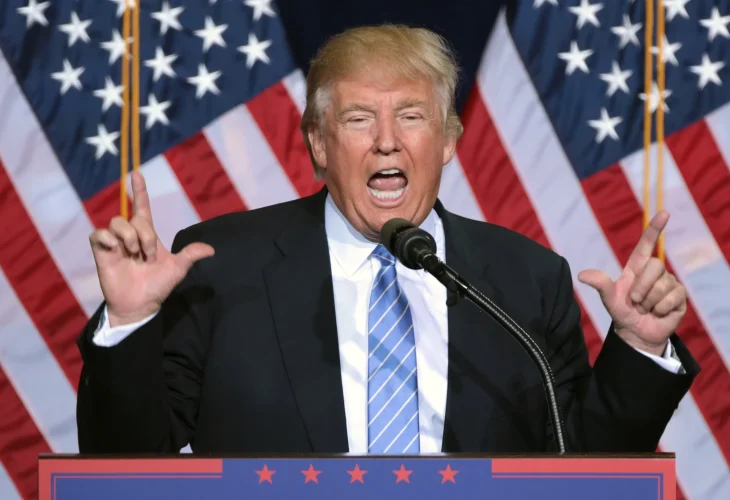 Donald Trump (Shutterstock)
United States President Donald Trump said Tuesday night that an additional “armada” of U.S. military vessels is sailing toward Iran, framing the move as part of sustained pressure aimed at forcing Tehran to reach an agreement with Washington.
Speaking in Clive, Iowa, Trump told supporters, “There’s another beautiful armada floating beautifully towards Iran right now,” adding that he hopes Iran will “make a deal” and saying it “should have made a deal the first time.”
Trump linked the current posture to U.S. military action earlier this year, saying that American forces had already dealt a decisive blow to Iran’s nuclear ambitions. “In June, we obliterated Iran’s nuclear capacity in Operation Midnight Hammer,” Trump said. “People had been waiting for 22 years to do that. They were about a month away from having a nuclear weapon. We had to do it.”
Trump’s statements have coincided with visible U.S. military activity in the region. On Tuesday, U.S. Central Command announced it was preparing multi-day readiness exercises designed to enhance the dispersal of assets and personnel, strengthen regional partnerships, and ensure flexible response capabilities across the CENTCOM area of responsibility. The command said the drills were meant to demonstrate a “credible, combat-ready, and responsible presence” aimed at deterring aggression and reducing the risk of miscalculation.
On Monday, a U.S. source confirmed that the USS Abraham Lincoln aircraft carrier strike group had arrived in CENTCOM waters in the Indian Ocean. A Reuters report said the group includes additional U.S. warships, destroyers, and fighter aircraft. It remains unclear whether Trump’s reference to another “armada” refers to the Lincoln group or to additional naval forces moving toward the region.
The buildup has unfolded alongside continued U.S.–Israel military coordination. CENTCOM commander Brad Cooper met Sunday with IDF Chief of Staff Eyal Zamir, with the two sides describing the talks as focused on strengthening defensive cooperation between the United States and Israel.
At the same time, regional allies have moved to limit their exposure to a potential confrontation. Iranian President Masoud Pezeshkian spoke by phone with Saudi Crown Prince Mohammed bin Salman on Monday, accusing Israel and the United States of directly supporting protests inside Iran. During the call, bin Salman pledged that Saudi Arabia would not allow its territory or airspace to be used for attacks against Iran. Saudi Arabia and the United Arab Emirates, both of which have previously been targeted by Iran and its proxies, are widely seen as preferring a weakened Iranian regime but are concerned about regional instability and retaliation.
Former senior U.S. military officials said such positions complicate American planning but do not prevent action if Washington chooses to proceed. “From a military standpoint, this increases the operational complexity and cost of any American action against Iran, but it will not stop it,” said David Deptula, a retired Air Force lieutenant general who played a key role in the 1991 Gulf War.
The Guardian reported yesterday that a network of more than 80 doctors across 12 Iranian provinces estimates the number of people killed in clashes surrounding the protests exceeds 30,000. Iran’s Human Rights Activists News Agency updated today it has verified 6,221 deaths so far, including 5,858 protesters, and is reviewing an additional 17,091 reported cases.
In Washington, Trump’s remarks were welcomed by prominent Republican lawmakers. Senator Lindsey Graham praised the president’s stance, writing on X, “Mr. President, I hope so. As long as it’s a good deal. Well done. Keep standing with the protesters in Iran. They can be our friends. The ayatollah will never be our friend.” Senator Ted Cruz went further, writing, “We need to arm the protesters in Iran. Now. Toppling the ayatollah, a tyrant who routinely chants ‘Death to America,’ would make America far safer.”
Despite the rhetoric and military movement, diplomatic contacts continue. Iranian sources told the Qatari newspaper Al-Araby Al-Jadeed that intensive efforts are underway between Tehran and Washington to reduce tensions and prevent a new war, with communication between Iranian Foreign Minister Abbas Araghchi and U.S. envoy Steven Witkoff remaining open. American officials have told Israel that preparations for a potential strike on Iran are not yet complete and that the window for action could still be months away, though they stressed that an earlier move remains possible if Trump orders it.

