

Israel News
USS Abraham Lincoln Enters CENTCOM Waters as Iran, Houthis Escalate Threats
U.S. carrier moves into Central Command’s area of responsibility while Washington warns Tehran over protests, drone warfare, and Red Sea instability
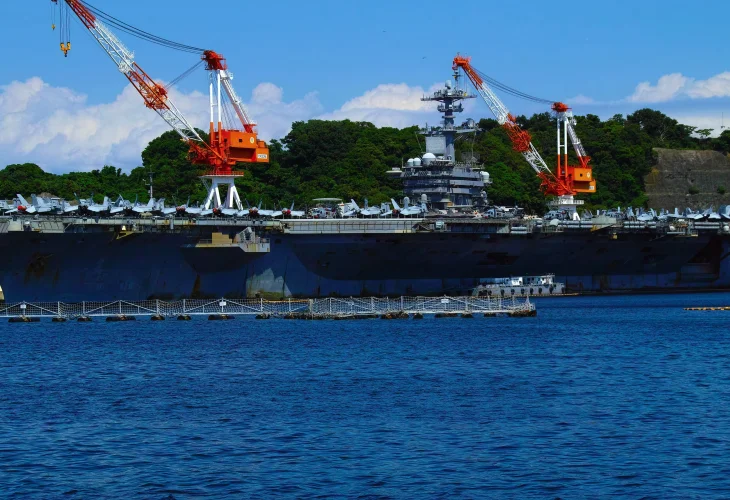 USS Abraham Lincoln (Shutterstock)
A U.S. aircraft carrier has entered the Middle East theater, though American officials say it is not yet positioned for possible military action.
The USS Abraham Lincoln has entered the area of responsibility of U.S. Central Command, according to Fox News correspondent Jennifer Griffin, citing a senior U.S. official. The official stressed, however, that the carrier has not yet moved into a location that would allow a strike against Iran.
The deployment comes during mounting instability inside Iran, renewed threats from Tehran, and warnings from U.S. officials that the situation could escalate if red lines are crossed. Washington has been reinforcing its military posture across the region by air, land, and sea while closely monitoring developments in Iran and neighboring arenas.
Reports in recent days have suggested that Iranian Supreme Leader Ali Khamenei has gone underground, a move widely interpreted as a sign of heightened concern within the regime. Iranian officials have continued to issue public warnings against both the United States and Israel.
Iranian Defense Ministry spokesperson Gen. Reza Talaei-Nik said any attack would “be met with a response that is more painful and more decisive than in the past,” according to Iranian state television, adding that Tehran must maintain “full and comprehensive preparedness.”
U.S. officials and military analysts have voiced particular concern over Iran’s expanding drone capabilities. Cameron Chell, CEO and co-founder of the drone company Draganfly, told Fox News that Iran has developed “an effective asymmetric threat against highly sophisticated military systems” by pairing low-cost warheads with inexpensive unmanned aerial platforms.
Chell warned that Iran could attempt saturation attacks by launching large numbers of relatively unsophisticated drones at naval vessels. If hundreds were launched in a short period, he said, some would likely penetrate existing defenses. He added that modern naval defense systems were not originally designed to counter that type of attack and that U.S. surface vessels operating near Iran would be prime targets.
“These drones give Iran a very credible way to threaten surface vessels,” Chell said, noting that large U.S. assets in the region are slow-moving and easily identifiable on radar.
Alongside the carrier movement, U.S. officials confirmed that a squadron of F-15 fighter jets has been deployed to the region and that C-17 aircraft carrying heavy equipment have arrived as part of a broader reinforcement effort.
The rising tensions have also spilled into the Red Sea. Yemen’s Iranian-backed Houthi movement released a short video threatening renewed attacks on shipping, showing previously published footage of a burning vessel with the caption “Soon.” The Houthis previously attacked more than 100 ships in the Red Sea corridor, claiming the campaign was intended to pressure Israel over its war against Hamas in Gaza. The group halted attacks following a ceasefire but has repeatedly warned it could resume fire.
U.S. President Donald Trump previously said the carrier and accompanying warships were being moved “just in case” he decides to take military action against Iran. Trump has publicly outlined two red lines: the killing of peaceful protesters and mass executions of detainees arrested during Iran’s nationwide crackdown.
Iran has also taken steps suggesting heightened concern over its airspace, issuing a notice banning small private aircraft flights while allowing limited exceptions for the oil industry and emergency medical services. Many Western airlines have begun avoiding Iranian airspace entirely due to the growing tensions.

