

Parashat Beshalach
Did You Remember to Pack Your Tambourines?
They Left Egypt Knowing There Would Be More to Sing About
- Rachel Wigman
- | Updated
This past Friday, my husband and I were walking through Sacher Park, Jerusalem’s version of Central Park (albeit much smaller) when we came across flowers growing out of a rock. These flowers, called rakafot in Hebrew (cyclamens in English) are one of my favorite parts of winter here in Jerusalem. They have these beautiful, emerald green leaves, and the tip of the stems turn upside down so that the flower faces downward while its petals sweep upward. They come in all different colors, all of them vibrant, and they are everywhere, including growing out of rocks.
The image of those rakafot in the rocks is extraordinarily striking. It is these little nuggets of beauty—of life—popping up in the most unexpected of places. Truthfully, we get excited even before the flowers bloom; once we see the iconic leaves starting to grow, we know what’s coming and we feel the joy of the anticipation. There’s beauty right around the corner, and that alone is worth celebrating.
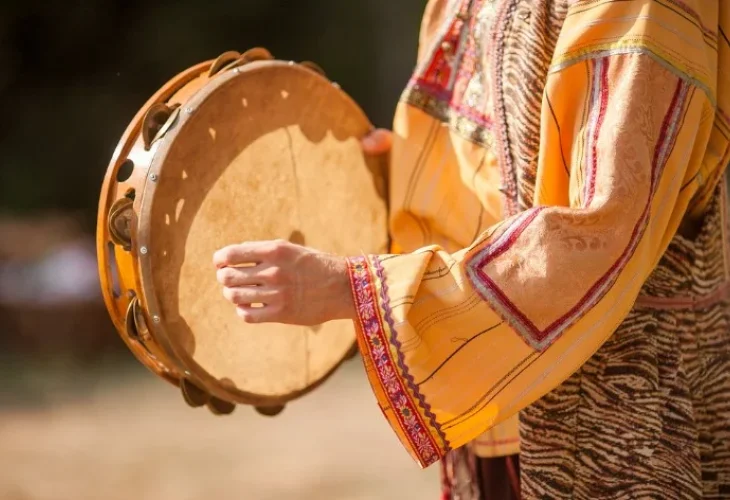
These flowers in unexpected places make me think of an incident in this week’s Torah portion. This Shabbat, we will read the fourth portion of the book of Exodus, the portion of Beshalach, which contains in it the song the Jewish people sang following the splitting of the sea. It’s a majestic response to an open miracle, with beautifully poetic verses proclaiming the greatness of God. Then, following nineteen verses of soul-stirring song, the Torah describes how the prophetess, Miriam, led the women in their own song. It was a single verse, of call and response: “Sing to God, for He has triumphed gloriously; horse and rider were hurled into the sea” (Exodus 15:21). It’s a very simple song, and it echoes one of the verses in the Song of the Sea. The difference, which the Torah highlights, is that Miriam and the women had instruments to accompany their song.
Remember that at this point, the Jewish people were a former band of slaves. They had been granted their freedom a week earlier. They had to leave so quickly that they didn’t even have time to bake bread. Where did the instruments come from? The Mekhilta, which Rashi cites, explains that these women were so confident that God would perform miracles for them that when they were preparing to leave Egypt, they made sure to take instruments.
When I was a schoolgirl and I learned this for the first time, the way my teacher taught it was that the Jewish women maintained hope even throughout the darkest of times. In the years since, I’ve come to realize that it’s more than just hope. The Exodus from Egypt was a moment of deliverance for which the Jewish people had waited for more than two hundred years. It was, perhaps, the greatest moment as a people to date. It was a moment that was worth celebrating, as we do every single year on Passover in our retelling the wonders of the story of the Exodus. Yet, the Jewish women knew, with every fiber of their being, that this would not be the end of the miracles. With that ironclad knowledge—not faith, and not hope, but knowledge—along with their matzahs, the women packed their drums, their flutes, and their tambourines, so that they would be ready to sing when the moment was right.
Jewish Women Are Still Singing
They had to wait all of one week before their vision came to pass. Three thousand years later, the Jewish women are still singing. On Monday, January 19 was the first day of the Jewish month of Shevat. The first of the month, in Hebrew called Rosh Hodesh (lit., the first of the month), is traditionally regarded as a holiday for women. In fact, Rabbi Israel Meir Kagan, in his commentary on the Shulkhan Arukh, writes that every Jewish woman should, in some way, make Rosh Hodesh different than a regular weekday. Here in Jerusalem, every Rosh Hodesh, hundreds of women gather to do just that, tapping into the ancient tradition of Jewish women’s song.
The event is a musical women’s hallel, the special prayer that is sung on Rosh Hodesh, made of different chapters from Psalms. The prayers themselves are songs, and they inspire us to join together in song. Led by Ricka Razel, who is joined by her daughters and various women accompanying the song with their instruments, it is an incredibly uplifting two hours in which women from across the Jewish spectrum come together where nothing matters but the moment. (Full disclaimer: One of Ricka’s daughters is my sister in law, so I am somewhat biased, but the hundreds who come every month would state that I am justified in how much I love these events.)
I can’t always go, simply based on my work schedule, but I was blessed to be able to take my mother to the event last week. She was visiting from New York, and I knew that she would love it. My mother in law also joined, and, together with all the various stripes of women, we sang. We sang because we could. We sang because it was a moment to celebrate, because it was the first of a new month, a new month which is pregnant with possibility. As I stood there, flanked by both my mother and mother in law, watching the women in the crowd bring out their tambourines and break out in dance, I was overwhelmed by the sense of connection with our ancestors.
Those women, back in the day, celebrated the joy of anticipation. They saw the leaves of the rakafot coming up through the rocks and they waited with bated breath until the flowers bloomed. They taught us to dance in those moments, not just to celebrate the moment itself, but because there is more good that is yet to come.
And that, indeed, is worth celebrating.

