

Parashat Beshalach
Why the Sea Almost Drowned Israel: A Hidden Lesson from the Splitting of the Red Sea
How division, unity, and character traits determined divine protection at the Red Sea
- Rabbi Moshe Shainfeld
- | Updated
 (Photo: Shutterstock)
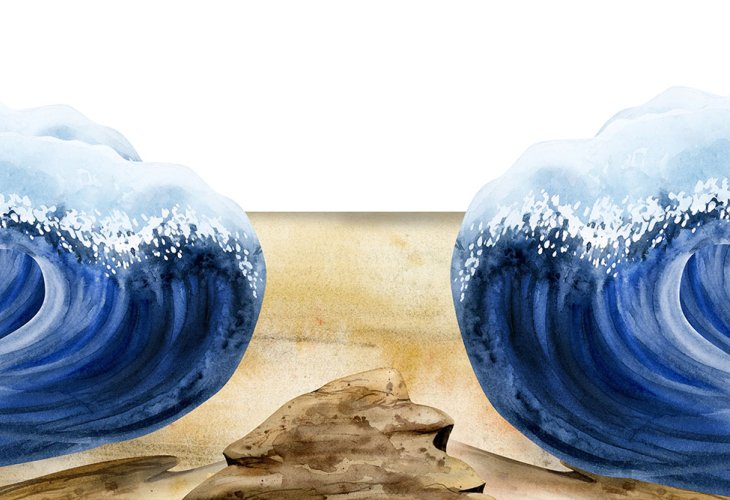
The Egyptians pursued the Children of Israel, and with no other choice, the Israelites entered the sea. The Holy One, blessed be He, performed a tremendous miracle for them: although they were inside the sea, they found themselves walking on dry land: “And the Children of Israel came into the sea on dry land, and the waters were a wall for them on their right and on their left” (Shemot 14:22).
A few verses later, the Torah describes the same event using different wording: “And the Children of Israel walked on dry land within the sea, and the waters were a wall for them on their right and on their left” (Shemot 14:29).
Indeed, it was an astounding miracle. Yet it emerges that the waters threatened to drown the Israelites at any given moment. This is learned from the word chomah (“wall”), which is written in an unusual way — without the letter vav: “And the Children of Israel walked on dry land within the sea, and the waters were a chomah for them on their right and on their left.”
Immediately afterward, the Torah states: “Thus the Lord saved Israel on that day from the hand of Egypt, and Israel saw Egypt dead upon the seashore. Israel saw the great hand that the Lord had wielded against Egypt, and the people feared the Lord, and they believed in the Lord and in Moses His servant.”
Why is the word chomah written without the letter vav?
The Sea’s Anger
The Sages teach that the word chomah is written without a vav in order to allude to cheimah — anger and wrath, that arose against the Children of Israel while they were crossing the sea: “And the waters were cheimah for them — Samael descended and said before Him: ‘Master of the Universe, did not Israel worship idols in Egypt? And You perform miracles for them?’ He raised his voice to the angel of the sea, who became filled with wrath against them and sought to drown them. Immediately the Holy One, blessed be He, responded: ‘Fool of the world! Did they worship idols knowingly? They did so only under coercion and mental anguish from oppression. Do you judge the unintentional like the intentional, and coercion like willingness?’”
(Yalkut Shimoni, end of section 234)
In other words, while the Israelites were inside the sea, walking on dry land, the Satan incited the angel of the sea to anger and create an accusation against Israel. The angel of the sea wanted the waters to return to their natural state, causing Israel to drown, God forbid.
Why did the sea become angry? Because it argued that the Israelites had worshipped idols in Egypt — so why should they be treated differently from the Egyptians, who were indeed meant to drown?
God answered that the Israelites had worshipped idols only because of mental confusion and the crushing burden of enslavement, and therefore they could not be judged harshly.
Why Only at the Sea?
Throughout the entire year preceding the splitting of the sea, the ten plagues struck Egypt, during which God clearly distinguished between Egypt and Israel. Yet we do not find any accusation claiming that Israel was unworthy of miracles.
Why did the accusation suddenly arise at the sea? Where was the accuser until now?
The Meshech Chochmah’s Insight
The Meshech Chochmah offers a remarkable and deeply relevant explanation, preceded by an important foundation.
The Mishnah teaches: “Be as careful with a minor commandment as with a major one, for you do not know the reward of the commandments” (Pirkei Avot 2).
We are unable to calculate which mitzvah is more important. From our perspective, we are obligated to fulfill the Creator’s will down to the finest detail. Yet when we observe the Torah’s commandments, we see that there are severe prohibitions — such as idolatry and forbidden relationships, that carry punishments like karet, stoning, or lashes.
By contrast, regarding sins related to character traits, such as discord, gossip, slander, and baseless hatred, we do not find explicit court-imposed punishments in the Torah. At first glance, these might appear to be “lighter” offenses.
When Character Traits Are Worse Than Idolatry
However, our sources reveal the opposite: sins involving character traits are often treated as more severe than idolatry or immorality.
When humanity in general — and Israel in particular, falls into moral corruption, disputes, gossip, and division, the divine response appears harsher.
Consider the following sources: “In the generation of David, they were all righteous, yet because there were informers among them, they fell in battle… But in the generation of Achav, they were idol worshippers, yet because there were no informers among them, they went to war and prevailed. For when the community is corrupted by idolatry or immorality, Scripture says: ‘Who dwells among them in their impurity.’ But regarding ethical corruption — slander and dispute — it says: ‘Exalted above the heavens…’ as if God removes His Presence from them.” (Jerusalem Talmud, Peah)
The Talmud famously teaches (Yoma 9b) that the First Temple was destroyed because of three severe sins, whereas the Second Temple was destroyed due to baseless hatred. The implication is that baseless hatred is even more severe — evidenced by the fact that the Second Temple was rebuilt, while the Third Temple has yet to be built.
We also know that God forgave Israel for the sin of the Golden Calf, despite its connection to idolatry, whereas for the sin of the spies — rooted in slander and ingratitude, the entire generation died in the wilderness.
Unity in Egypt, Division at the Sea
In light of this, we can now understand why the accusation arose specifically at the sea.
In Egypt, although some Israelites worshipped idols and neglected circumcision, they were exemplary in their character traits. They loved one another, and there was no slander or internal conflict among them (Mechilta, Bo 5). Therefore, God performed miracles for them, and no accusation arose.
At the sea, however, before it split, the Israelites became divided into four factions, each advocating a different response to the crisis.
Moshe said to the people: “Do not fear! Stand firm and see the salvation of the Lord that He will perform for you today. For as you have seen Egypt today, you shall never see them again. The Lord will fight for you, and you shall remain silent” (Shemot 14:13–14).
The Sages explain: “Israel split into four groups at the sea: one said, ‘Let us fall into the sea’; one said, ‘Let us return to Egypt’; one said, ‘Let us wage war against them’; and one said, ‘Let us cry out against them.’ To the group that said, ‘Let us fall into the sea,’ it was said: ‘Stand firm and see the salvation of the Lord.’ To the group that said, ‘Let us return to Egypt,’ it was said: ‘For as you have seen Egypt…’ To the group that said, ‘Let us wage war,’ it was said: ‘The Lord will fight for you.’ And to the group that said, ‘Let us cry out,’ it was said: ‘And you shall remain silent.’” (Mechilta of Rabbi Yishmael, Beshalach, section 2)
Because division and internal conflict arose among the Israelites at the sea, which had not existed in Egypt, the divine protection weakened, and the accusation was able to emerge.

