

Parashat Bo
Why We Wear Tefillin: The Deeper Meaning of the Sign, the Remembrance, and the Weak Hand
How the Exodus from Egypt and the mitzvah of tefillin offer hope, faith, and strength — especially in moments of weakness
- Rabbi Moshe Shainfeld
- | Updated
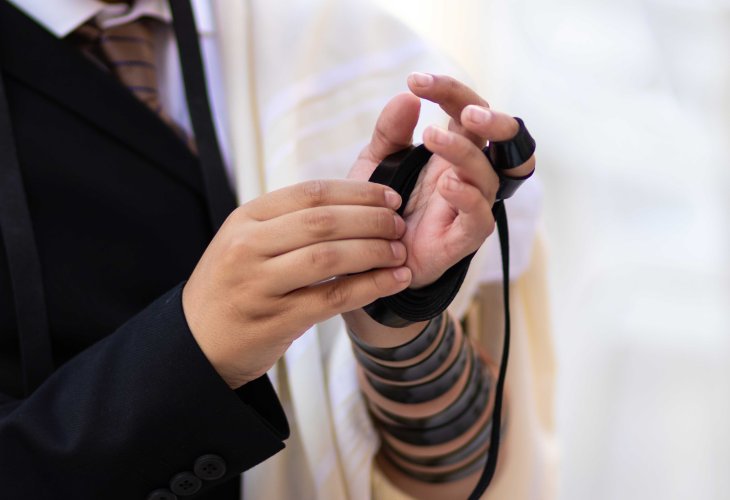 (Photo: shutterstock)
At the end of Parashat Bo, after the Plague of the Firstborn, the Torah commands the mitzvah of tefillin: “And it shall be for you as a sign on your hand and as a remembrance between your eyes, so that the Torah of Hashem will be in your mouth — for with a strong hand Hashem took you out of Egypt” (Shemot 13:9).
“And it shall be as a sign on your hand and as frontlets between your eyes — for with strength of hand Hashem took us out of Egypt” (Shemot 13:16).
Tefillin are a sign and a remembrance of the Exodus from Egypt. What is the difference between a sign and a remembrance? A sign points forward, toward something that is still to come — while a remembrance points backward, toward the past. Tefillin, then, are a sign for the future, built on the remembrance of the past (as explained by the Meshech Chochmah in our parashah). Let’s clarify this and see how it speaks to all of us today.
Tefillin as a Remembrance: Holding On to What Our Fathers “Knew” in Egypt
Tefillin are a remembrance of the foundational truths of faith that our ancestors grasped in Egypt. The Ten Plagues and the miracles surrounding the Exodus brought them to a high level of awareness of God’s reality in the world — His providence, and the entire framework of reward and punishment.
They experienced faith in a vivid, almost tangible way. What they came to know, we must keep remembering constantly — and that remembrance itself brings us closer to that knowledge.
Remembering the Past Keeps Hope Alive for the Future
Remembering the miracles of the past prevents us from despairing of a future redemption — both national and personal, even when we are surrounded by troubles. In Egypt, God redeemed our ancestors even though they were at the very lowest point materially and spiritually (the Torah had not yet been given). Still, God kept His covenant with the holy Patriarchs and redeemed Israel — “a nation from within a nation.”
The same is true today. God will not forget His people and will bring them to a meaningful and beneficial end at the final time (in the wording of the Meshech Chochmah). Even if our spiritual state is not shining, we believe and hope for future redemption just as it happened in Egypt.
The Meshech Chochmah writes (paraphrased and partially quoted): This is a remembrance of the core beliefs that were attained through the Exodus — God’s providence and His relationship with us, and reward and punishment… so that we do not despair of the future hope… for Hashem will continue to redeem His people… He took them out when they were in the lowest state materially and lacking spiritual greatness, and nevertheless He kept His covenant and redeemed them — this is a sign that Hashem will not forget His people and will bring them to a beneficial end in the time of redemption.
Why “Yad’cha” (יָדְכָה) and Not “Yad’cha” (יָדְךָ)?
Now the Meshech Chochmah points out something striking. The Torah says: “And it shall be for a sign on your yad’cha (יָדְכָה)…”
Why “יָדְכָה” and not the more common “יָדְךָ”?
The Talmud (Menachot 37a) teaches that tefillin are placed on the weaker hand (for most people, the left). The proof is from the word “יָדְכָה,” which can be read as an allusion to the “yad keheh” — the dim/weaker hand (Rashi).
Why specifically the weaker hand? What idea is the Torah planting here?
The “Sign” for the Future: When Our Hand Feels Weak
The Meshech Chochmah explains that the “sign” is aimed at the future. When Israel’s hand is weak — when we feel collapsed, powerless, or worn down, we are to hope in what God promised through His prophets, and to remember what our fathers learned in Egypt: that God can save in any situation.
For this reason, the tefillin go specifically on the weak hand: to turn weakness itself into a daily reminder of faith and future redemption.
As the Meshech Chochmah expresses it (in content): When Israel’s hand becomes weak, they should hope for the future and remember that what seemed impossible became openly true — so too they will yet reach the desired goal, even from poverty and lowliness.
This matches the verse: “You rule over all, and in Your hand are power and might; and in Your hand it is to make great and to strengthen all” (Kohelet I, 29:12).
The truly strong hand is God’s hand.
Another Layer: Hand Tefillin vs. Head Tefillin — One vs. Four
There is another well-known difference between the arm tefillin and the head tefillin:
Head tefillin are divided into four separate compartments, each containing one parchment with one of the four passages (“Kadesh,” “VeHaya Ki Yeviacha,” “Shema,” “VeHaya Im Shamoa”).
Arm tefillin contain one compartment, with one parchment on which all four passages are written together.
The Meshech Chochmah explains the meaning of this difference.
There is a verse: “And My eyes and My heart shall be there all the days” (Melachim I, 9:3).
“My eyes” refers to God’s supervision/providence over human beings, while “My heart” refers to God’s love for His people.
Providence has “levels” — God’s supervision of a person corresponds to the person’s spiritual level. There is more general providence and more individualized providence; the more a person cleaves to God, the more precise and personal that providence becomes (as discussed in Moreh Nevuchim III:18, and related sources).
Therefore, the head tefillin, symbolizing God’s providence, are divided, reflecting differentiated modes of supervision.
However, God’s love for His children is not divided into categories. In that sense, it is one and the same love. Therefore the arm tefillin, aligned with the heart, are one unit, because the love of God for His people is one.

