

Israel News
Rafah Crossing Reopens Under Israeli Monitoring in Pilot Phase
Limited pedestrian traffic resumes after months of closure, with strict Israeli security oversight
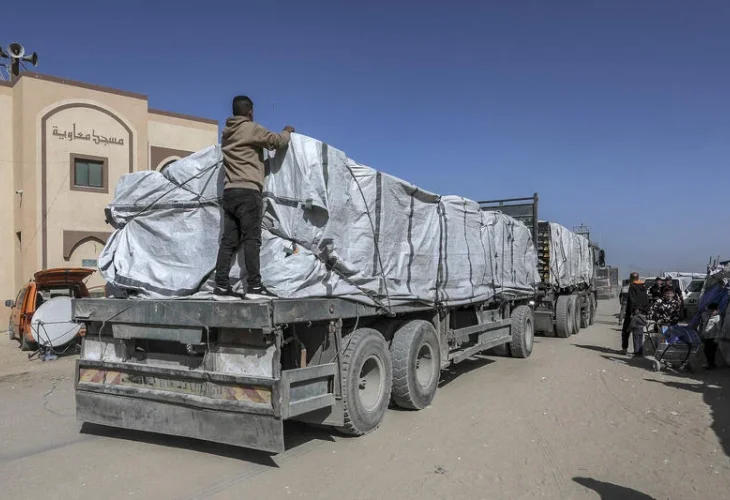 Humanitarian aid enters Gaza through the Rafah border crossing from Egypt (Flash90)
The Rafah border crossing between Gaza and Egypt reopened Sunday morning in a limited pilot phase, marking the first resumption of activity after being largely closed since May 2024. The move was approved by Israel and coordinated with Egypt, the European Union, and Israel’s Coordinator of Government Activities in the Territories, with pedestrian traffic only and no transfer of goods.
Israeli officials described the reopening as part of early implementation of U.S. President Donald Trump’s 20-point peace plan, framing it as a tightly controlled test of humanitarian movement under ceasefire conditions. The crossing’s operation is intended to balance growing international pressure to ease humanitarian conditions in Gaza with Israel’s security requirements.
Sunday’s activity was defined as a rehearsal day, during which systems and procedures were tested. Regular pedestrian movement is expected to begin Monday, subject to operational readiness and security compliance. Under the current framework, up to 150 Gazans are expected to exit the Strip daily, while up to 50 people are expected to enter from Egypt. Medical evacuations are prioritized, and several ambulances were seen preparing to cross as part of the pilot.
Operational control of the terminal rests with Palestinian personnel identified with the Palestinian Authority, while a European Union mission supervises passport checks and identification procedures. Israel does not maintain a physical presence at the terminal itself, instead conducting remote monitoring through surveillance systems and advanced security vetting. Egypt submits daily lists of travelers for Israeli approval prior to movement in either direction.
Israeli officials emphasized that the arrangement is conditional and reversible. According to a reported Israeli security assessment, there is concern that low-level Hamas terrorists could attempt to exploit humanitarian cover in order to exit or reenter Gaza. Officials warned that any irregularity, falsification, or lack of transparency could lead to an immediate suspension of the mechanism. Israel has made clear that the crossing will operate exclusively for pedestrian movement and will not be used for the transfer of goods, which continue to move only through Israeli-controlled crossings.
Humanitarian pressure remains a central driver of the reopening. Gaza health authorities claim that roughly 20,000 patients and wounded individuals are awaiting permission to leave the Strip for treatment abroad, including approximately 440 cases requiring urgent evacuation.
The reopening has drawn criticism within Israel. Opposition figures argued that the presence of PA-linked personnel at the crossing poses a security risk and could undermine Israel’s control. Government officials, however, have presented the move as a technical and procedural step rather than a political concession, stressing that Israeli oversight remains intact.
In a joint statement, Arab and Muslim foreign ministers condemned what they described as repeated Israeli violations of the ceasefire and warned that recent developments could threaten regional stability and undermine diplomatic efforts.
“These repeated violations constitute a dangerous escalation that threatens regional stability and undermines efforts to advance the second phase of President Trump’s peace plan,” the statement said.
Former UN envoy Nikolay Mladenov, now head of the Peace Council, also weighed in, expressing concern over recent developments surrounding the crossing. “I am deeply concerned by what has happened since Friday: Hamas gunmen emerging from tunnels in Rafah, and Israeli strikes that tragically also killed civilians,” he said. Mladenov called on all parties to exercise restraint, adding, “All sides must show restraint and uphold the ceasefire as the technocratic committee prepares to assume civilian and security responsibility.”
Israeli security officials said the coming days will determine whether the mechanism remains in place. Regular movement through Rafah is expected to begin Monday, but officials stressed that the pilot remains under constant review and could be halted at any sign of abuse or security failure.

