

Behind the News
What Israel Will Put on the Table as Witkoff Meets Netanyahu
Israeli leaders outline red lines on Iran’s nuclear program, missiles, and regional proxies ahead of decisive U.S.–Iran talks
- Brian Racer
- | Updated
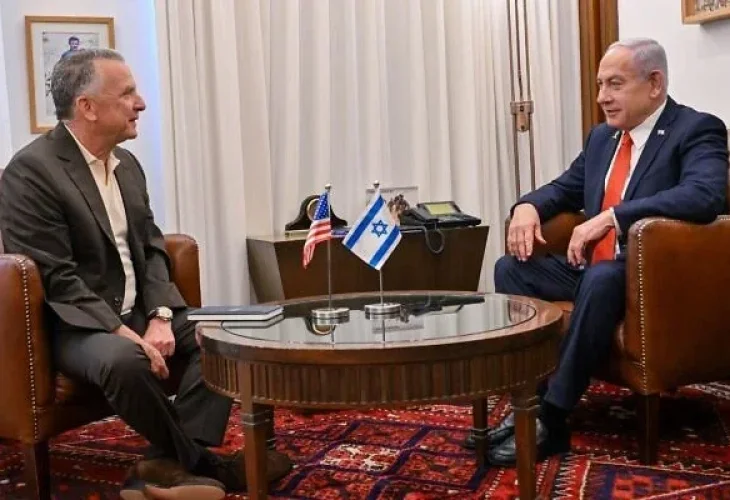 Steve Witkoff and Benjamin Netanyahu (Kobi Gideon/GPO)
U.S. Middle East envoy Steve Witkoff is meeting today in Jerusalem with Prime Minister Benjamin Netanyahu and Israel’s top security leadership, as Israel seeks to shape Washington’s approach ahead of renewed talks with Iran later this week.
Witkoff is expected to hold discussions with Netanyahu, Defense Minister Israel Katz, IDF Chief of Staff Eyal Zamir, and Mossad Director Dedi Barnea. The meetings come just days before Witkoff’s planned talks in Istanbul with Iranian Foreign Minister Abbas Araqchi, at a moment Israeli officials describe as critical for determining whether diplomacy or military action will follow.
Israeli security officials say today’s meetings are intended to define U.S. red lines before negotiations begin, rather than respond to terms already set in motion. According to senior officials, Israel views the moment as a strategic fork in the road: either the emergence of a comprehensive agreement that reshapes regional security, or a rapid slide toward direct confrontation with Iran.
At the center of Israel’s message to Witkoff is a warning against partial agreements. Israeli officials say they will stress that a strong deal must be comprehensive and address Iran’s full range of strategic capabilities, not just its nuclear program.
According to senior security sources, Israel will place four core principles on the table. The first is the removal of Iran’s enriched uranium stockpile to a third country. The second is a complete halt to uranium enrichment inside Iran. The third is the imposition of significant limits on Iran’s ballistic missile program, including both range and production scale. The fourth is an end to Iranian funding and support for regional proxies such as Hezbollah and the Houthis.
Israeli officials have expressed concern that U.S.–Iran talks could focus narrowly on the nuclear issue alone. “A deal that focuses only on the nuclear issue would be a weak and dangerous agreement, for us and for the entire region,” one senior Israeli official said.
Missiles, Israeli officials argue, must now be treated as a central threat rather than a secondary file. Security officials point to the recent twelve-day war as a turning point in Israeli threat assessments. “Iran saw during the twelve-day war how it could rely solely on ballistic missiles and cause significant damage to Israel. This must be included in the agreement,” a senior official said.
In addition to missiles, Israeli officials are expected to raise concerns over Iran’s remaining enriched uranium stockpile. Israeli assessments estimate that between 400 and 450 kilograms of highly enriched uranium remain in Iran, including material believed to be buried beneath damaged facilities. Officials fear Washington may not insist on zero enrichment or on the physical removal of the material from Iranian territory, instead settling for monitoring or temporary limitations.
U.S. officials have said President Donald Trump is pressing both sides to reach an agreement. “The president’s been calling for them to make a deal. The meeting is to hear what they have to say,” a U.S. official said, according to Reuters.
According to Israeli assessments, Washington is seeking clarity by Friday on whether Iran is prepared for serious and substantive negotiations. If talks fail to produce clear progress, Israeli officials believe the military option will again move to the forefront.
Despite the renewed diplomatic track, Israeli officials say they do not view the talks as a stalling tactic or deception. Still, senior figures in Israel’s security establishment assess that U.S. military action against Iran remains a realistic possibility. For Israel, today’s meetings are seen as a final opportunity to shape the framework before decisive choices are made.

