

Magazine
The Miraculous Journey of Ronen Dvash: From Music to Spiritual Awakening and Escape
A story of repentance, Divine intervention, and survival in an Indian prison
- David Fried
- | Updated
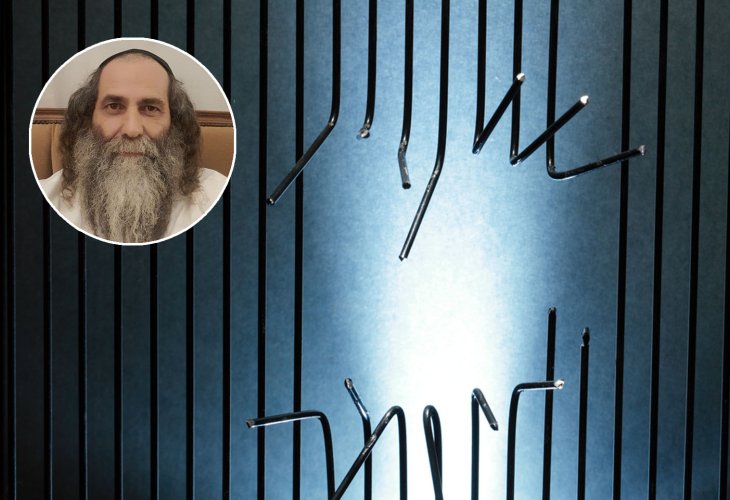 Inset: Ronen Dvash (Background photo: Shutterstock)
Ronen Dvash lives near the Western Wall, sporting a long beard and sidelocks that are hard to miss. Nothing about his appearance reveals his past. From an external meeting with him, it's hard to believe what he's been through and the path he took to arrive in the world of Torah and mitzvot. But behind Dvash lies a long journey to Judaism, spanning the world of electronic music, a secure Indian detention facility, and a miraculous escape after heartfelt prayers and repentance.
A Secular Start in Life
Dvash was born into a secular family. "I studied in secular schools, and like ‘everyone else,’ I joined the army," he recalls. "From the start, I wanted to be as combat-focused as possible, so I enlisted in the combat engineering corps. I remember when we entered Lebanon, feeling proud and calm, perhaps too much so.
"I later encountered a series of dangerous situations, one of which I still can’t forget. It happened while we were clearing mines at the Syrian border. I had a friend, Eliyahu, who sat on one of the rocks. I warned him not to, fearing a trap, and retrospectively, I was right. The rock exploded in front of us, and he was left disabled for life. That event was not the only one. In another situation, we conducted an ambush and waited at a location for two and a half days. At one point, our connection to the base was lost. We were at the mercy of fate, but today I can say, at the mercy of God. We lay there for 40 hours surrounded by Hezbollah. We were eventually rescued by divine grace."
Life After the Army and a Life of Travel
After his military service, Dvash worked as a driver and bodyguard for Israel's Finance Minister (Dvash prefers not to reveal the minister’s identity). He then traveled abroad, eventually making his way to the North Pole. "The place that left the deepest mark on me during these travels was India. It’s hard to describe, but from the moment you land there, it feels like a place with no limits. That’s what attracted me. That’s what draws thousands of Israelis there every year. I settled there for the next nine years, only occasionally visiting Israel. I lived what I thought at the time was the ‘good life’."
A Spiritual Revelation at a Party
Dvash explains that his spiritual awakening began after a series of experiences that seemed to come from another world. "I remember one particular situation very well. I was at a party, surrounded by many people I had invited. But in the middle of it, I felt the need to step outside for some air. I went up and, to this day, I can't explain it, but when I looked up, I felt like I heard a voice say, ‘What will become of you? Return to repentance!’ It shook me, but I didn’t change my ways. Later, there was another event where I was on a yacht with friends abroad. Suddenly, I felt like I was being pulled out of there. I left for the hotel I was staying at, and on the way, I found myself muttering Tehillim — something I had never done before."
The Gradual Journey to Torah and Mitzvot
Dvash’s journey to Torah and mitzvot was gradual. "I had a good friend who built a house in the Himalayas. On Shabbat, he suddenly started baking challahs. He invited me to keep Shabbat with him, and I was really drawn to the idea. In another instance, a friend in New Delhi introduced me to the book Likutei Moharan. In chapter 151, there’s a passage about Goa — the city I visited every year after my army service, along with many Israelis. We would engage in foreign Indian practices, and we were a group of secular Israelis who had never received spiritual light. We were getting vitality, but from the side of impurity. To my astonishment, I saw that Rabbi Nachman quotes the Talmud about Goa, saying that when the Jewish people mix with the Gentiles and learn their ways, God sheds two tears into the great sea, bringing light from the future and causing repentance. This book was written two hundred years ago, specifically about Goa, and what Rabbi Nachman described was exactly what was happening. I knew this was not a coincidence."
Since then, Likutei Moharan became Dvash’s constant companion. "A friend gave me the book at my request, and from that point on, during all my trips, I would open it and read. I didn’t fully understand it, but I found a lot of points that helped me. At the same time, I asked my father for tefillin and began putting them on daily."
Miraculous Events Leading to Belief
Dvash shares more events that led him to believe. "I traveled abroad many times, especially to India, to maintain stores I had opened there. A significant part of my return to Judaism came when I ate non-kosher meat and, shortly afterward, I began experiencing severe stomach pains. A friend’s grandfather, who was close to religion, suggested I immerse in the Ari Mikveh in Safed. I reluctantly went, and to my astonishment, as soon as I left the mikveh, the pain stopped."
"As the days passed, I realized that Judaism is the truth," he continues. "I saw friends around me becoming closer to Judaism, and it affected me. I saw the light and tranquility on their faces, and I felt I wanted that too. Eventually, I understood that long hair wasn’t appropriate according to Kabbalah, so I decided to cut my hair, which included no less than 120 dreadlocks. It was a very difficult moment because it was my symbol among the bohemian crowd, but it also symbolized for me that I wasn’t on that side anymore."
A Fateful Trip to India
Despite his growing connection to Judaism, Dvash did not define himself as religious at the time. His final step toward Judaism would come from a low point, which led him to move to Safed. "I wanted to disconnect from the bad experiences in Tel Aviv," he notes. "But when I reached this point, I began to experience huge doubts, and I struggled to decide whether to fully commit to spirituality or not. The desire to return to Judaism was strong, but it was hard for me to make that decision. I began to believe that perhaps God didn’t want my repentance. I was so broken at that time that I decided to end everything and bought a one-way ticket to India."
Just before his flight to India, a friend proposed a marriage match, and Dvash stayed in Israel. He married, built a home in Safed, and believed he found tranquility in Judaism and with the family he created. But then, the store he had opened selling Indian clothes began to show signs of collapse. In an attempt to cover his debts quickly, Dvash decided to return "one last time" to India. "I had bad feelings before the trip. For some reason, something told me it wasn’t a good idea to go to India at this point. Even my father intervened for the first time in my life and asked me not to go. But I was determined to go."
Why did you go despite the bad feelings?
"I felt at that time that India was my last chance for quick financial relief. A friend offered to have me transport a suitcase and promised me good pay for it. The suitcase contained legal jewelry that could be sold in Europe, but at the bottom of the suitcase were also forbidden materials, and having them in my possession could lead to severe penalties."
On the flight from Israel to India, everything went smoothly, but when he arrived in New Delhi, customs officials immediately signaled for him to send the suitcase for another scan. "Something didn’t sit right with them." The two officers checked the suitcase, and when they found the forbidden materials, they detained him.
"I understood at that moment that I was in trouble," Dvash recalls. "India can sometimes seem like a country without limits, but it’s not. As expected, I was taken into custody. A group of officers escorted me as if I were a dangerous terrorist. Fortunately, they allowed me to make a call to my wife. I called her and tried to calm her down, telling her I believed I could escape once they released me. I knew that to even make it to a trial in India would require divine mercy, and it could take a long time before I would see a judge. Under these conditions, I realized I wouldn’t give my body to the Indian justice system. But while talking to my wife, I heard her crying. That’s when I realized this was not just an issue for me — it was for my family as well. I didn’t know then, but that would be the last conversation I had with her for the next six months."
What was the prison like?
"The conditions were horrendous. The heat reached 45 degrees Celsius, with no air conditioning, no fans, and no windows. Everything was closed. I was immediately taken to a cell with hundreds of people, overcrowded and suffocating. The place was meant to hold 180, but there were about 400 there."
He recalls the terrible conditions: "We slept on the floor, with no mattresses, no furniture. There was dirt everywhere, and the hygiene was appalling. People were stuck in there for six or seven years without a chance to leave. The only residents who voluntarily stayed there were the rats, which ran between the prisoners and made life even more miserable."
The Miraculous Escape
Dvash’s desire to escape became clear when he fell ill with malaria. His condition worsened, but a miracle occurred when he managed to break out of the prison and escape. "I jumped out of the window into the courtyard, and to my surprise, a taxi was waiting for me. It took me through the alleys, and I later found out that if I had taken the main route, I would have been stopped immediately because the guards had set up roadblocks. The divine supervision continued to guide me as people helped me with money and supplies. In one case, police officers who were searching for me didn’t even notice me when I stood right in front of them. That’s how I was able to cross all of India and make it back to Israel without getting arrested."
Dvash sums up: "I was the only one in decades who managed to escape that place. All of this happened with the power of prayer. I truly believe it was divine intervention."

