

Israel News
French Court Summons Pro-Israel Activists on Genocide Charges, Exposing IDF Veterans to Legal Risk
Activists warn the case is a test run to criminalize pro-Israel activity and later target thousands of French citizens who served in the Israeli army
- Brian Racer
- | Updated
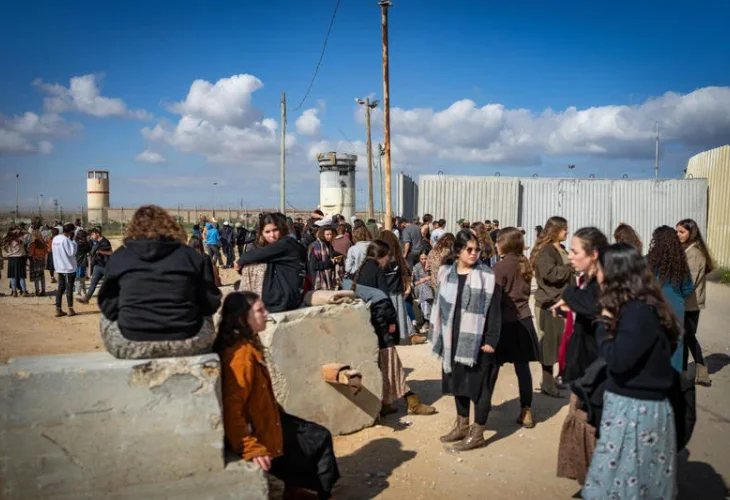 People protest against aid trucks entering the Gaza Strip, at the Kerem Shalom crossing in southern Israel, February 22, 2024. Photo by Erik Marmor/Flash90
French judicial authorities have summoned two dual French-Israeli activists over their involvement in protests against humanitarian aid entering Hamas-run Gaza, accusing them of “complicity in genocide” and “incitement to genocide.” The women say the move is not aimed at their individual activism, but is intended to establish a legal precedent that could later be used to prosecute French citizens who served in the Israel Defense Forces.
Rachel Touitou and Nili Kupfer-Naouri condemned the summonses as politically motivated. Touitou told JNS that she is “just a pawn in a broader effort to make defending Israel illegal,” arguing the case is designed to “open the door” to future prosecutions. If a civilian protester can be summoned on genocide-related charges for political demonstrations, Touitou warned, it lowers the legal threshold for pursuing French citizens who served in the IDF.
According to French media reports, the complaints accuse the women of crimes linked to their participation in protests against the flow of humanitarian aid into Gaza. The demonstrations targeted aid deliveries to Gaza during the war, with protesters arguing that assistance was being diverted by tHamas errorist and criminal groups.
Touitou said the summons illustrate a deliberate legal strategy. “I am not the real target,” she said. “The strategy is to later go after Franco-Israeli soldiers.” If a civilian protester can be summoned on genocide-related charges for political demonstrations, she added, it lowers the threshold for pursuing those who served in Israel’s security forces.
French outlet Le Figaro reported that anti-Israel activist groups filed the complaints, citing the French penal code’s broad jurisdiction in genocide cases. Under that framework, French citizens may be questioned or tried in France for alleged genocide-related offenses committed abroad.
The legal step has drawn sharp reactions from Jewish community groups in France and from Israeli officials, who have described the move as “lawfare” aimed at criminalizing support for Israel. In an open letter, Israeli Knesset member Yosef Taieb condemned the use of genocide accusations against Israel, writing: “I condemn with the utmost firmness the fact that Israel could be accused of genocide, and that this accusation could be the subject of an attempt to give this allegation judicial justification at your expense.”
French reporting has also noted that authorities are examining separate war-related complaints, including cases involving French-Israeli soldiers, reinforcing activists’ concerns that the current summonses could serve as a test case for wider action. Kupfer-Naouri warned that such a precedent could make it risky for French citizens who served in the IDF to travel to France to visit family.
A summons is not an arrest warrant. It is a legal order requiring a person to appear before a magistrate for questioning, without pre-trial detention. Failure to comply, however, can lead to escalation, including arrest warrants. Both women are currently outside France and have said they do not intend to travel there while the matter remains unresolved. Their lawyers are seeking to have the summonses lifted.
Kupfer-Naouri said she would not be silenced by the legal action, declaring on social media that she was “proud to fight on this front of truth and justice,” alongside Israeli soldiers fighting on the battlefield. Touitou likewise vowed to continue defending Israel, warning that the case will determine whether pro-Israel activism itself becomes legally risky in France.
While the proceedings remain in their early stages, activists and community leaders say the case is being closely watched as a potential turning point that could expose French citizens who served in the IDF to legal risk and restrict their ability to travel to France.

