

Magazine
Finding Light in the Geyser: An Artist's Journey of Healing Through Mandalas
As a child facing a cracked mirror, she learned to articulate words without understanding why. Years later, she realized that those whispered words were timeless prayers born from her heart. Discover the inspiring story of Orlit Cohen, who transformed mandala painting into circles of healing for women and children.
- Shira Dabush (Cohen)
- | Updated
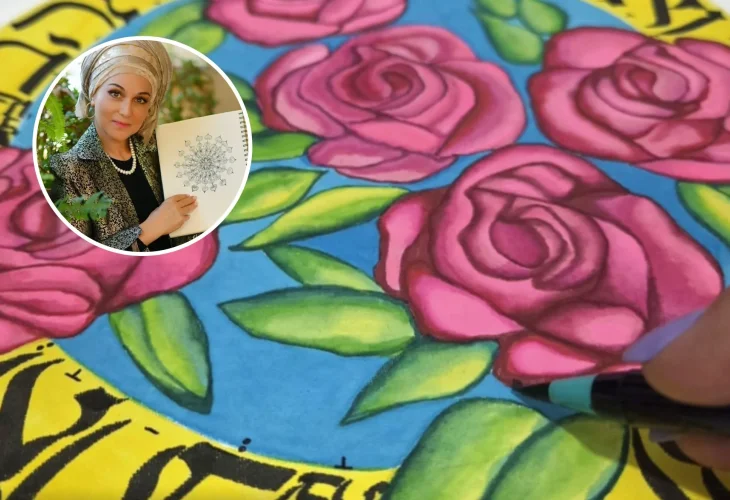 Inset: Orlit Cohen
Some girls speak to themselves not because they are lonely, but because they are deeply attentive. Girls who perceive the world through delicate layers of scent and sound. Girls whose curiosity bubbles within them, constantly drawing them forward to explore. This was the kind of girl Orlit Cohen was, growing up among the orchards of Petah Tikvah.
At the time, she did not know who the Creator was or what faith meant. Yet when she looks back today, she is instantly returned to moments in her childhood when she understood, without being taught, that truth is not found in what is spoken but in what is felt.
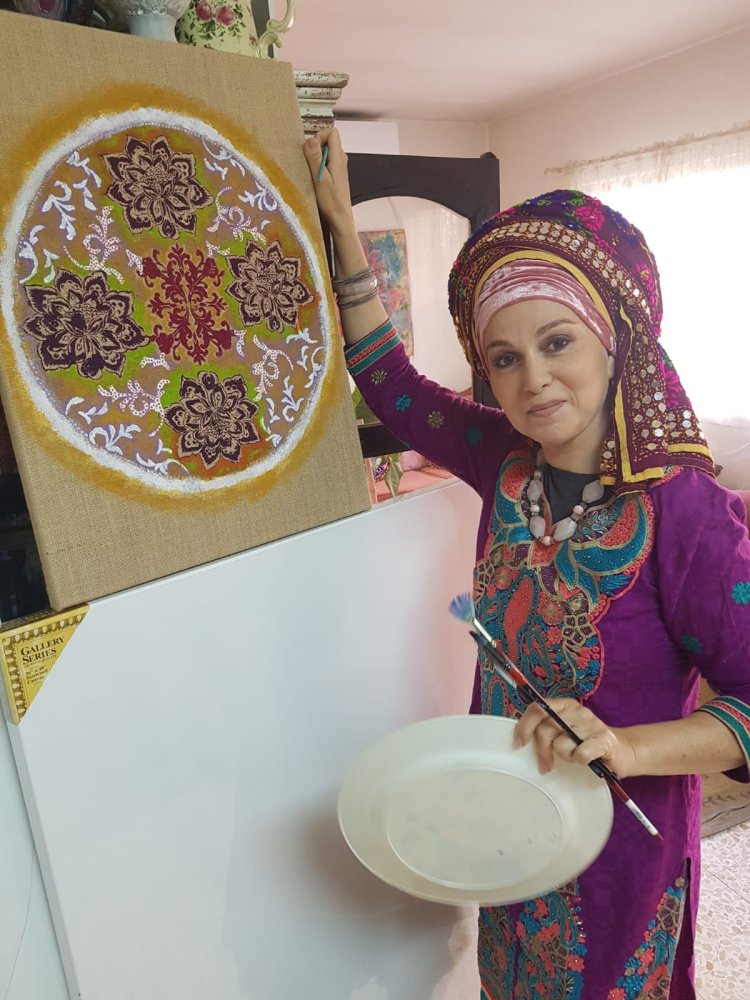 Orlit Cohen
“I grew up with a grandmother who spoke in parables,” she recalls, “with soft phrases and deep wisdom.” Even then, her grandmother sensed that there was something different about her, that she understood the world in another way.
“She taught me not to be angry, to be like a silk handkerchief in the wind, delicate and quick to dry. Through her words, I understood that something was missing in me. It was not a longing for my parents, because they were both present. It was a nameless longing, one that brought me to silent tears at night. As if my heart knew something my mind could not yet articulate. Today I know it was a longing for the Creator. I did not know how to name it then, but my soul already did.”
Cohen, a mother of two grown sons who now lives in Harish, was born in Petah Tikvah and raised in the Amichai neighborhood, surrounded by fields, forests, and orchards. One of her strongest memories is the loudspeaker that traveled through the streets at the end of cucumber season, calling people to the fields to gather what remained. Families would arrive with old plastic baskets, collecting cucumbers straight from the soil.
“I remember the scent of the earth,” she says. “How potatoes were pulled from the ground, how I would bite into a tomato just picked from the field.”
It was a childhood shaped by generosity. “Before we sat down to eat, my mother would always say that we must first feed the cats and the birds. Only then would we eat. ‘The birds eat and give thanks to Hashem,’ she used to say. That is how we were raised.”
Touching the Inner Truth
Listening to Cohen today, it becomes clear that her journey was never only inward. It was a life spent listening to creation itself, to the quiet hints scattered along her path, and choosing to gather them one by one in order to reconnect with her roots.
Words now play a central role in the mandala workshops she leads. When asked when she first recognized their power, she returns to early childhood.
“It began around the age of six,” she says. “I remember standing in front of a cracked mirror, examining every word before I said it. I would ask myself whether I felt it. If I did not feel it, I would not say it.”
That moment, she explains, taught her to touch her inner truth. “Precision became my guiding principle. I believe that from then on, I tried to walk a path that was accurate to who I truly am.”
This commitment to precision followed her throughout her life. It is striking to discover such inner strength in a young child who understood that words must resonate deeply before being spoken. The cracked mirror did not distort the truth. Instead, it became her first teacher, guiding her to see honestly, even when truth does not align with the world’s expectations.
Asked why precision mattered so much, she answers simply. “It is not just about language. It is a worldview. When a person is precise with words, they become precise with emotions, with relationships, and with their spiritual path.”
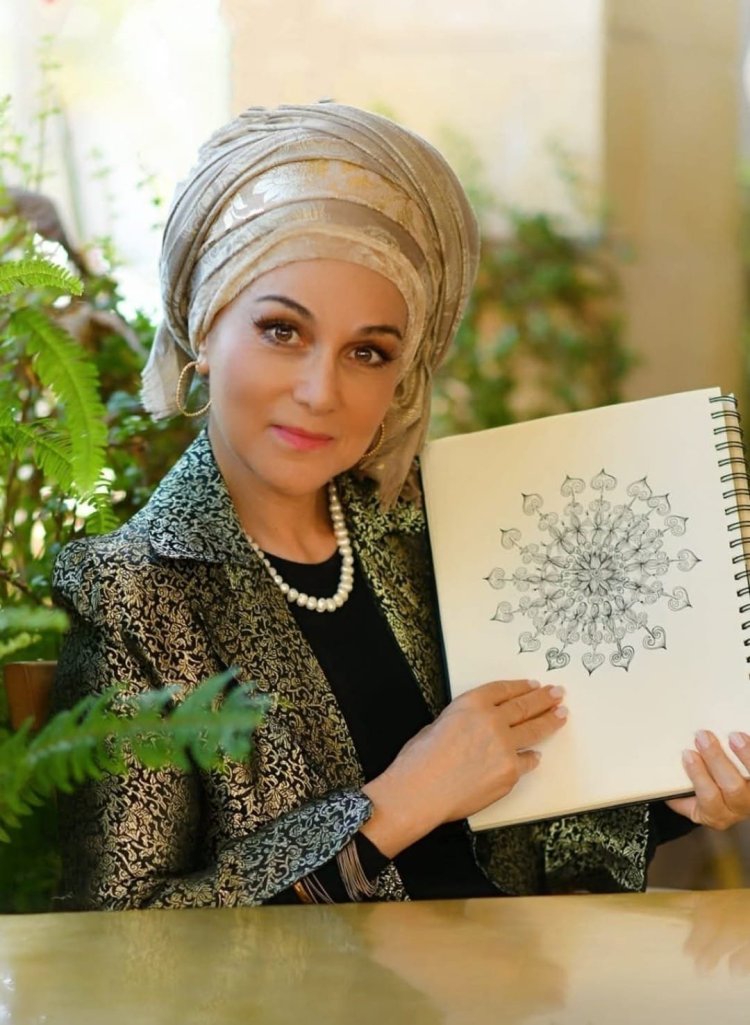 Orlit Cohen with her art
Searching Without a Name
This precision eventually led her to painting, to circles of letters, to prayer, and to meaning, each unfolding within her inner world. But the path toward clarity was long. The deeper her search became, the more she realized how much she needed the Creator and His grace.
“I traveled to breathtaking places,” she recalls. “Massive waterfalls whose sound takes your breath away. In those moments, you realize how small a human being is in comparison to creation. You understand that you are not even an ant. These are powers that cannot be described in words.”
Still, something remained incomplete. Her search led her through meditation workshops, yoga, and various spiritual methods. “But I always left with the same feeling,” she says. “Something was missing, and I could not explain what it was.”
That sense of absence eventually brought her, unexpectedly, to Judaism. While living in Montreal, she opened an art gallery displaying archaeological works she was researching at the time. Within the gallery stood a cabinet dedicated to Jewish art.
“Most of the visitors were not Jewish,” she explains. “They were curious about Jewish symbols. The more they asked, the more I researched, and I discovered that it spoke to me deeply.”
The true turning point came when she opened a book of Tehillim she had at home. “For the first time in my life, something inside me settled. I breathed deeply and felt calm.”
From there, she began attending synagogues and listening to Torah classes, truly listening. When she encountered the teachings of the Baal HaSulam, everything aligned. “I realized that everything I had felt all my life was already written. I finally found a language for my soul. Words I could say because I fully identified with them.”
She understood then that her place was not abroad. Slowly, she began weaving the dream of returning home. “My mission is here,” she says. “To enlighten women, to teach, to create, and to transform art into healing.”
The Harzitz in the Geyser
That understanding crystallized during a moment in Yellowstone National Park, as she stood watching a geyser erupt.
“It was a wild force,” she says. “A giant boiling circle, smoke, blazing blue colors. You cannot get close to it.”
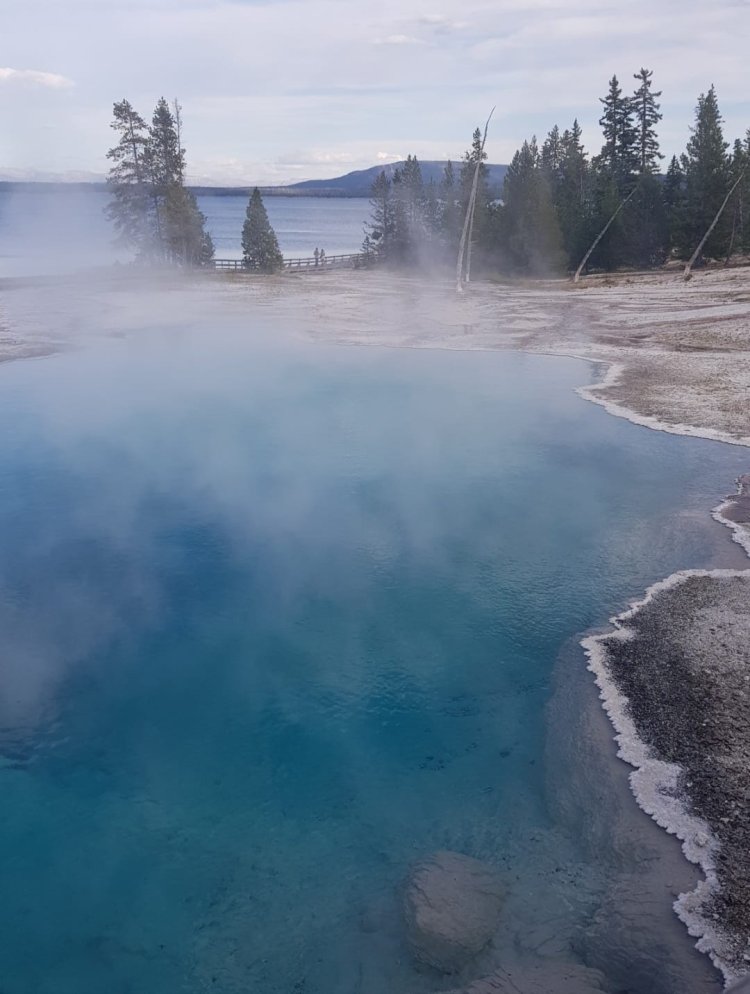 The geyser at Yellowstone National Park
At the center of that overwhelming power, she noticed something unexpected. A small harzitz growing from a mound of earth.
“In that moment, I understood that the Creator was speaking to me.”
Asked what she felt she was being shown, she answers with quiet certainty. “That even in the most dangerous, burning, eruptive places, there is life. There is a choice to remain gentle, simple, and luminous. You may feel like a geyser inside at times, but you are not the geyser. You are the harzitz.”
That realization gave her strength. It taught her that softness can exist even within intensity, that smallness can carry great meaning.
Mandalas as Prayer
This insight became part of a deeper process of return, grounded in awareness, choice, and constant dialogue with the Creator. “There is not a moment in my day without Him,” she says. “When I saw the harzitz, I knew there was a message meant just for me.”
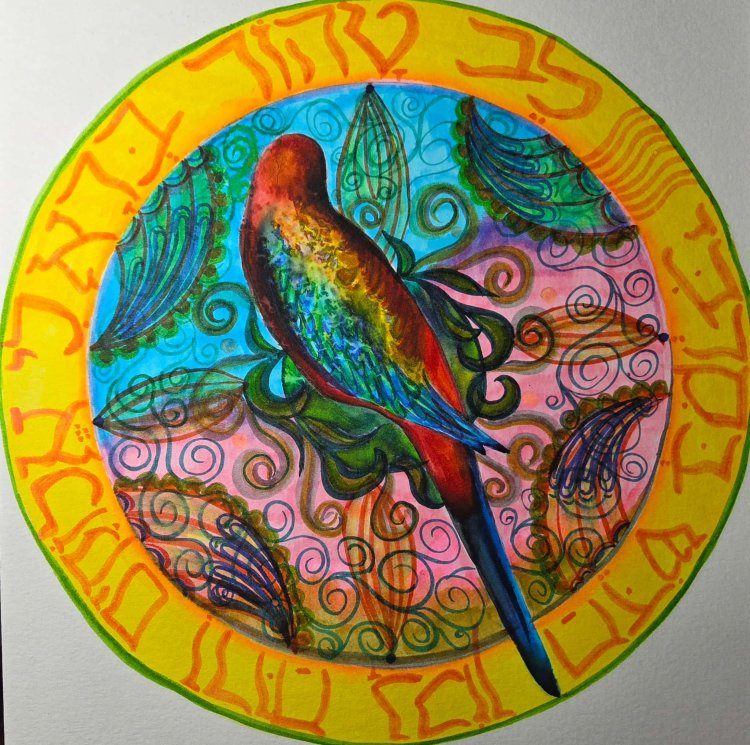 Orlit's artwork
Her art transformed alongside her faith. Letters, verses, words, and frequencies entered her work. Painting became prayer. The letters, she believes, shape reality, just as the world was created through speech.
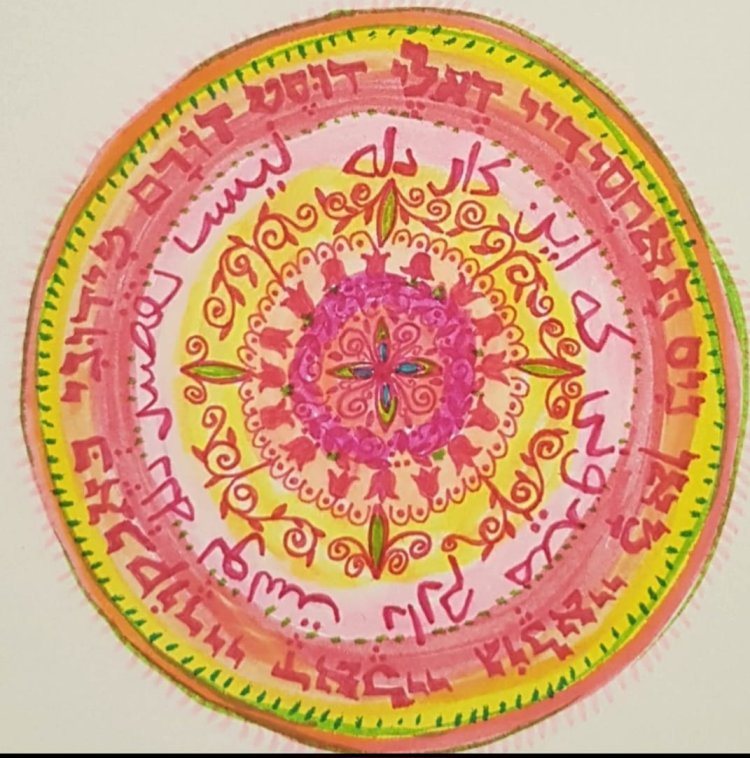 Orlit's artwork
When she places a word within a mandala, it is not decoration. It is invitation. Healing. Today, through her mandalas, she helps women and children look at what their hands have created and learn to accept themselves.
To see the beauty that already exists within them.

