

Magazine
The Journey of a Ba'al Teshuvah: Dror Yahav's Path to Judaism and His New Literary Work
A former high-tech professional turned author and educator, explores his return to Judaism, the challenges of ba'alei teshuvah, and the wisdom of integrating Jewish teachings into modern life
- Moriah Luz
- | Updated
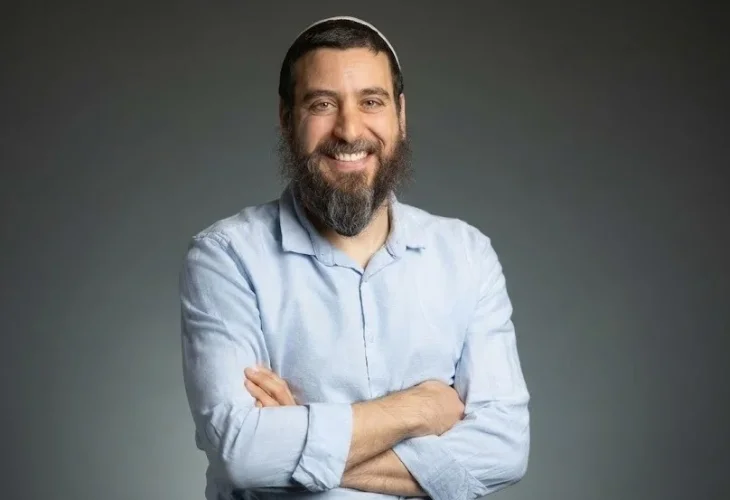 Dror Yahav
A young man, dressed in full traditional Orthodox attire, sits on a bus on his way to his parents' house. Suddenly, an old rock song plays on the radio, and the young man starts drumming along to the beat and singing all the lyrics. An older secular woman sitting on the nearby bench watches him with amazement. One detail is missing from her understanding: the Orthodox young man in front of her is a ba'al teshuvah (a returnee to Jewish observance). The scene described comes from the book "Don't Look at Me Like That" by Dror Yahav, and it indirectly reflects the story of his own life.
Curiosity and Truth Seeking
Yahav, 43, a resident of Ramat Gan, is married to Sharon and has four children. He is an author, content manager at the VLU program (which makes Judaism accessible to entrepreneurs and managers), and teaches at a yeshiva for ba'alei teshuvah (returnees to Judaism) affiliated with the "Nehora" community. He is currently finishing his doctoral dissertation on the subject of returning to Judaism.
“I grew up in Yavne in a non-religious family,” he begins. “From my teenage years, I was searching for meaning. I was interested in many areas, including Buddhism, philosophy, and psychology.” He mentions that Judaism did not seem worth exploring at the time. Before enlisting in the army, he studied for a year in a secular preparatory program. “There, I was exposed to Jewish texts and corresponded with various writers and thinkers in the field, to whom I remain grateful to this day.”
Yahav served in the IDF’s Unit 8200, and at the same time deepened his interest in Judaism. “The trigger was during the Second Lebanon War. I was stationed at an intelligence base in the north, and rockets were flying over our heads. In an internal dialogue, I asked myself: ‘This is our land, why are they shooting at us?’” This led him on a deep journey of exploration. “Over time, I realized I wanted to live a historic lifestyle and connect to the tradition.”
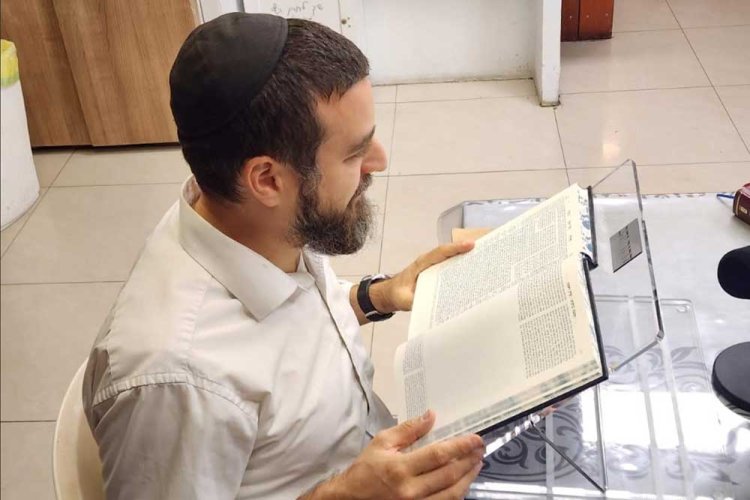 "I've been looking for meaning since I was a teenager"
The Early Years
The process of returning to Judaism was not without its challenges. When he decided to keep Shabbat, Sharon, who he envisioned building his home with, didn’t understand where the idea came from. “One Thursday, I came home with a hotplate and a food warmer. Instead of running away, which would have been the natural thing to do,” he laughs, “she decided she wanted to understand what would make a normal, rational person take on all sorts of commandments and prohibitions.
“She started coming to classes, and discovered that some of the topics also spoke to her. Gradually, she concluded she was willing to marry me, although she wasn’t interested in keeping mitzvot.” Later, Sharon also found her way to Judaism, and today they maintain a Torah-observant home.
“My main challenge was that I didn’t have a guide. I went through the process of teshuvah independently, and in the early years, I didn’t feel comfortable in any group. There were disadvantages to this, as it was really complicated. But on the other hand, independence allowed me to connect to many ‘teachings.’ In hindsight, I gained a broad Jewish and Torah-based wealth and connection to many rabbis.”
In the early years of his return to Judaism, Yahav worked in high-tech. He used to print a Torah thought every week from the “Aish HaTorah” website and post it in the kitchenette. “One week, I had a work trip to London. When I returned, I overheard two guys in the kitchenette, and one of them said: ‘I see that the sheet here stayed the same as last week. I wonder what happened, usually it gets changed every week.’ I realized that someone was actually reading it.”
"Judgment comes from all sectors."
A few years after returning to Judaism, Yahav decided to switch careers. He left the high-tech field and sought how to fulfill his dream of becoming a book editor. He sent requests to all the publishing houses in the country. “Out of all the emails I sent, only one responded – Oren Mas from Reuven Mas Publishing, may God protect him.” Yahav took his first steps in the field, and with the help of “good messengers,” as he calls them, he progressed and became more professional.
His first book, “Just Interested”, was written when he had already established himself in writing. In the book, he put into writing what was missing for him as a new ba'al teshuvah. He clarified basic concepts in simple words – from the background, through the reason, to the practical and execution level. His second book is being published now. This time, it’s not a scholarly book but a narrative novel.
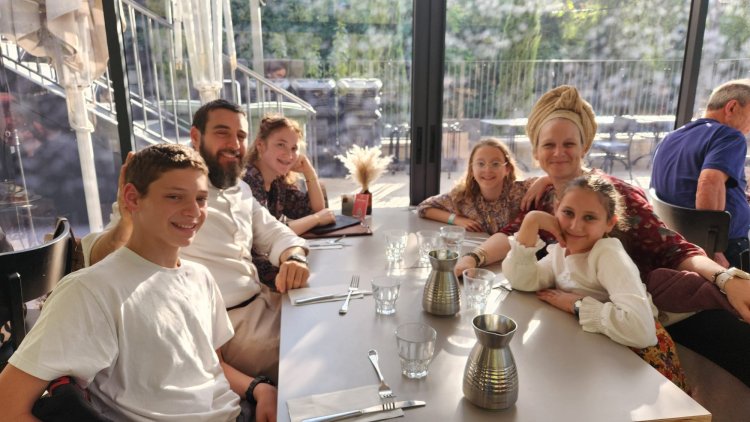 The Yahav Family
In your daily life, you mainly deal with matters of holiness. What leads a spiritual person, who teaches at a yeshiva, to write a novel?
“I’m constantly thinking of ways to make content accessible to people. When I looked at the world, I saw that what interests many people are ‘Netflix’ and series. These are the topics that people constantly talk about – even in news websites. The reason is that as people, what really fascinates us, and me personally, are stories.
“When I realized this, I looked for a way to crack the code of how to turn stories into holiness. Rabbi Kook wrote that part of the Torah of the Land of Israel is the ability to make for God a ‘dwelling in the lower worlds.’ To take what seems low to us, elevate it to holiness, and give it added value.”
Yahav took the project seriously. He enrolled in writing workshops, purchased professional books, and honed his prose skills until he felt ready to write the book.
“I wrote about two people who are very different from each other. One is a young man who somewhat resembles me when I was his age. He starts discovering Judaism slowly, while around him a crime drama is unfolding. At the same time, there is an Orthodox ba’al teshuvah who is caught in a situation involving the desecration of a Torah scroll in his childhood neighborhood in North Tel Aviv. He is asked by a rabbi to solve this mystery. Over the course of the book, the two stories start to converge.
“We judge a lot based on appearance – he’s like this, she’s like that, she dresses like this, and so on. Judgment comes from all sectors. I named the book ‘Don’t Look at Me Like That’ because it aims to show what’s behind the scenes. There is much more than what meets the eye.” He adds that the book also aims to depict the world of ba’alei teshuvah, including their challenges and successes.
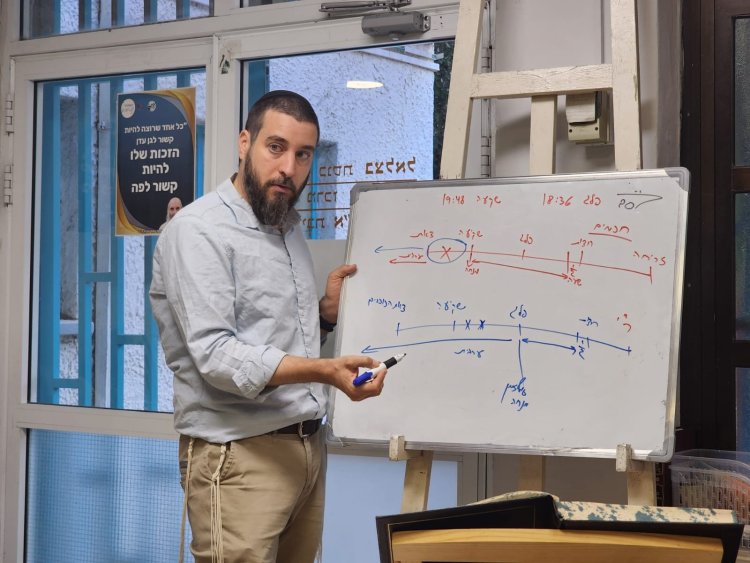 Yahav during a class
“Don’t deny the good in your past.”
The world of ba'alei teshuvah is a subject close to Yahav’s heart. “I’ve been studying this topic for many years, and in my opinion, it’s not discussed enough. The ba'alei teshuvah of the previous generation gave up all their previous lives – including family and profession – and simply devoted themselves to a life of Torah and mitzvot in an admirable way.
"However, such a process, of ‘breaking’ from where you came from, comes with difficult prices. One price is the phenomenon of dropouts among the second generation. Another price is the personal sacrifice of desires, authenticity, and personal aspirations. Among them is the ‘15-year crisis.’”
What does the “15-year crisis” mean?
“A concept I heard from Rabbi Ofer Gisin and Rabbi Dan Tiomkin. They founded an organization to address the challenges that ba'alei teshuvah face.”
Yahav explains that a ba’al teshuvah has his own “childhood version”: a personal world of memories, culture, music, and worldview. In the past, there was a tendency to erase one’s personal background, but the memories resurface with full force later on.
“Suddenly, he sees his younger brothers making far more money than he does, buying homes, and traveling abroad. Or sometimes, marital problems arise because of livelihood. These difficulties lead to issues with serving God, with questions and doubts. Unfortunately, there have been many people who left Judaism after many years.”
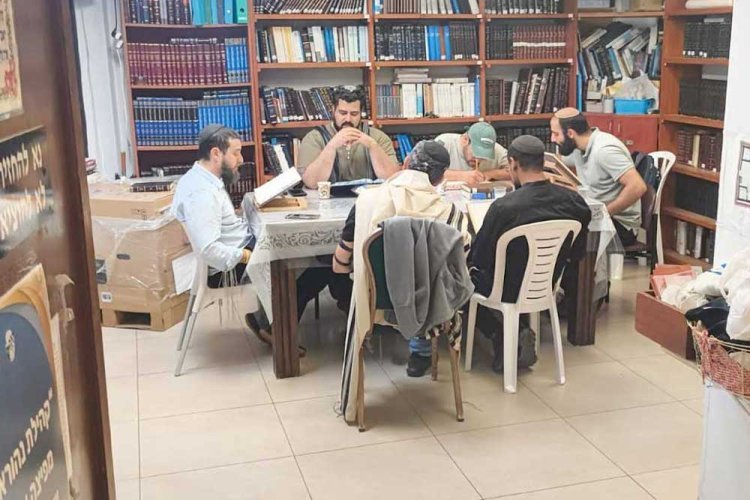 In a class at "Nehora"
And what’s the solution to this?
“The crisis happens when you forget yourself along the way. Part of what I do every day is to accompany ba'alei teshuvah. I constantly emphasize to them not to forget themselves. God didn’t place you where you are by mistake. The path you’ve walked is what you needed to go through, and there’s much good in your past. You don’t need to deny it. If you jump into the waters too quickly, you’ll just get erased. And if you get erased, you certainly won’t be a servant of God.”
“Let My People Know”
In the last three years, Yahav has been the content manager for the VLU program. The target audience is young managers and entrepreneurs: high-tech professionals, programmers, financial experts, lawyers, and industrialists.
“The program combines insights from the world of management and the most advanced management theory, alongside insights from Jewish wisdom. We talk about success with meaning, which goes beyond mere material success. Our target audience is primarily managers who are at the beginning of their careers and have no prior background in Judaism.”
You’ve chosen a challenging target audience – sharp, connected people who require a lot of courage to engage with.
“That’s right. I think one of the amazing things about VLU is that we’ve managed to create a language that, on one hand, is not judgmental, but also not apologetic. We present things as they are – without preaching, and without imposing on anyone. We simply make Jewish wisdom accessible to our audience.” Yahav adds that the program is priced high, which reflects the seriousness of the participants’ intentions.
“I think the success of hundreds of graduates, and the huge demand for our programs, shows that we’ve cracked something that Israeli society is really searching for.”
Towards the end of the conversation, Yahav shares: “In the last two years, I feel that Israeli society is undergoing a real transformation, and we are standing before a great wave of return to Judaism. This new form of return is different from what we’ve known until now. It’s a return that is much younger in age and much more open to the world. These aren’t people who leave everything behind and go to Mea Shearim.
“In a way, Judaism has become trendy again. I think it’s wonderful, but it can’t stay there. We need to find ways to make it accessible and add more knowledge and understanding, so that it will be deep and rich. It shouldn’t get stuck in tradition and folklore.
“In the spirit of the famous slogan ‘Let my people go,’ Rabbi Adin Steinsaltz had a similar slogan. He would say: ‘Let my people know’ – make the tools and wisdom of Judaism accessible to the people. In my opinion, in our generation, everyone who knows how to give a class should open one and start teaching.”

