

Health and Nutrition
Wheat Reconsidered: Health, History, and Its Place Among the Seven Species
Why wheat remains one of the world’s most important and nourishing grains
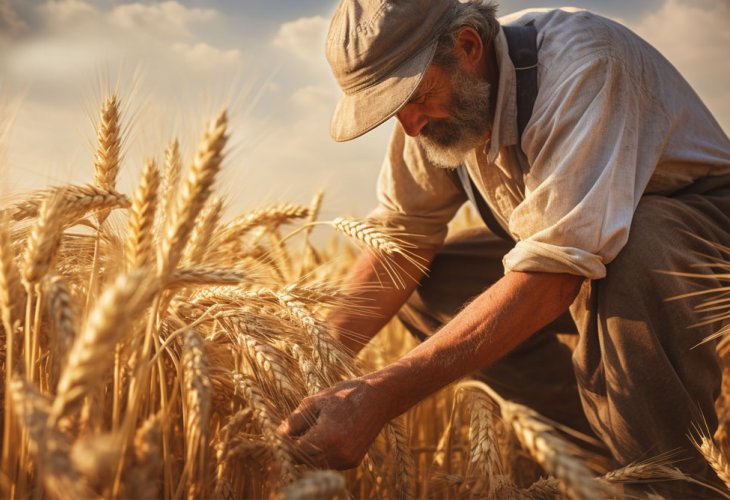
If you’ve followed health news even a little over the past decade, you’ve probably absorbed the repeated message that wheat, in all its forms, isn’t all that healthy. In the past, we all ate white bread — because that’s what there was. Today, supermarket shelves are flooded with breads made from a wide variety of grains, some of them completely wheat-free. As a result of confusing and often misleading information circulating online, wheat doesn’t always get a fair assessment. We’re here to bring some order to the confusion. In honor of Tu B'Shvat, we set out to gather interesting facts about the world’s most common grain — and to restore wheat’s lost reputation.
1. By the Numbers
Wheat is one of the most important cereal grains in the world. It is grown almost everywhere, except in tropical regions. Annual global wheat production stands at approximately 736 million tons, making it a primary food source for about 35% of the world’s population.
Wheat contains roughly 70% starch, about 10% protein, and around 2% dietary fiber. It is used to make a wide range of foods including bread, cakes, and pasta, and is an important source of vitamins, minerals, and enzymes.
2. Sensitivity to Wheat
In recent years, awareness has grown around what is often called “wheat sensitivity.” This is not celiac disease — which is a life-threatening gluten intolerance that can be clinically diagnosed, but rather a condition in which the body reacts poorly to wheat. Symptoms of wheat sensitivity may include digestive and skin issues, and the only treatment is avoiding wheat consumption.
If such sensitivity is diagnosed, it is clearly important to avoid wheat products in all their forms. However, for those who are not sensitive to wheat, consuming it can actually be highly beneficial.
3. Pure Health
Despite its somewhat tarnished reputation, wheat is an excellent source of dietary fiber, which is essential for digestive health. Fiber helps promote a feeling of fullness and reduces the risk of heart disease, type 2 diabetes, and certain types of cancer. Wheat also contains protein, which is vital for tissue growth and repair, proper immune system function, and healthy muscles and nerves. And let’s not forget carbohydrates — an essential energy source for the body and crucial for proper brain and nervous system function.
4. Wheat in Jewish Sources
Wheat plays a central role in Judaism and appears throughout the Bible, the Mishnah, and the Talmud. It is one of the Seven Species with which the Land of Israel is praised, as mentioned in Devarim 8:8: “A land of wheat and barley, of vines and fig trees and pomegranates; a land of olive oil and honey.”
On Tu B'Shvat, it is customary to place bread or puffed wheat on the table, as wheat symbolizes abundant livelihood. Rabbi Chaim Palagi writes in his book Mo’ed LeKol Chai (Section 30): “On the night of Tu BiShvat, the New Year for the Trees, it is customary in many Jewish communities to set the table with fruits of the tree and fruits of the land, according to one’s means, and each person recites a blessing over one fruit. The man blesses wheat after Grace After Meals — ‘He satisfies you with the finest wheat’ (Tehillim 147:14) — so that he may have abundant sustenance. The woman blesses the vine, as it is written, ‘Your wife shall be like a fruitful vine,’ and the son blesses the olive — ‘Your children like olive saplings around your table.’”
5. One Special Leaf
The final leaf of the wheat plant, known as the “flag leaf,” is responsible for producing about 75% of the nutrients that fill the grain heads. If the flag leaf is damaged, yield is dramatically reduced.

