

History and Archaeology
Unpacking the Sinai Revelation: Compelling Evidence for a Cornerstone Belief
How can we be certain that the Revelation at Sinai truly occurred? Dive into this comprehensive article for intriguing answers.
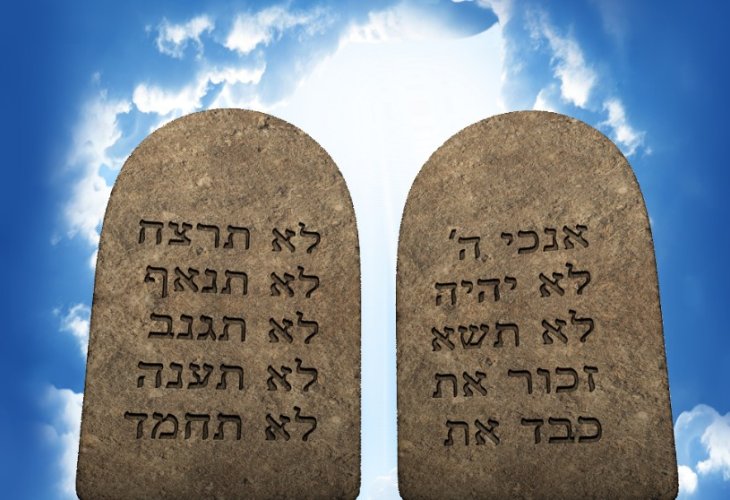
“How can I fully believe in it when I’m not sure the Bible isn’t simply a collection of invented stories?” This question is asked by many people who were not raised in a religious home. They often continue by asking: if we are to believe in a faith, why not Christianity or Islam, which have far more adherents than Judaism?
The central question here is whether belief in the Bible is merely an “act of faith,” relevant only to those raised with it, or whether there is a logical basis for believing that the Torah, given at Sinai by the Creator and ruler of the world, belongs to every Jew. The answer is unequivocal. Belief in the divine origin of the Torah at Sinai is indeed faith, but it is not blind faith. Every Jew can intellectually understand that the Torah of Israel is divine, as we will demonstrate.
It is important to note that the proof presented in this article is the one upon which the entire House of Israel has relied throughout the generations to believe that the Torah is from Heaven. Other arguments serve only as support to this foundational proof. Therefore, belief in the divine origin of the Torah does not depend on the acceptance or rejection of any specific secondary argument.
We all believe in the existence of historical figures such as the French general Napoleon, who conquered many countries, and Alexander the Great of ancient Greece, who achieved vast conquests at a young age. Similarly, we believe that the French Revolution took place in the late eighteenth century and that the Holocaust occurred in Europe. Why do we believe these events happened? After all, none of us witnessed them firsthand; they occurred long before our time.
Historical Events
For an event to be considered historical and an irrefutable fact, it must meet the following criteria:
Historical continuity, meaning information about the event is transmitted consistently through multiple, independent, and diverse channels.
A large number of witnesses. Humanity universally accepts human testimony, to the extent that a person can be sentenced based on the testimony of two witnesses. When there are only a few witnesses, doubts may arise regarding reliability. However, when large numbers of people testify uniformly about an event, even the most skeptical minds accept it, as it becomes implausible to claim that all the witnesses were lying, hallucinating, or imagining the same thing.
It is also universally accepted to trust the testimony of previous generations regarding major events that occurred in their time, or events known to them from their ancestors, provided that many members of the earlier generation corroborate the account. With a multitude of witnesses, claims of coordinated deception, mass illusion, or fantasy collapse. Nor is it possible to fabricate a story about a massive event and persuade the public that it occurred without anyone having heard of it previously. One would immediately ask, “How did we never hear about such an extraordinary event until now?”
When we examine the Sinai revelation, the descent of the Divine and the giving of the Torah to the Israelites, we find that it meets all the criteria of a historical event with unparalleled strength.
First, the Sinai revelation was a massive event witnessed by an entire nation. God descended upon Mount Sinai and gave the Torah to Moses before a people numbering approximately three million. The Torah itself records 600,000 men aged thirteen and above; when women and children are included, the total reaches roughly three million individuals.
Second, the historical continuity of the Sinai revelation surpasses that of any other historical event. Those who witnessed it testified to their children that the entire Torah, received through Moses from beginning to end, is absolutely true. Their children testified to their children, and so on, until our own generation. In every generation, Jews gathered on weekdays, Shabbat, and festivals, in synagogues and around family tables, faithfully transmitting the details of this extraordinary legacy: the giving of the Torah at Sinai, the Exodus from Egypt, and the hundreds of thousands of laws of the Torah.
Fathers Do Not Lie to Their Children
Consider the following: the Jewish people were dispersed among the nations for more than two thousand years, divided into communities separated by thousands of miles, without any means of communication such as telephones, mail, or digital messages. Yet when Jews from Persia, Tunisia, Lithuania, Poland, Morocco, and Russia eventually encountered one another, they all returned with the same Torah and Talmud. They observed the same holidays and commandments.
Even more astonishing is that the Hebrew calendar was preserved with absolute precision across these communities, despite the complexity of determining which months contain thirty days and which contain twenty-nine, and despite the lack of a fixed sequential order. Each year was calculated according to intricate rules, and all communities arrived at identical results.
Additionally, when these communities brought their Torah scrolls together, it was discovered that every letter, among countless letters, and every cantillation mark was identical, with only negligible variations that did not affect the meaning of the text. How could this have occurred if not through meticulous, faithful transmission across generations? The Jewish people preserved their testimony with unmatched precision and vitality throughout history.
Moreover, the witnesses of the Sinai revelation were not priests or clergy with personal interests or power to gain. They were our fathers. Fathers testified to sons, sons to grandsons, and so on. Fathers, who love their children deeply, do not deceive them or burden them with falsehoods. As the Ramban writes in Deuteronomy 4:9, when we transmit the giving of the Torah to our descendants, they will know it is true without doubt, as though they themselves had seen it, because a father does not lie to his children or teach them nonsense.
It is impossible to claim that an entire generation conspired to invent a false account of the Sinai revelation and impose it upon their descendants. This was not a collection of pleasant legends with no obligations, but a demanding Torah that imposes restrictions and, at times, requires sacrifice and even martyrdom. It is inconceivable that countless fathers would deliberately deceive their children into living and dying for a fabricated belief.
The unavoidable conclusion is that the Sinai revelation must be regarded as a real and irrefutable historical event. There is no generation in which this story could have been invented from nothing. Is it conceivable that millions of people coordinated a detailed and consistent false testimony? Could an entire nation be convinced that they experienced a monumental event that none of them had ever heard of before? Regarding the first generation that transmitted the account of Sinai, we can be confident that they truly witnessed it. A nation cannot collectively fabricate a detailed event, nor can a nationwide hallucination be taken seriously.
The Difference Between Judaism, Christianity, and Islam
This leads to the fundamental difference between Judaism and Christianity, Islam, and other religions. Millions of Christians and Muslims have faithfully transmitted their beliefs across generations. However, the origin stories of their religions cannot be verified through eyewitness testimony, even according to their own traditions. No one witnessed Jesus receiving a divine mandate, nor did anyone witness Muhammad meeting the angel Gabriel in the desert and receiving a new religion.
We accept as historical facts that there was a man named Jesus and a man named Muhammad who claimed to have received divine messages, because many people testified over time that such individuals existed. But believing their claims requires blind faith, as it means believing the account of a single individual. As King Solomon said, “The naive believes everything.”
Is it reasonable that God would replace a religion given through a massive public revelation with one delivered privately to a single person, requiring blind faith from the entire world? As a humorous analogy goes, a Jew once dreamed that he was a rebbe. The rebbe replied, “Your followers should dream that, not you.” Likewise, if God wished to give a Torah, it would be revealed to an entire nation, not entrusted to a lone individual who demands universal belief.
Christianity and Islam therefore resemble inverted pyramids: they rest upon a single individual and expand as followers accumulate. But what strength does such a structure possess? Imagine one person leading a line of one hundred blindfolded individuals, each holding onto the one in front, following blindly. Is that the decision of one hundred people, or the decision of a single leader? Now imagine ten independent individuals all choosing the same direction on their own. Which scenario reflects greater certainty and strength?
This is the difference between Judaism and other faiths. Judaism is not based on belief in a single person. It is founded on the experience of an entire nation that witnessed, heard, and encountered the Divine revelation at Sinai.
As the Rambam writes: “The Israelites did not believe in Moses because of the signs he performed, for belief based on signs is subject to doubt. One might perform signs through deception. Why, then, did they believe in him? Because of the Sinai revelation. Our own eyes saw and not another’s, our own ears heard and not another’s. The fire, the voices, and the torches were all witnessed by us, and Moses approached the thick cloud while the voice spoke to him, as we heard: ‘Moses, Moses, go tell them such and such.’” (Hilchot Yesodei HaTorah 8:1)

