

History and Archaeology
The Panic That Led to Tragedy in the Synagogue
During a special prayer, the entire Jewish community of Metz gathered closely in the synagogue. Suddenly, amidst the emotional rendition by the cantor, a loud noise echoed "as if a great building was collapsing."
- Yosef Yabece
- | Updated
Five months into the war, we are trying to adjust, yet for many, nights are still sleepless. There has been so much loss, so many missing and wounded, and once again the alarms sound—rockets, attacks. May Hashem have mercy on us and protect us.
At the same time, we must be careful not to give in to unnecessary panic, which only adds strain to an already tense reality.
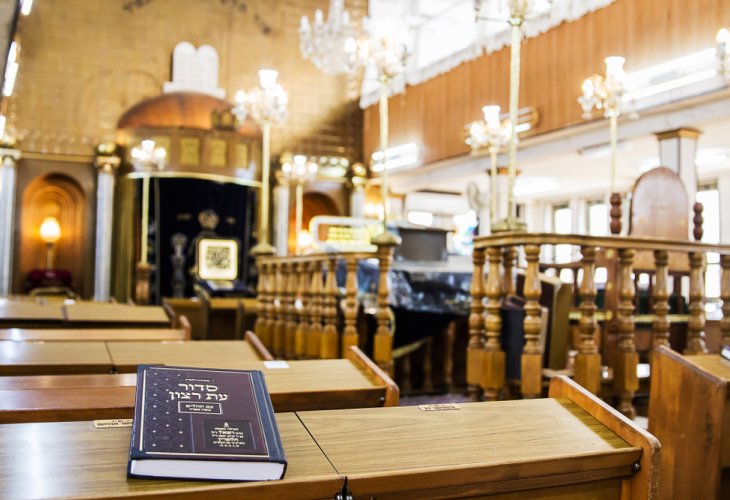
A chilling and thought-provoking account is recorded by Glikl of Hameln. On Shavuot of 1715, in the city of Metz, the entire community gathered to hear the renowned cantor, Rabbi Jukli of Rishia. Rabbi Jukli was a traveling cantor who visited towns that invited him, and in honor of his special prayers, the entire Jewish community of Metz crowded into the synagogue.
Suddenly, in the midst of the moving cantorial service, a loud noise echoed through the synagogue, “as if a great building were collapsing.” The men feared that the synagogue’s dome was about to fall and urgently called for their wives to hurry down. There were two women’s galleries, an upper and a lower. In the upper gallery, chaos broke out, and the women rushed to descend and save themselves:
“In their haste, each tried to go before the other, and heaven help us, they fell on top of each other… more than fifty women lay on the stairs, entangled as if glued together, the living with the dead… men came to the Jewish street with ladders and axes to bring the women down from the upper gallery.”
The author, Glikl, was seated in the lower gallery and did not hear the loud noise, only the panic of the women above. As she helped her pregnant daughter Esther down the five or six steps at the exit of the lower gallery, Glikl fell on the final step:
“In the spot where I lay, all the men who wished to help the women on the upper gallery stairs had to pass, and if just another moment had passed, I would have been trampled. But finally, the men noticed me and helped me up.”
Tragically, six women from the Metz community lost their lives after being trampled, even though there was no actual cause for alarm. Nothing fell from the ceiling, and there was no need to rush or crowd.
Glikl writes that, in her view, this calamity was connected to sins committed on Simchat Torah, about eight months earlier. After the Torah had been raised, as was customary, a dispute broke out among the women, during which headscarves were torn from one another’s heads, leaving them bareheaded in the women’s gallery. This turmoil then spread to the men’s section, where arguments and fighting also erupted. Those involved were punished by the community leaders, yet, according to Glikl, the desecration of the synagogue exacted its own toll.
We must be extremely careful not to fall into unnecessary panic, to follow instructions, and to act with reason. With Hashem’s help, may we be redeemed by Purim from this war and from all enemies who seek to destroy us.

