

Health and Nutrition
The Resilient Torah: A Tale of Survival and Legacy
In 1837, a devastating earthquake hit Tzfat. While the Abuhav Synagogue was destroyed, the southern wall with the ancient Torah remained intact.
- Yosef Yabece
- | Updated
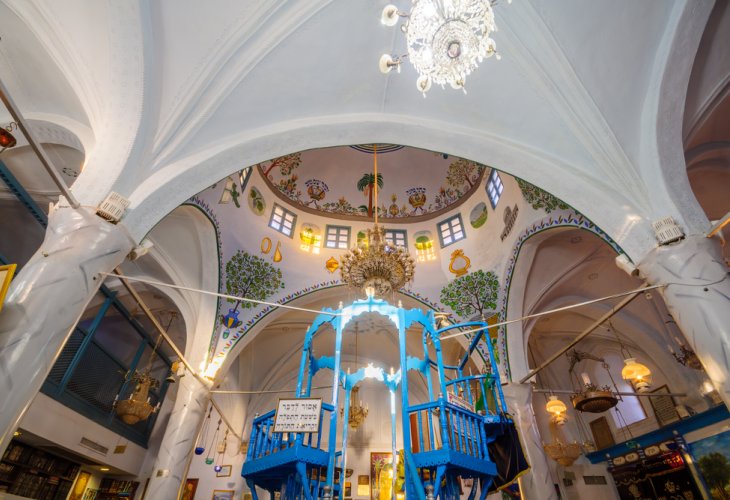 Abuhav Synagogue, Tzfat
This year, it seems that visiting Meron on Lag B’Omer may not be possible, but for those wishing to explore our heritage, Tzfat beckons with its rich Jewish history and miraculous tales.
Around seven centuries ago in Spain lived Rabbi Isaac Abuhav, the esteemed author of Menorat HaMaor. He wrote a magnificent Torah scroll that was passed down through his family. Approximately two hundred years after his passing, the expulsion from Spain took place. His descendant, also named Rabbi Isaac Abuhav of Castile, head of the Toledo Yeshiva, fled while carrying this sacred Torah. The yeshiva dispersed, and his distinguished students—Rabbi Isaac Canpanton, Rabbi Abraham Zacuto, Rabbi Isaac Abravanel, and Rabbi Jacob Berab—were also forced into exile.
Rabbi Jacob Berab immigrated to the Land of Israel and settled in Tzfat. He brought with him his teacher’s Torah scroll, known as the Abuhav Torah, along with the rabbi’s halachic writings. Rabbi Joseph Caro, author of the Beit Yosef, relied heavily on these writings, preserving them in his monumental halachic work, the Shulchan Aruch.
The synagogue that housed this exceptional Torah was named the Abuhav Synagogue in its honor.
In 1759, a powerful earthquake struck Tzfat, destroying the synagogue while leaving the Torah scroll miraculously unharmed. The community hesitated to touch it, amazed by its survival. Eventually, ten survivors bravely transferred the Torah to the Great Synagogue of Tzfat, which was thereafter known as the Abuhav Synagogue, where the Torah remains to this day. Legend has it that those who moved the Torah met untimely deaths, due to an ancient taboo against relocating it.
When another devastating earthquake struck Tzfat in 1837, the Abuhav Synagogue was once again destroyed. Yet again, the southern wall and the Torah survived. The synagogue has since been restored and now contains three holy arks: the right ark holds the Abuhav Torah, which is read only on the High Holidays and on Shavuot; the left ark displays a Torah written by the revered kabbalist Rabbi Salman Ohana; and the central ark houses additional Torah scrolls.
Beyond its holiness and historical significance, the synagogue is adorned with intricate artwork, including the symbols of the Twelve Tribes, an array of musical instruments, and five crowns: Torah, Priesthood, Kingship, Good Name, and the unique Crown of Salvation. A striking depiction of the Temple decorates the dome. Modern artworks, intended for tourists, also hang within the synagogue—though whether Abuhav himself would have approved remains uncertain.
The synagogue continues to function both as a place of prayer and a tourist site, hosting services and prayers on special occasions. Visitors are encouraged to respect its sanctity, arriving not only to admire the art but also to absorb and appreciate the Jewish values it represents.

