

For the Woman
Unveiling the Truth: From the Dead Sea Scrolls to Biblical Criticism
For generations, scholars speculated based on the oldest known biblical manuscript, the Leningrad Codex from around 1000 CE. The discovery of concrete evidence, however, has fundamentally reshaped those theories.
Four thousand years ago, our patriarch Abraham stood against idol worship. Approximately 2,300 years ago, the Maccabees battled Greek culture and ideology. A millennium ago, Jewish sages debated Christianity. In modern times, a new illusion emerged—known as biblical criticism.
This field arose in the wake of Christianity’s decline. For nearly two thousand years, Christians persecuted Jews with absurd accusations: that they murdered their messiah, desecrated the Eucharist, mixed Christian blood into matzah, and rejected the logic of the Trinity, among many others. As modernity advanced, these claims were increasingly recognized as baseless and irrational. Christianity was left without a compelling argument to annul the Torah it referred to as the “Old Testament.” The question became: what next?
In response, German Protestant scholars developed so-called “critical” theories about the Torah. One of the most influential figures, Julius Wellhausen, argued that Judaism as we know it was not ancient at all. According to his theory, there were multiple Israelite sects during the Second Temple period, each with its own version of Scripture. The group that later became known as “Judaism,” he claimed, triumphed over other authentic groups—such as the Sadducees and the ancient Israelites—suppressing them and falsifying the original religion. Judaism, he argued, was a late invention, and so too was the Torah.
Wellhausen claimed that if we could travel back to the Second Temple era and examine Jewish libraries across the land, we would discover multiple versions of the Torah. The “original” versions, he suggested, aligned more closely with Christian theology: they minimized sacrificial commandments and emphasized inner devotion, echoing prophetic language that prioritized heartfelt faith over ritual observance. Through selective readings of the prophets and what was then considered supporting evidence, these theories spread widely among German scholars.
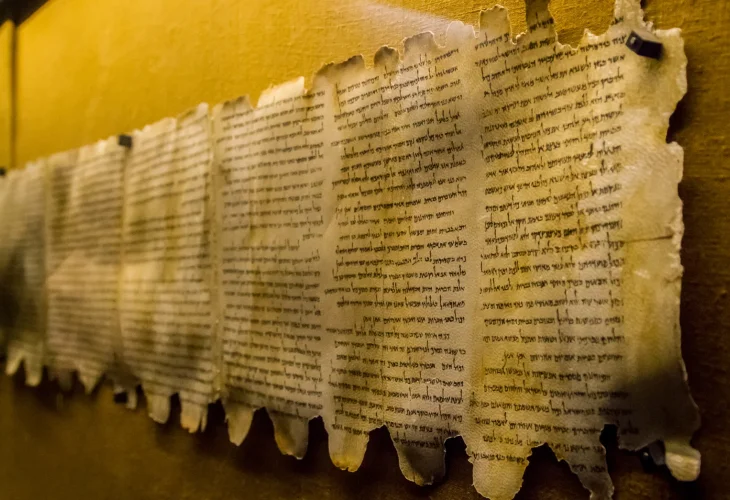
Then, in the twentieth century, what once seemed like a fantasy became reality. Humanity effectively traveled back in time—by uncovering the libraries of dissident Jewish sects from the Second Temple period. This was achieved through the monumental discovery of the Dead Sea Scrolls.
To appreciate the scope of this discovery, it is worth noting that the Dead Sea Scrolls were published in forty volumes by Oxford University Press over fifty-four years (1955–2009). For nineteen years, Professor Emanuel Tov of the Hebrew University led a team of ninety-eight scholars, editing and publishing twenty-eight volumes. Before him, Professor Eugene Ulrich and his team published eight volumes, in addition to the first fourteen.
Before these discoveries, many theories flourished among biblical scholars, largely because the oldest complete biblical manuscript available was the Leningrad Codex, dated to around 1000 CE (preceded slightly by the Aleppo Codex). Once the scrolls were studied, however, the facts directly contradicted those theories.
According to the scholarly consensus prior to the scrolls’ discovery, the Torah was still being edited during the Second Temple period, with multiple versions in circulation. Different Jewish sects were believed to possess their own “original” versions of the Torah and the Prophets.
Let us therefore call to testify the very editors of the Dead Sea Scrolls themselves.
In his article “The Absence of Sectarian Variants in the Biblical Scrolls from Qumran – How?” Eugene Ulrich writes:
“When asked to write about the ‘sectarian elements’ in the biblical scrolls discovered at Qumran, I replied with some reluctance that my article would not exceed a page because, in all my years working on the scrolls, I never encountered a sectarian variant. Assuming that titles might be instructive, I suggested writing abou the absence of sectarian textual changes from the scrolls, as such an absence offers us a valuable lesson.”
The expectation of sectarian changes was entirely reasonable. The Qumran sect harshly criticized the priests, the residents of Jerusalem, and the halachic system of their time. They were unfamiliar with the concept of Chazal and were not bound by any later rabbinic canon. One would naturally assume that such a group would alter biblical texts to reflect its ideology.
Yet the reality is striking: no such changes exist. Even in relatively late books, such as Daniel, no ideological or sectarian alterations are found. Despite the vast literary output of the Qumran scribes, modifying Scripture itself was simply not part of their culture.
What, then, constitutes a sectarian textual change? A clear example is found in the Samaritan Torah, where several passages were altered to imply—or explicitly state—the sanctity of Mount Gerizim. As Ulrich explains:
“It is important to note several facts: each of these examples is a secondary version, each is distinctly tendentious, appropriate to the Samaritans (or northern believers)… the specific Samaritan motif recurs in these versions.”
Do we find anything comparable among the Jews or Israelites of the Second Temple period?
Ulrich answers unequivocally:
“The specific arguments appear in ‘sectarian’ secondary compositions, whereas the scriptural texts themselves remain unchanged… Throughout my work on biblical copies from the fourth cave for publication… I found nothing I could define as a sectarian textual change.”
Regarding the book of Samuel—apparently written at Qumran itself—Ulrich writes:
“When we specifically search for sectarian changes, we find nothing. All changes in the scrolls, in the Masoretic Text, in the ancient Greek translations, later Greek manuscripts, and the ancient Latin translation are insignificant and commonplace—such as adding implied but unstated elements. There is no sectarian change in the scrolls, the Masoretic Text, or the Septuagint that one could define as an intentional alteration by any Second Temple Jewish group.”
Ulrich concludes:
“Regarding the evidence on the text: no textual changes were discovered indicating that any group—Pharisees, Sadducees, Samaritans, Essenes, Christians, or others—changed the scriptural text to support their beliefs. The only exceptions are two Samaritan doctrines: that God chose Mount Gerizim and commanded the building of the central altar there. All groups held distinct views, yet all appear to have agreed not to alter the ‘original’ text of Scripture, resolving difficulties by appealing to an earlier source rather than reshaping the text to suit ideology.”
And so, Ulrich notes, the ancient scribes acted accordingly: they almost always sought to copy the text exactly as it stood before them, or as they believed it had originally been written.
In short, while the theories of biblical criticism may have appeared compelling, reality exposed them as fundamentally flawed. No evidence supports claims of ideological editing or content replacement in the Torah, Prophets, or Writings. From the Sadducees and Essenes to the sects dwelling by the Dead Sea, all adhered to one single, shared biblical text.

