

Israel News
Zamir Signals Continued Israeli Action Against Iran as Tehran Warns of Another Strike
IDF chief’s remarks come with Iranian threats, missile activity, exposed smuggling routes, and a looming Netanyahu–Trump meeting
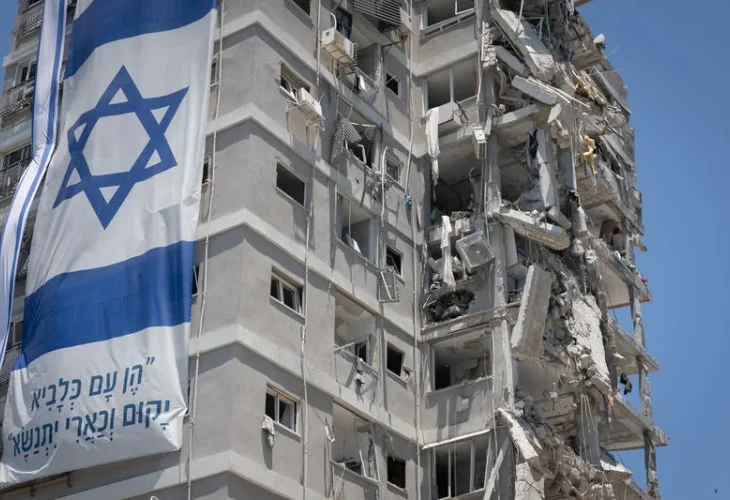 Bat Yam after Iran attack (Chaim Goldberg/FLASH90)
IDF Chief of Staff Eyal Zamir said today that Iran remains at the center of Israel’s threat assessment and signaled that Israel may again be required to act beyond its immediate region. Speaking at a ceremony marking the handover of the IDF Planning Directorate, Zamir said that the campaign against Iran “concluded with significant achievements” and that the “long arm of the IDF will continue to strike wherever required — in near and distant arenas.”
In parallel, Iranian officials have continued to address the possibility of renewed Israeli action while insisting that Tehran is prepared. Iranian Foreign Minister Abbas Araghchi said today to “Russia Today” that Iran does not rule out another Israeli strike but said the country’s preparations are intended to prevent war. “The best way to prevent war is to prepare for it,” Araghchi said, claiming Iran rebuilt all damage from the previous conflict. He warned that if Israel repeats what he called a failed experience, “it will not achieve a better result.”
Araghchi also said Iran cut off contacts with U.S. envoy Steve Witkoff several months ago, saying Washington was not willing to pursue what Tehran considers a fair agreement. He added that Iran would wait for a change in the American approach before resuming talks, without saying when the last contact took place.
Adding to the tension, Iranian opposition outlet Iran International recently reported that Western intelligence agencies identified coordinated movements by Islamic Revolutionary Guard Corps units tied to drones, missiles, and air-defense systems. Israeli officials have also voiced concern over Iran’s efforts to expand ballistic missile production, assessing that missile rebuilding is a more urgent focus than restoring damaged nuclear facilities.
Additional insight into Iran’s regional activity has come from a video circulating on social media that shows a large underground smuggling tunnel near the Iraq–Syria border. According to foreign reports, the tunnel is linked to pro-Iranian militias and the IRGC and sits along a key route Iran uses to move weapons through Iraq and Syria toward Lebanon. The footage shows a wide tunnel with lighting and enough space for vehicles to pass through.
Rare criticism has also come from within Iran itself. Hossein Alaei, a former commander of the IRGC navy, said Iran’s intelligence services were not sufficiently focused on Israeli activity and could have provided earlier warning about plans to target Iranian commanders and scientists. He added that the recent war exposed gaps in Iran’s intelligence system and said it needs to be reorganized to match the level of threat posed by Israel.
The military signaling is unfolding ahead of a meeting later this month between Prime Minister Benjamin Netanyahu and U.S. President Donald Trump, where Netanyahu is expected to brief Trump on options to prevent Iran from restoring its missile and nuclear capabilities, including scenarios ranging from Israeli action with U.S. backing to joint operations.
Six months after direct confrontation, neither side is signaling restraint. Israel continues to stress operational freedom, while Iran pairs warnings with military activity and internal reassessment, leaving the strategic standoff active and unresolved.

