

Torah Personalities
The Earth's Structure: A Reflection of Its Creator
The formation of Earth’s continental crust remains one of science’s greatest mysteries. This article explores the limits of geological explanations and reflects on how the structure of our planet points to its Creator.
- Hidabroot
- | Updated
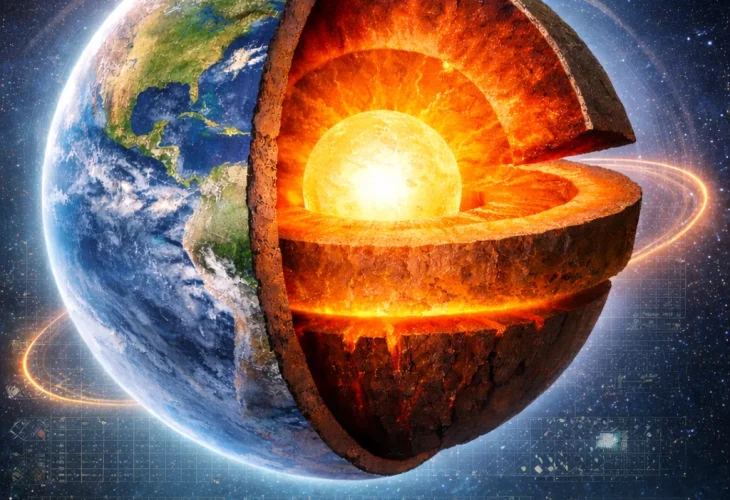
The origin of the continental crust that covers the Earth has puzzled scientists for generations. The mystery is so profound that it has earned a dramatic title among geologists: the holy grail of geology.
A Planet Unlike Any Other
At the heart of this puzzle lies a striking fact. Earth’s outer surface is composed of numerous cold and brittle tectonic plates. Beneath them lies the mantle, a molten layer that becomes visible mainly through volcanic eruptions. No other known planet in the universe possesses a tectonic plate system comparable to Earth’s.
Two Types of Crust
Adding to the complexity, Earth’s tectonic plates are made up of two very different kinds of crust: oceanic crust and continental crust. Scientists have developed a fairly solid explanation for the formation of oceanic crust. Along underwater ridges, vast mountain ranges hidden beneath the sea, thin oceanic crust rich in basalt appears to emerge from the ocean floor. This basalt suggests that oceanic crust originates in the molten mantle, even though the magma undergoes refinement and slight changes during the process.
The Enigma of the Continental Crust
The continental crust, which lies beneath the continents rather than the oceans, remains largely unexplained. It differs greatly from oceanic crust and contains silicate minerals, which are salts of silicic acid. As a result, continental crust is thicker and less dense than oceanic crust, making its origin far more difficult to account for.
An Incomplete Scientific Explanation
The prevailing scientific view holds that the continents formed before the oceans and are therefore older. This idea attempts to explain the greater thickness of continental crust, yet it still fails to explain how the continental crust itself came into being.
What Recent Studies Reveal and What They Do Not
Two recent studies addressing this issue, one published in New Scientist and the other in Nature Geoscience, have offered explanations for the formation of specific strips of land measuring between 150 and 250 miles. However, their findings do not extend beyond these limited regions. Moreover, the Nature Geoscience study concluded that the areas where continental crust formation could be explained involved relatively new crust that differs in composition from typical continental crust.
Returning to the Fundamental Question
This brings us back to the original mystery. How was the continental crust beneath Earth’s six continents formed, and why did these continents appear so rapidly?
An Answer from the Book of Genesis
Science offers no definitive answer to this question. The Book of Genesis, however, presents a clear description:
“And God said, Let the waters under the heavens be gathered together unto one place, and let the dry land appear; and it was so. And God called the dry land Earth, and the gathering together of the waters called He Seas; and God saw that it was good.”

