

Israel News
Trump, Netanyahu Present Unified Front on Gaza, Iran, and Regional Security
During a day of meetings in Florida, the two leaders addressed hostages, Hamas disarmament, Iran, and broader regional threats
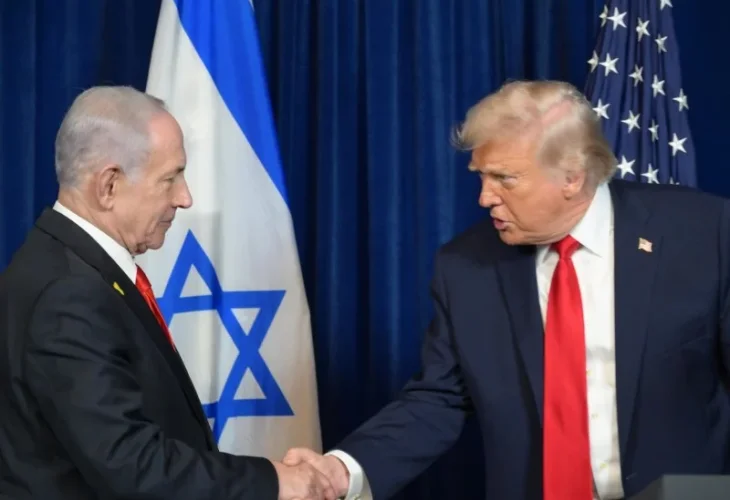 Trump and Netanyahu (Amos Ben Gershom/GPO)
Prime Minister Benjamin Netanyahu met Monday with U.S. President Donald Trump in Florida for a full day of talks focused on the Gaza ceasefire, the fate of Israeli hostages, Iran’s nuclear ambitions, and wider regional security challenges.
Netanyahu’s visit began with a meeting in Palm Beach Secretary of State Marco Rubio to discuss implementation of the Gaza ceasefire, the status of hostages held by Hamas terrorists, and regional diplomatic coordination. He later met Defense Secretary Pete Hegseth, with talks centered on Israel’s security needs, military coordination with the United States, and regional threats.
Earlier in the day, the family of fallen hostage Ran Gvili met senior U.S. officials, including Rubio and White House figures Jared Kushner and Steve Witkoff, before later meeting both Netanyahu and Trump. The family said they received “an attentive ear and a willing heart from both leaders,” adding that they urged Trump to “use all the levers of pressure on Hamas” and stressed that “it is impossible to move to phase two without Hamas playing its full part.” Ran’s mother, Talik Gvili, said, “Time does not heal my broken heart; it only diminishes the chances of bringing Rani home,” while his father, His father, Itzik Gvili, said that “victory will only be achieved with the return of all the hostages home,” adding that the people of Israel would not agree to leave Rani behind.
Netanyahu arrived at Trump’s Mar-a-Lago estate in the early afternoon, where the two leaders held a closed-door working lunch with senior advisers. According to officials, the discussion focused on the Gaza ceasefire and a possible second phase, Hamas’s future in Gaza, the hostages, Iran and regional threats, and broader U.S.–Israel strategic coordination.
In their public appearance afterward, Trump framed the talks as reflecting near-total alignment between the U.S. and Israel. “There’s very little difference in what we’re looking at, in where we want to be and where we want to go,” he said. Netanyahu described the relationship as “a partnership second to none,” rejecting the idea that the United States advances its interests by distancing itself from Israel. “President Trump has done the exact opposite,” Netanyahu said, adding that despite occasional differences, “most of the time we see eye to eye.” He described the meeting as “very, very productive.”
On Gaza and Hamas, Trump presented the next phase of the ceasefire as potentially imminent but conditional. He said movement forward could happen “as quickly as we can,” but only if Hamas disarmed. “There has to be a disarming of Hamas,” Trump said, warning that if it failed to do so, “it’ll be horrible for them, really, really bad for them.” Netanyahu did not commit publicly to timelines, instead keeping the focus on conditions discussed behind closed doors. Trump further claimed Hamas was internationally isolated, saying that if the group failed to disarm, “we have 59 countries that signed on” and that those countries “want to go in and wipe out Hamas.”
On the hostage issue, Trump emphasized pressure and leverage, crediting his administration with recent releases. “Every hostage just about that’s been released was released because of me, Steve Witkoff, Jared Kushner, my whole team,” he said.
Turning to Iran, Trump warned against any attempt to rebuild nuclear capabilities. He said Iranian sites had been “obliterated” and that if Tehran attempted to reconstitute its program, the buildup would be “very quickly” eradicated. Trump said he would support negotiations with Iran but backed Israeli action if Iran pursued nuclear weapons or ballistic missiles. Netanyahu did not dispute Trump’s framing and emphasized Israel’s security concerns in the broader regional context.
On regional diplomacy, Trump grouped Syria, Hezbollah, and Turkey under a broader effort to prevent renewed instability. He said U.S. policy aimed to keep the region from sliding back into conflict and noted his relationship with Turkish President Recep Tayyip Erdoğan. Netanyahu emphasized Israel’s interest in a secure northern border and said protecting Druze and Christian minorities was a core Israeli concern. Trump acknowledged that he and Netanyahu did not agree “100 percent” on Judea and Samaria but said conclusions would be announced at a later stage.
Trump described Netanyahu as a “wartime prime minister” and said the United States would continue to stand with Israel. Netanyahu then announced that Israel would award Trump the Israel Prize, marking the first time in nearly 80 years that the honor would be given to a non-Israeli, saying the decision reflected broad Israeli appreciation for Trump’s support of Israel and its fight against terrorism.
Later in the press appearance, Trump suggested that Israeli President Isaac Herzog was moving toward a pardon for Netanyahu. Israel’s President’s Office later issued a clarification denying that any such discussion had taken place.

