

Magazine
A Conversation with Oded Harush: Finding Inspiration and Faith Through Life's Journey
Judaism, inspiration, resilience, and the deep happiness found at the Shabbat table
- Avner Shaki
- | Updated
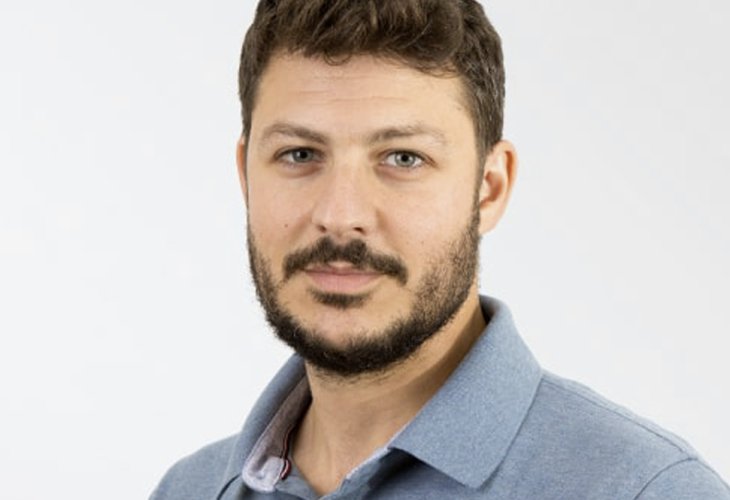 Oded Harush
“My name is Oded Harush, 33, married and a father of three, living in Dimona. I write and present for Kan 11 and for Hidabroot, and I run the ‘Ruach BaMidbar’ organization — a center for Jewish thought and culture for young adults operating in Dimona.”
A Jewish figure who inspires you?
“There are many writers and thinkers whose wisdom I continue to draw from — from the holy Or HaChaim, whose commentary I look forward to studying every Shabbat, to Rabbi Kook, whose thought and writings have shaped me since my teenage years, and to Rabbi Cherki, with whom I had the privilege to study at Machon Meir in Jerusalem. I still enjoy reading his books and commentaries today.
“The person who most inspires me never wrote a book and probably won’t be familiar to most readers — her name is Esther Maman, may she live many more good years — my grandmother.
“She was widowed at age 24, after my grandfather was killed in a car accident in Morocco, when my mother was only four months old, with three older siblings above her. My grandmother managed to raise a beautiful, dignified family, immigrate to Israel straight into the barren desert of Dimona, work double shifts in the Kitan textile factory to support her children — and despite all the crises she faced over the years, and there were many — she never gave up her faith and trust in God.
“I grew up most of my life with my grandmother by my side. My eternal childhood memory is of the early morning sun breaking through my bedroom window, and in the doorway — my grandmother, her hand on the mezuzah, whispering a familiar prayer. That is the picture that greeted me almost every morning. To this day, I am grateful for the privilege of growing up beside such a grandmother.”
What does Judaism mean to you?
“Love of God. That is what I strive for — and that is how I try to raise my children. I want connection — a heartfelt bond — like between a father and a son.
“My own father also told me what was allowed and what wasn’t, sometimes hugged and sometimes got angry. But if you ask me about my relationship with him, I would be doing an injustice if I reduced it only to the moments he permitted or forbade things.
“All of those details — they shape you — but in every crisis I go through, I try to rise above the specifics and reconnect to that deep, original relationship between myself and my Father in Heaven. The details are only part of a much greater story between us.”
Share a meaningful Shabbat experience
“For me, the COVID period felt like one long holiday — especially the Shabbat lockdowns. Of course, it was also full of challenges and uncertainty, but something changed for us.
“Before COVID, since I was rarely at home, simply sitting at the Shabbat table and feeling the different atmosphere was enough for me to feel that I was giving my children a sense of Shabbat.
“But when COVID began and I found myself home with my kids for weeks on end, I was afraid that Shabbat would no longer feel special — that it would become just another day. So from that point on, we began investing much more in our Shabbat table — more stories, more songs, more space to listen to the kids.
“In the end, COVID — for us, became a kind of family gift. Quality time that came ‘by force,’ but without guilt.”
A memorable conversation you had?
“We launched a new online series, part of ‘Hidabroot Video,’ which brings the beautiful and diverse people of Israel to the screen. The series is called ‘Oded on the Road’ — and along the way I meet fascinating personalities: a musician, an author, a man dedicated to locating forgotten graves in Tzfat, and many more.
“What they all share is that each one — in their own way — chose to do good and influence the world positively. We try to bring that perspective to viewers at home — a bit of light and positivity in a media climate that is often cynical.”
“One of the most interesting conversations was with Dr. Gadi Taub — a secular Tel Aviv academic, someone who on the surface represents ‘the other side’ of me culturally and socially.
“He spoke openly about his ideological shift — how his experiences since Oslo, through the Gaza Disengagement, and up to the 2011 protest movement — led him to rethink his worldview and write a book that reframes political discourse not as Right vs. Left, but as ‘rooted vs. mobile’ identities.
“The conversation was fascinating — not because it was about religion, but because of the courage required to question your own camp, your past assumptions, and your intellectual comfort zone. What I took from it is that every person must constantly ask questions, seek growth, and refuse to accept reality or public discourse as unquestionable truth.”
A mitzvah you feel especially connected to
“About four years ago, I began working a lot outside the city — both in media and in my role in Jerusalem with the student Beit Midrash network. That means I am constantly traveling.
“I asked whether I should recite Birkat HaGomel regularly, and opinions varied. Some said saying it once on Shabbat covers all travels from that week. Others said modern travel isn’t considered dangerous anymore.
“But when it comes to an opportunity to thank God — I don’t look for leniencies. I have so many reasons to express gratitude that, for me, every trip is simply another excuse to stand up in synagogue and say, ‘Thank You for all the goodness You have given me.’”
What makes you happiest?
“Since getting married and having children, I’ve come to understand the difference between happiness and joy. Today, happiness for me is nachat — deep contentment. And nothing gives me more nachat than a Shabbat table with my wife and kids.”
A song that deeply influenced you
“‘The Song of the Grasses’ by Naomi Shemer. And Naomi Shemer herself — someone raised on a kibbutz, yet deeply connected to Jewish heritage — moves me tremendously.
“She wrote songs many modern artists would never dare write today — songs rooted in Jewish memory and longing — and she did it authentically, not as a religious person, but as someone profoundly connected to the story of this land.”
Where do you see yourself in ten years?
“This may sound evasive, but it’s really how I live my life. I don’t aspire to be something — I aspire to be someone.
“I don’t dream of a particular position — I dream of a feeling: of fully realizing the abilities God planted in me.
“You can be a prime minister and still not feel fulfilled — or you can be a teacher who wakes up every day feeling that he is living his purpose. I envy the second person — and that is what I strive for. Not a title, but a state of being.”
What most moves you in Judaism?
“Music. The Alter Rebbe once said: ‘Speech is the quill of the heart — but song is the quill of the soul.’
“Artists like Shuli Rand and Evyatar Banai move me deeply — their music gives space to human vulnerability. And as we know — a broken heart is sometimes the most whole.”
Something meaningful connected to your family
“We recently moved into our new home in Dimona. On the surface, that sounds ordinary — but we bought the land shortly after I visited my grandfather’s grave in Morocco.
“Standing there, I suddenly realized how unimaginable a privilege it is to purchase land in Israel — in the heart of the desert. Something our ancestors could only dream of.
“There, beside his grave, it hit me how often we take life in Israel for granted — and how much my grandfather would have given for a single moment of what I am blessed to live.”

