

Magazine
From Public Housing to Hedge Fund Millions: The Faith-Fueled Journey of Naor Baruch
How an Israeli who grew up in extreme poverty used crypto, hard work, and deep belief in God to build wealth, give millions to charity, and teach others smart money skills
- Avner Shaki
- | Updated
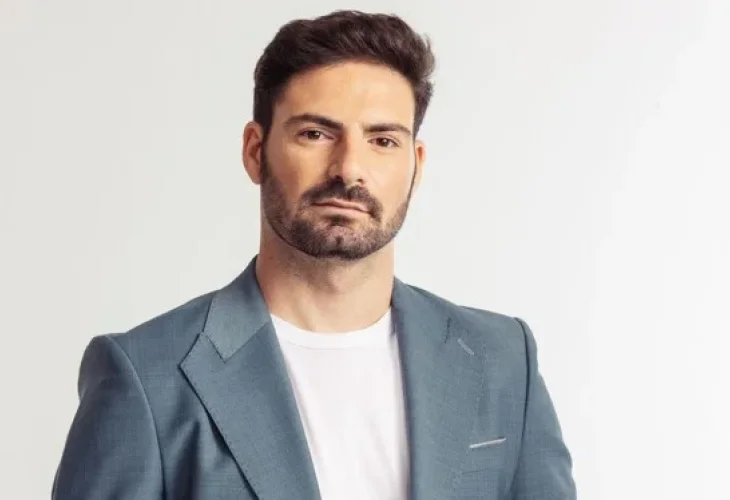 Naor Baruch (Photo: Micha Lubaton)
The impressive penthouse apartment of Naor Baruch — perched on the 44th floor of a luxury tower in the heart of Tel Aviv — gives no hint of the harsh childhood he endured. Naor, 30, a businessman who owns two hedge funds, grew up in a 25-square-meter government housing unit and experienced extreme poverty. Yet, through deep faith and what he calls tremendous Divine assistance, he eventually achieved significant financial success. From the balcony of his home, you can see Herzliya — the city of his childhood — and be transported back for a moment to the years that shaped his life.
“From as early as I can remember, we were very poor,” Naor says at the beginning of our conversation. “When my mother was pregnant with me, my father was seriously ill, and we reached a point where we literally had nowhere to live. She turned to Amidar (public housing) and asked for an apartment, but they didn’t approve her request — so in the end she broke into one of their vacant apartments in Herzliya Pituach.
“We lived in one of the wealthiest — and also most secular — areas in Israel. The children in my school were the sons and daughters of the country’s elite, and in our home there was barely anything to eat. My father passed away when I was three years old. A short time later, my mother underwent a surgery that went wrong and was left almost blind — so I slept at friends’ houses very often.
“During those years I spent a lot of time in boarding schools because our situation at home was so difficult — but I kept running away because I suffered there so much. My mother’s condition continued to be very serious, and for several years she was hospitalized around 40 times a year. In ninth grade I transferred to a gifted-students boarding school in Herzliya, and in eleventh grade, after a long persuasion campaign on my part, I finally returned home.”
In what way do you think your childhood poverty influenced your financial situation today?
“It affected me in many ways. One of them is that money interested me from a very young age. I also started working early. By sixth grade I was already babysitting, delivering flyers, and selling popsicles.
“Some of my classmates’ parents were among the richest people in the country, and I would ask them how money is made. By high school, I was already succeeding in a few small business ventures.
“In one case I needed someone to sign as a guarantor for a large sum. I had no one to ask. When I told my mother about it, she offered to sign for me herself. I asked her how she wasn’t afraid — considering our financial situation — what would happen if it didn’t work out? And she said: ‘Make sure it succeeds. I trust you.’ Her words gave me tremendous confidence — and it really did succeed.”
A Personal Business School
“After high school, I had two hundred reasons not to enlist in the army — and my mother wouldn’t sign for me to serve in a combat unit — so I served in the Kirya base in Tel Aviv. It was very important to me to serve and contribute to the country.
“While I was in the army, I worked for two extremely wealthy businessmen — whom I got to know through my classmates’ parents — and that’s where I learned a huge amount about finance and the business world. I would find investment opportunities for them, offer them different ways of thinking, and they trusted me very much.
“One of them once forgot a bag containing a million shekels somewhere we had been — and I returned it to him. That obviously strengthened the trust even more.”
You eventually became wealthy through cryptocurrency investments. How did you first hear about it?
“Actually, I first heard about crypto in high school — and it intrigued me — but I really began looking into it during my army service, after the grandson of one of the businessmen I worked for told me about it again. I told myself that if I’m hearing about it for the second time, it’s worth investigating seriously.
“I basically paused my life and studied everything I possibly could about crypto. I took out a bank loan of 200,000 shekels and invested all of it. Very quickly I began to see profits — my money multiplied in ways I never imagined — and I realized this could change my life.
“Later, when I had more knowledge and confidence, I managed to convince one of the businessmen — during a joint flight on his private jet — to let me invest for him. It worked brilliantly. Unfortunately he never paid me for it because we hadn’t signed a contract — but at least I learned a very important lesson from that experience.
“I gained experience very quickly and saw that I was making a lot of money, especially during market downturns. As a kind of emotional closure, at age 23 I bought the very same public-housing apartment I grew up in.
“Later on I established two hedge funds: one for crypto and another called Algo. The crypto fund has four major investors — people who believed in me before anyone else — and I don’t accept new investors there. I generate extraordinary returns for them. The Algo fund has fewer than ten investors — it’s much more stable — and I don’t add investors there either.”
There’s a saying that the tests of the wealthy are harder than those of the poor. What do you think about that?
“I’ve known that saying for many years — and I don’t agree with it. I know what it’s like to be poor and what it’s like to be rich — up close — and being poor is far more difficult.
“Opening an empty refrigerator when you’re hungry, knowing you have nowhere to sleep, wondering how you’ll get money just to survive another day — that’s harder than any test a wealthy person goes through.
“There were months when I earned 40–50 million shekels — and I try to give a fifth of my income to charity — so there were months when I donated close to 10 million shekels. I won’t say that’s easy — but the struggles of the poor are much, much harder.”
Wealth, Giving — and Perspective
“True, in some ways I live a luxurious life today — partly as compensation for the difficult childhood I had — but I never forget that money is not the most important thing in life.
“I actually live quite modestly relative to what I could afford. My real happiness comes from volunteering twice a week — for years now — at Shalvata (a psychiatric hospital) and at Beit Loewenstein rehabilitation center. I help people put on tefillin there — and also on the street, and I bring sweets and games to patients.”
Because he knows what poverty feels like, Naor is now working on a financial education initiative.
“I want to help people understand how to manage money wisely and how to invest responsibly. There will be several program tracks and the price will be affordable. I could offer it completely free — but I’ve learned that when people get something for free, they often don’t value it. I truly believe this program will change many lives, and I’m investing a lot so that it will be excellent.”
He is also helping develop financial-literacy programs for children.
“A child in Israel finishes 12 years of school without knowing how a salary is calculated, what a stock is, or how to manage money wisely. That’s an educational failure.
“My mother saved my child allowance — 170 shekels a month. Altogether that was 36,720 shekels. If she had invested that money at a 10% annual return — like the market yielded over the past decades — I would have reached age 18 with nearly 100,000 shekels. That’s a sum that can change the entire course of a person’s life. Warren Buffett called compound interest ‘the eighth wonder of the world’ — and he was right.”
Faith, Loss — and the Search for Family
“Even though I grew up in one of the most secular areas in Israel,” Naor continues, “my mother passed down a strong sense of Jewish tradition. In her later years she kept Shabbat, and we made Kiddush at home. After she passed away, I became much more observant.
“My mother was over 100% disabled. She passed away when I was 28 — and after that I began keeping Shabbat and saying Kaddish for her almost every day. She was the most amazing mother in the world, and I wanted to honor her soul.”
He admits he feared that moment his entire life.
“I knew that when it happened, I would be alone in the world — with no one to love me or care for me. I have no siblings — and from a family perspective, I was left completely alone. Thank God I have friends, but it’s not the same.
“That loss strengthened my desire to build a family. I really want to get married and have children. I’m looking for a woman with strong values and faith in God — someone kind-hearted, who loves to volunteer and help others. People are welcome to contact me through social media — both about financial questions and… about potential matches,” he adds with a smile.
Several months ago, media outlets reported that you’ve been active in campaigns supporting public tefillin stands. Where did that connection come from?
“When I was young, I met a wonderful man named Rabbi Meir, who put tefillin on people in the street. After I saw how good it made me feel to put them on, I started doing it myself — and I still do today.
“With time, our activities expanded. A few months ago, I came to put tefillin on students at a school in Tel Aviv — and the school staff threatened to call the police. They didn’t come, but I discovered that there’s a law prohibiting tefillin stands within 30 meters of schools. I can’t understand how in the only Jewish state in the world, such a restriction exists — and recently I’ve been working to change it.”
Naor has since met with several ministers and Knesset members to advocate for legislative reform.
“We want a law guaranteeing full freedom to offer tefillin anywhere in Israel — and that anyone who harasses or prevents it will be subject to criminal penalties.”
“Everything I Have Comes From God”
“In general, I feel that my connection to God and the Torah brings blessing into my life. Everything I have is thanks to Him. Statistically speaking — the chances of someone starting where I started and ending up where I am now — are almost zero. So I pray a lot. I talk to God — especially before I go to sleep. Every morning I say Modeh Ani, and I even post it online.”
Naor keeps Shabbat as much as possible, gives significant charity, and says that from the moment he began tithing seriously, he saw extraordinary blessing in business.
“My connection to Torah keeps me grounded,” he says. “It reminds me what really matters. It helps me stay humble — to always see the ‘little person,’ to greet the security guard at the mall — to remember that no one takes their money to the grave.
“If God gave you abundance — you must thank Him — and ask yourself how you can use it to help the people of Israel. That’s everything.”

