

Israel News
A Mother's Journey: Transforming Tragedy into a Mission
After losing two children in a flash flood, Kinneret Asor devotes her life to awakening the Jewish people to pray for Mashiach and Redemption
- Moriah Luz
- | Updated
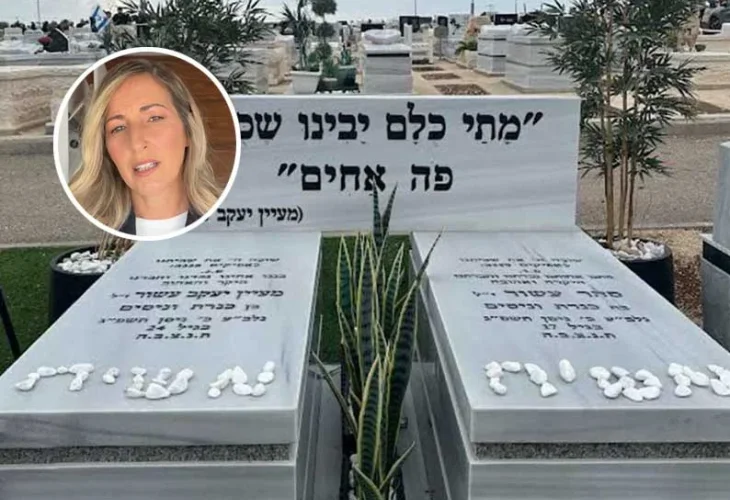 In the image: The graves of Ma'ayan Yaakov and Sahar Asor, of blessed memory. Inset: Kinneret Asor.
“I’m a mother of four children – two of them are currently not here,” says Kinneret Asor, carefully emphasizing the word “currently.” About two and a half years ago, she lost her eldest son, Ma’ayan Yaakov, 26, and her daughter, Sahar, 17, in a flash flood in southern Israel. She is 50 years old, and by profession a mental coach. Since the day of the tragedy, she has stepped away from that field to devote herself to the project she chose as her life’s mission: awakening the Jewish people to ask for Mashiach and Redemption. She calls it “the journey of my life,” and notes that the Hebrew word “masa” (journey) is also an acronym for her children’s names: Ma’ayan and Sahar Asor.
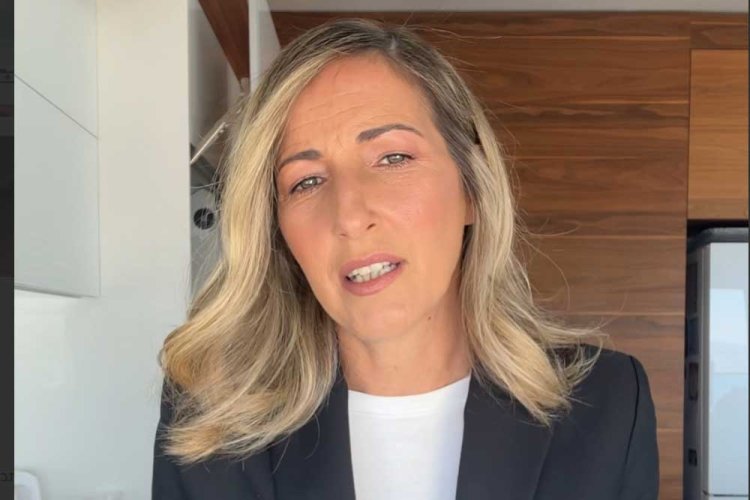 כנרת עשור
Today, Asor juggles different projects and doesn’t refuse any interview – even if she has to squeeze it in while preparing salads for Shabbat. “Wherever I’m asked to come – I go,” she says firmly. “Before the tragedy, we were a happy family. My husband and I, each of us ran a business, but the main thing was always the children. As far as we were concerned, we came to this world to be parents.” About 15 years ago she became religious, and she shares that in previous years the family was “split” in terms of observance: she and two of the children kept Shabbat, while her husband and the other two did not. “But we lived in perfect harmony,” she is careful to stress.
 סהר עשור ז"ל
“When will everyone understand?”
About two and a half years ago, the day before the Seventh Day of Pesach, the family left their home in Tiberias and headed toward Eilat. Their destination was Kinneret’s sister’s house, where they planned to celebrate the holiday together. That same week, two sisters from the Dee family and their mother were murdered by terrorists in an attack on the road in the Jordan Valley. The Asors decided not to risk that route and chose a different path – via Highway 6.
Regarding that terrible attack in the Jordan Valley, Kinneret adds: “People think the story of Am Yisrael started on October 7. But the story started almost a year earlier, when from Heaven they began taking pairs of siblings, one after another: the Paley brothers from Jerusalem, the Yaniv brothers from Har Bracha, the Dee sisters from Efrat, and my children – who were the fourth pair. Even before our tragedy, my children and I begged Hashem to send us Mashiach and Redemption, because we understood there was an internal war among our people and that a disaster could come. We saw where it was heading.”
She shares that just two days before the flood that took her children’s lives, she watched a video that shook her. “I finished watching it at 1 a.m., called my son Ma’ayan and told him: ‘We’re calling for Mashiach for the wrong reason. There’s a civil war here among Jews, and it's frightening to think what kind of disaster is going to come on us.’ The next morning Ma’ayan wrote on his Facebook page: ‘When will everyone understand that we are all brothers here?’ That sentence later became the slogan that accompanies me on my journey to bring the Redemption.”
 מעיין יעקב עשור ז"ל
Kinneret continues describing that day: “We left in two cars. In one car were Ma’ayan and Sahar; in the other were my husband and I, our two other children, and my sister with special needs, who has been living with us for several years.” During the drive they stopped for lunch together, and at the end bought popsicles at a nearby kiosk. “There were a few extra popsicles left. Ma’ayan saw two small kids and handed them the popsicles without saying a word. That’s how I raised my children – the main thing is to be good people, nothing else.”
She remembers that from the beginning of the trip, her youngest son kept begging to ride in Ma’ayan’s car. They told him he could switch cars after the lunch stop. “At the end of the meal, just before we got back into the cars, suddenly heavy rain began to fall. Ma’ayan told the little one: ‘Not now, my brother. Right now I don’t have time to rearrange the seats for you. Next time.’ Today I say thank You so much to Hashem for that huge miracle. He took two of my children, but it could have been worse, and nothing is taken for granted.”
The continuation of that terrible day was widely reported in the media: the two cars ended up taking different routes. Ma’ayan and Sahar’s car drove into an area hit by a flash flood and was swept away by the water. Sahar managed to send her mother a message about the flood before contact was lost. A day later, their bodies were found.
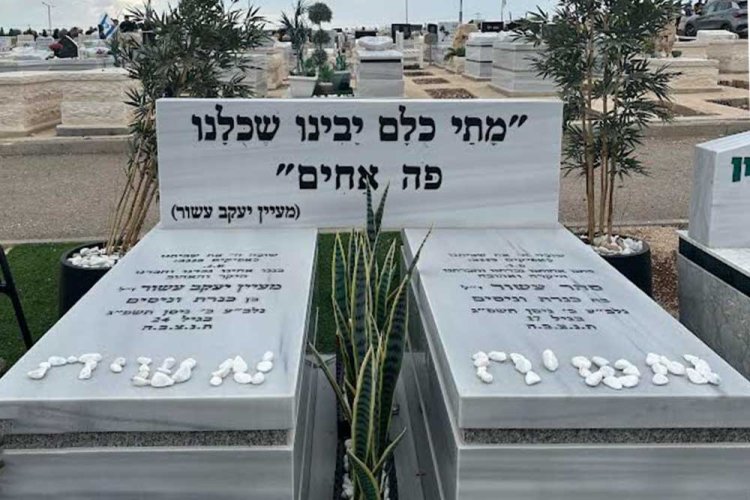 מצבותיהם של מעיין יעקב וסהר ז"ל
Long hours passed until the bodies were found. Did you believe they would be found alive?
“The more time went by, the more I understood they wouldn’t,” she says. “I prayed nonstop, but at the same time I felt that Hashem was making me understand that Ma’ayan and Sahar would not return, and that I was the fourth mother about to pay a very heavy price for hatred between brothers.”
Kineret recalls the chilling moments of receiving the news, from the operations room the family had set up in her sister’s home in Eilat. “I always asked Hashem for one thing: that He protect my children. When the police officer came in and delivered the news, I went out to the balcony. I lifted my eyes to Heaven and said: ‘First of all, thank You that I am a Jew. Thank You that we have the holy Torah. And thank You that we have the 13 Principles of Faith, two of which speak about Mashiach and the Resurrection of the Dead. Thanks to them I know there is hope for my loss.’
“I continued and said to Hashem: ‘Until now, I wanted Mashiach for the sake of all Am Yisrael, and it hurt me – and still hurts me – so much to see what’s happening between us. But now, the desire for Mashiach and Redemption has become my personal interest, and I am going to turn the world upside down to make it happen.’”
At the funeral, as her children lay before her, Kinneret cried out similar words in her direct, unfiltered style, and her speech deeply moved many. She notes that tens of thousands of visitors came to the huge mourning tent that was put up at the foot of their building in Tiberias.
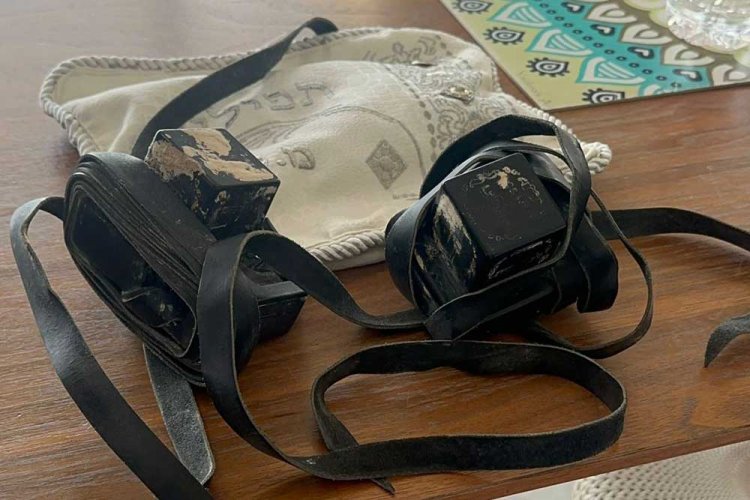 התפילין של מעיין יעקב - הפריט היחיד שנותר מהשיטפון
“We told Hashem: until Mashiach comes, we’re not sitting still”
Kineret promised to “turn the world over,” and the day after the funeral she began doing exactly that. Today she invests all her energy and time in raising awareness and bringing the language of “asking for Mashiach and Redemption” into the public conversation.
“I had a successful clinic, and my husband had a thriving business that ran for 25 years. After the tragedy we shut them down and told Hashem: until Mashiach comes, we are not planning to sit still for a moment. I work hard and I don’t take one shekel from anyone, no matter where I go or what I do.”
 כנרת בפודקאסט שיזמה
What does your activity actually include?
“We want to awaken Am Yisrael to ask for Redemption – in every possible way. I give lectures all over the country and organize prayer evenings. Last week we initiated a huge prayer gathering at the Kotel, with thousands of people who came to cry out and ask for the coming of Mashiach.
“We also have a project of distributing sweets to needy families and orphans, out of a desire to ‘sweeten’ life for anyone whose life is bitter – and we pray that these sweets will sweeten the harsh decrees for Am Yisrael. This project brings us great joy, and we believe that this is how you bring Redemption – through goodness.”
She adds that inside their home they have a small synagogue called “Kulanu Achim” (“We Are All Brothers”), where Mincha and Ma’ariv prayers are held, along with Torah classes. She also runs a group of bereaved mothers called “Nashim She’Yecholot” (“Women Who Can”) – a play on the phrase “Nashim Shekulot” (“bereaved women”), but turned into something positive.
In addition, she runs a group of about 700 women, where each day different women post new spiritual commitments – one accepts upon herself to say a daily prayer, another to strengthen her modest dress. In recent months she has also launched a podcast called “Metim Lachzor” (“Dead Who Want to Return”), dealing with the topic of the Resurrection of the Dead.
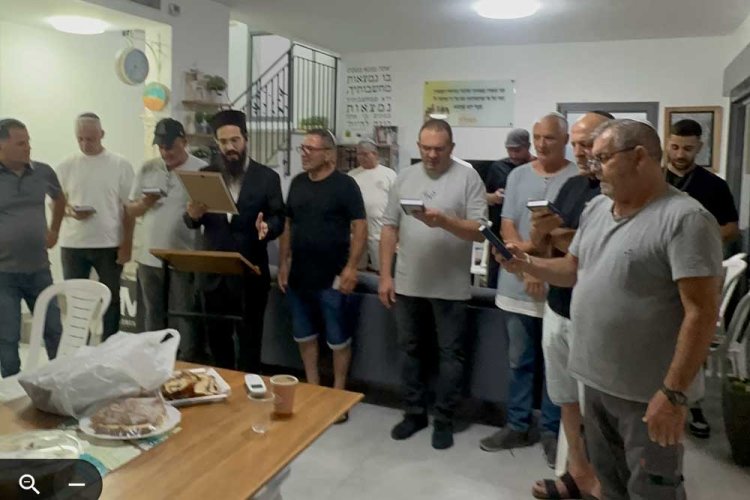 המניין שפועל בבית משפחת עשור מאז האסון
 You mentioned that you and your husband stopped working in your previous professions. Where does the funding for all this come from?
“We work for Hashem — and there is nothing we’ve wanted to do in this area that hasn’t materialized,” she says. “Take the podcast as an example. It costs 3,000 shekels a month, and we’re the ones funding it. From the first moment, about half a year ago, I said to Hashem: ‘Every idea a person gets is only because You decided so. I’m going to produce and pay for this podcast — and I’m sure You’ll reimburse me.’”
She goes on to describe what happens: every month, right around the time the payment is due, she gets a phone call — each time from a different person — who says they want to join the project and donate exactly 3,000 shekels for it.
Another example of this special Divine assistance, this time in the financial realm, is tied to the sentence Ma’ayan wrote two days before his death: “When will everyone understand that we are all brothers here?” Kinneret wanted that phrase to spread everywhere and enter people’s hearts. One problem stood in her way: the campaign she imagined would cost a fortune.
“I do what I can do, and then I turn to Hashem and ask Him to send me messengers. A few days later I opened my Facebook and discovered that the entire country was plastered with Ma’ayan’s sentence — malls, bus stops, everywhere. It turned out that an advertising executive from Tel Aviv, named Yaron Salama, had seen Ma’ayan’s sentence and invested two million shekels in the project.”
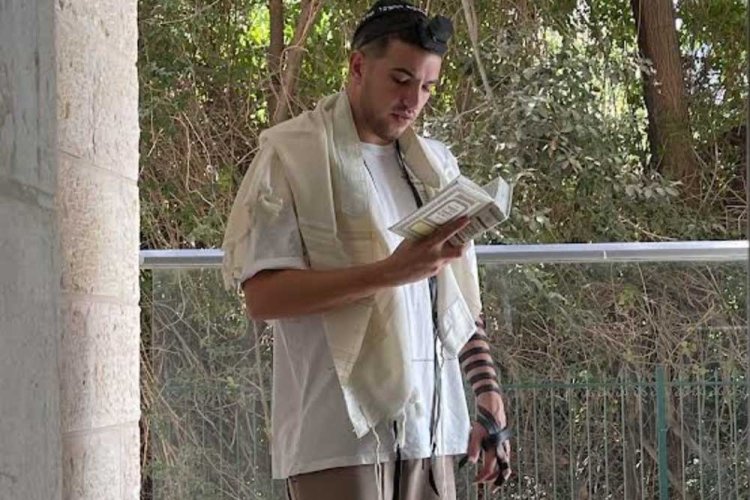 מעיין יעקב בהנחת תפילין. הקפיד על כך מיום בר המצווה
Do you also get responses from people who see you as delusional or pitiful?
“Of course,” Kinneret answers immediately. “People who didn’t know me at first saw me as pitiful — a woman who lost her sanity after her loss.” She adds that now, after a lot of consistent work, the ideas she’s trying to spread are more familiar and accepted, but at the beginning she indeed faced many such comments.
She also gets calls from people struggling with severe mental health issues, who see themselves as “Elijah the Prophet” or “Mashiach ben Yosef.” About them, Kinneret says with a half-smile: “At least they’re imagining about these things and not about other things.”
“We’re just going for a few moments to bring Mashiach”
Regarding the audiences who join her activities, Kinneret points out a surprising fact: most of them are from secular or traditional backgrounds.
“A parent who loses a child cannot learn to ‘live alongside’ that reality. Why did no one ever introduce them to the possibility that there’s another way? People from secular backgrounds say things to me like, ‘Why didn’t anyone tell us there’s hope?’”
She shares that today a community has formed of widows and bereaved mothers who refuse to just “accept the decree” as final. “I love Hashem very much and I don’t argue with Him, God forbid. It’s clear to me that only He decides and determines. Everything I do is only to plead with Him to bring the Redemption as soon as possible.”
Do you find yourself imagining the moment you’ll meet Ma’ayan and Sahar again at the Resurrection of the Dead?
“I imagine that moment non-stop,” she answers with a big smile. “It also gives me strength, because thought creates emotion.
“I see myself running toward my children and them running toward me, until we meet and hug. I can picture Ma’ayan bursting into laughter and saying to me: ‘Mom, are you crazy? What happened to you? We just went for a few moments to bring Mashiach.’
“It’s written in Tehillim, ‘Then our mouths will be filled with laughter and our tongues with song.’ When Mashiach comes, we’ll laugh so much, and we’ll realize that everything we went through was like an illusion and a dream — not the real reality. The true reality will only begin when Mashiach arrives, with God’s help.”

