

Magazine
From Tattoos to Tzitzit: The Inspiring Journey of Ariel Tabachnik
A juggling artist, yoga instructor, and balloon entertainer shares his powerful path from a secular childhood and life challenges to faith, joy, and spiritual purpose
- Avner Shaki
- | Updated
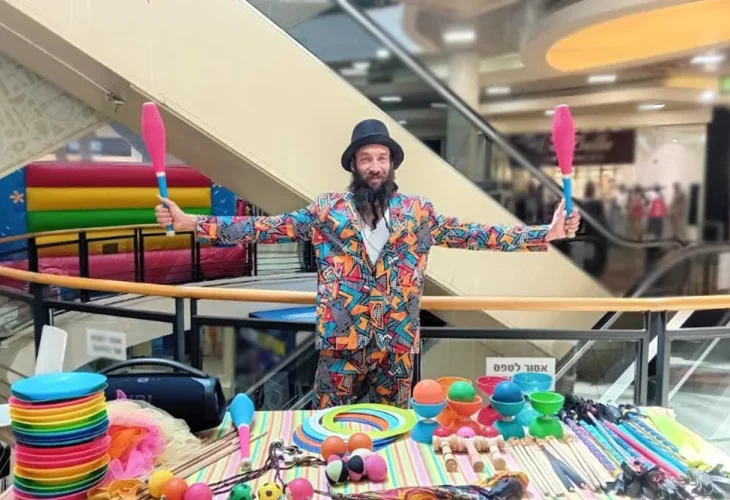 Ariel Tabchnik
I first met Ariel Tabachnik at a family birthday party where he had been hired to entertain the children. The moment I walked into the hall, I noticed him — and to be honest, no one at the event could have missed his presence. His colorful personality — both literally in his lifestyle and in his clothing — the balls and torches he repeatedly juggled into the air, and the tzitzit strings swaying with the movement of his body all caught the eye. At the same time, the many tattoos on his body raised intriguing questions.
“I can understand why I attract attention,” he admits shyly at the beginning of our conversation. “My mission is to make people happy, and I try to do that in the best way I can. Part of it is dressing differently when I perform, standing out a little. I see what I do as part of serving God — and serving God should be done in the best way possible. Any job can be connected to serving Hashem — especially mine, where I bring people joy.
“In Judaism we know the great merit of those who bring happiness to others, and how important it is to live with joy. It’s also a privilege for me to earn a living doing something I love — and because I love it and value it, I do it even outside of work. For example, when I’m on a train, I sometimes juggle or make balloon figures, and I see how it lifts people’s spirits.
“Before becoming religious, my outlook was much narrower, and I felt less joy. But the closer you get to God, the more connected you feel — to yourself, to the world, to people. After you come closer, your perspective expands. Life gains deeper meaning, and you realize that every day is a gift — every day is another opportunity to improve your mission in this world and do the things you were created to do.”
“I Became Like a Father to My Brother”
“I was born into a very secular family,” says Ariel, 34, a single Jerusalemite, circus performer, balloon artist, and yoga instructor. “And not just secular — we were very far from Judaism. My mother is Jewish but my father is not, and that also distanced us from Jewish life. It simply wasn’t part of our world — I didn’t even have a bar mitzvah.
“My parents were born in Ukraine and immigrated to Israel in 1990. I was born two months later. We lived in Karmiel, where my younger brother was born, and we tried to adjust to life in Israel. My mother wanted to be a clown when she was young, but she grew up in a strict home where the children were pushed toward academic subjects. My grandfather refused to let her pursue it — so today my brother and I both work in clowning in a way that fulfills her childhood dream.
“Our childhood was not easy. My father was an alcoholic, and at a certain point my mother was diagnosed with cancer. Maybe because of all that, we gravitated toward humor and things that bring happiness. As a child I loved movement, play, and physical activity — academics interested me much less. And in many ways, I became like a father figure to my younger brother, because our parents were often not really present.”
How did someone so far from religious life become observant?
“After high school I enlisted in the army and served in the Border Police. That was my first exposure to Judaism. Today I know that it was thanks to my army service that I became religious.
“Many of the guys I served with were Mizrahi — naturally traditional or religious — and through them I discovered the beauty of Torah and mitzvot. That’s also why I follow Sephardi halachic practice today — that’s the tradition I first connected to.
“Rabbi Nachman explains the phrase ‘The wicked, even in their lifetime, are called dead’ — that when you’re disconnected from God, you lack spiritual vitality. When I encountered mitzvot, I felt life and energy. I felt like I was coming out of darkness into light. I also noticed that the religious guys behaved with more respect, kindness, and dignity than what I was used to in secular society.”
How did your environment react to your growing observance?
“It was very hard. After my discharge I returned to my family and friends in Karmiel, and it was difficult to continue keeping mitzvot. Becoming religious meant going against everything I had known. One time I got off a bus in Karmiel, and a girl I knew saw me wearing a kippah and asked if I’d gone crazy. It really hurt. I didn’t yet have a strong backbone in my teshuvah, and her words made me question myself.
“It’s very hard to do teshuvah without support — and I want to call on anyone reading this: please help baalei teshuvah at the beginning of their journey.”
After some time traveling abroad and studying, Ariel continued exploring spirituality — eventually strengthening his connection to mitzvot, beginning to lay tefillin, keeping Shabbat, and growing in Jewish learning. He describes key turning points — including refusing to work on Shabbat and seeing unexpected blessing afterward — that strengthened his commitment.
He also recalls the inner struggle: “At first I was embarrassed to wear tzitzit — I’d tuck them inside my pants so no one would see. Only on the last day of my degree did I have the courage to walk on campus with a kippah. Baalei teshuvah often feel like they’re in between worlds — belonging to neither side — and that makes the process emotionally difficult.”
Circus Performing and Building Bridges
In Jerusalem, Ariel studied in a yeshiva for baalei teshuvah while also teaching yoga and developing his circus and juggling work. Over time, he and his brother began performing together — birthdays, events, haircutting ceremonies, community programs, and more.
“I feel that because of the path God led me through, I’m able to connect with people from many backgrounds and bring them closer to one another. Secular people see my tattoos and feel that I’m ‘one of them,’ while religious and Haredi people see my beard, peyot, and tzitzit — and also feel connected.
“Sometimes I literally see stereotypes melting away.”
He reflects deeply on the process of teshuvah: “The journey of a baal teshuvah is not always easy — but I’m very happy I chose it, and that I’m still walking it. If I hadn’t become religious, I’m sure I’d have many more tattoos today — even on my face. I still think they’re beautiful — but I know God forbids it, and that knowledge holds me back.
“Yes, I made mistakes in the past — but teshuvah is stronger than everything.”
Ariel is also deeply involved in outreach — distributing weekly Jewish pamphlets, encouraging others, and helping Jews reconnect.
“In recent years even my mother has become stronger in her connection to Judaism — and that moves me deeply. Even my grandmother — who barely speaks Hebrew and struggles to recognize people, now says Shema Yisrael every day because I taught it to her.
“When you try to bring Jews closer — amazing things happen. And I never stop being moved by it."

