

Simchat Torah
A Journey of Faith, Love, and Strength: The Life Story of Rabbi Yossi Cohen and His Wife Raaya
From decades of devotion and resilience in Jerusalem’s Old City to a miraculous lung transplant and a legacy of compassion
- Moriah Luz
- | Updated
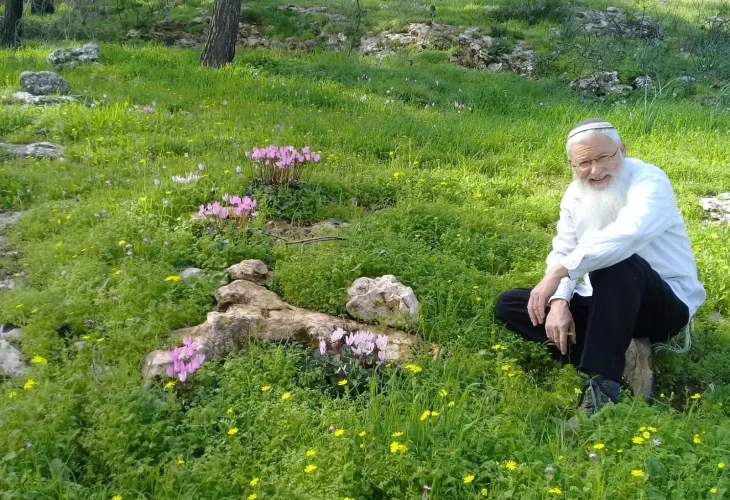 Rabbi Yossi Cohen
“I always believed we would overcome — and quality of life was always important to us,” begins Rabbi Yossi Cohen. “That’s how we lived even when my wife Raaya’s lungs were functioning poorly. We rented a jeep with sealed windows so dust wouldn’t get inside, loaded the oxygen tanks into the car, and went out on trips.”
Rabbi Yossi Cohen has taught for many years at the “L’Netivot Yisrael” yeshiva in the Old City of Jerusalem. His warm and radiant demeanor gives no hint that only a few months ago, he lost his wife after many close and loving years of marriage.
“Beyond the Mountains of Darkness”
The Cohens married 45 years ago. At the time, Rabbi Cohen was a kollel student, learning in a newly founded yeshiva located in Beit HaMa’aravim — a Jewish-owned building in the Muslim Quarter that had been abandoned after the 1929 riots. It was about twenty years after the Six-Day War; the ruined Jewish Quarter was slowly being rebuilt, but the rest of the Old City was largely devoid of Jewish life.
“When we got engaged, I asked Raaya whether she’d be willing to live near the yeshiva — and she agreed. We renovated an apartment inside Beit HaMa’aravim, where only a few students lived, and a few months after our wedding we moved in,” Rabbi Cohen recalls. “The greatest difficulty was the isolation. We were the only Jewish family in the building — in fact, in the entire area. We lived near the Western Wall, but we were in the Muslim Quarter, and the place was considered ‘beyond the mountains of darkness’. Physically too, the conditions were harsh — no paved roads, no electricity in the homes — very primitive. Slowly, a few other families joined, and a small community formed.”
The years passed. The neighboring families grew and expanded — while the Cohens’ home remained quiet.
“It was very hard for Raaya. I didn’t feel it as strongly — I was busy in the yeshiva, and I always believed we would eventually have children. But Raaya was the brave one. She underwent constant blood tests, was frequently absent from work for treatments she could not even explain to colleagues, and carried the pain inside her. Still, we refused to sink into self-pity. We kept close friendships, went out on trips, and made sure to breathe a little air. Looking back, we went through very hard things — but shutting yourself indoors and feeling sorry for yourself only adds more suffering. What God gives us is enough — He does not ask us to burden ourselves further.”
Their strength, he says, came from Torah study and from great rabbis who embraced them.
“One of them was Rabbi Shalom Eisen of Meah Shearim, who loved us like his own children. I don’t know what we did to merit that. His support gave us tremendous strength. Other rabbis also encouraged us, and from them we learned that God sees us — and we are not alone.”
He recalls that Rebbetzin Chana Tau would often speak with Raaya and repeat to her: “Life as it is, has value. It is not true that if there are no children, nothing has meaning.”
Raaya worked as a nurse, and for 18 years served in a hospice for terminally ill patients. She left only when her health forced her to transfer to another ward. “It was emotionally tough work. The staff poured their soul into caring for the patients — and yet constantly faced loss. Raaya gave herself fully to that mission, and found deep purpose in it. The ten years until our daughters were born were full of meaning for her. She didn’t sit and cry.”
Some years after their marriage, they learned about IVF — then a new and difficult treatment — and decided to try.
“Baruch Hashem, after ten years of marriage, our first daughter, Yiska, was born. Three years later — after more treatments — our second daughter, Noa, was born.”
“Like Techiyat HaMetim”
Alongside raising their daughters, Raaya began experiencing severe breathing difficulties. Tests showed progressive and unexplained loss of elasticity in her lungs. Within a few years, she could barely breathe.
“When Noa was 10, Raaya was already connected to oxygen tanks constantly. Because of her work in hospice, she knew many patients in similar situations — and was convinced her days were numbered. She began saying goodbye to people. Then, completely unexpectedly, a medical option reached us — something barely performed at the time: a lung transplant.”
“It felt like techiyat ha-metim — resurrection,” Rabbi Cohen says. “We could hardly imagine such a thing existed.”
Raaya was placed on a transplant waiting list — knowing that if matching lungs became available, she would need to reach the hospital immediately.
“One night, the call came. We rushed to the hospital. The entire Old City stayed awake saying Tehillim. With God’s kindness — the surgery succeeded and we were granted twenty more good years.”
Because of the transplant, Raaya had to suppress her immune system with heavy medication. She was transferred from hospice to a sterile department — which turned out to be the IVF unit.
“It felt like a beautiful circle closing — she returned to the very world that had given us our children. From her own experience she knew exactly what those women were going through — the early-morning tests, the pressure to arrive at work on time afterward, the heartbreak after a failed treatment. She offered gentle words, compassion, and deep understanding. To this day, women write to me telling how much she helped them.”
“Learning How to Rejoice”
Through the years, Raaya continued working faithfully — even as new medical challenges appeared. She battled cancer five years ago, and recovered. When her abdominal pains worsened, tests made it clear that this time, the direction was not toward life.
After several weeks of farewells — Raaya passed away. In her last days, she was in the hospice where she had once served others — and finally at home, near the Makom HaMikdash.
Did you ever struggle with faith?
“No. I asked myself what I needed to fix, and I prayed a lot for healing — but I never felt anger toward God. I believe He challenges us to reveal strengths we didn’t know we had — and I tried to prove myself worthy. Teaching emunah for many years — along with learning from great Torah scholars, gave me a stable outlook.”
Rabbi Cohen also describes the sheer practical intensity of caring for her: “When her lungs deteriorated, I would carry enormous oxygen tanks — like barrels — on foot from Jaffa Gate down to our home in the lower Old City. After the transplant she needed over twenty medications every morning, special forms and approvals — I took responsibility for all of it. I even learned how to give her IVs and morphine. I simply had no time for spiraling thoughts.”
How did you build such a powerful marriage?
“That was all Raaya,” Rabbi Cohen says, his voice breaking. “She was the righteous one. Now that she’s gone — I feel her absence physically. Every corner of Jerusalem reminds me of her. Our life was maybe twenty percent challenge — but eighty percent enormous goodness. When you accept the struggle as something to withstand, it doesn’t break you. You grit your teeth, move forward — and when the burden lifts, you look for ways to rejoice. Joy gives you the strength for the next wave.”
Raaya herself insisted on dignity, beauty, and vitality — even at the end.
“She used to say: ‘Jerusalem is not built through misery.’ She dressed beautifully, cared for our home — even in her last weeks. In her final hospitalization, while gravely ill, she asked to go to the clothing shop near the hospital to buy a dress. After she passed, I distributed over thirty elegant dresses to our daughters and her friends.”
They valued even the smallest measure of life — chayei sha’ah. “We understood that even a short time has meaning,” he says. “You give value to every moment.”
During COVID, he lived in constant fear of infecting her — shielding himself and distancing from students.
“We had many deep conversations near the end. Because of her fragile immune system, we received a private room. We spoke for hours — about life, about the past and the future, about how to go on without sinking into sadness. We recalled the good we had built — and baruch Hashem, there was much to remember. That is how I was able to part from her.”

