

Magazine
From Death Sentence to Miracle Escape: Moshe Harir’s Imprisonment and Rescue from Yemen
After months in a secret Yemeni prison accused of being an Israeli spy, Moshe Harir was miraculously saved, and still dreams of returning to rescue the Jews left behind
- Chaim Gefen
- | Updated
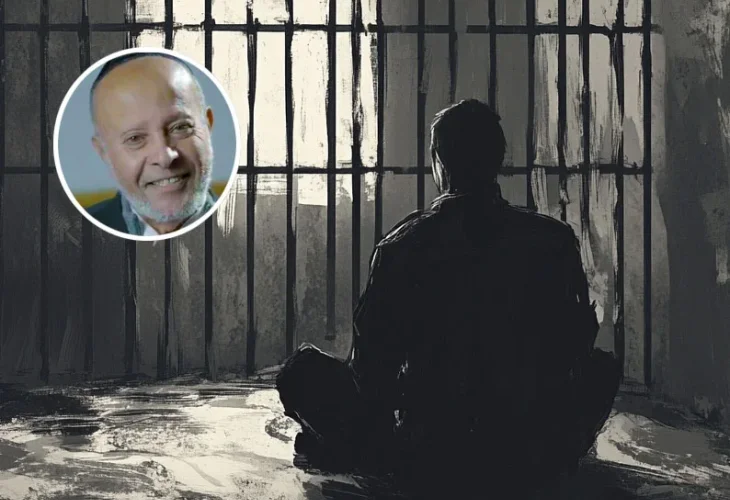 Inset: Moshe Harari
The small room in the remote hotel in northern Yemen was especially dark. Moshe Harir drew the curtain aside and looked out toward the nearby border separating Yemen from Saudi Arabia. The sky was black, illuminated only by the beams of the watchtower spotlights. Armed soldiers patrolled back and forth along the border, and military jeeps sped by. “It’s dangerous to get involved with these soldiers,” Harir thought to himself as he drifted off to sleep.
Before dawn, loud knocks thundered on the door. Harir woke in fright and peered through the peephole: three Yemeni intelligence agents were waiting outside. “That’s it — the end has come,” he whispered to himself, moments before he was taken away in a vehicle toward the unknown.
A Secret Remedy
The story of 72-year-old Moshe Harir, born in Yemen and now an Israeli citizen, begins about forty years ago, when he started traveling on spiritual missions to Yemen.
“Scattered Jews were living across the villages, with no spiritual or religious support,” he recalls. “I came to help provide them with what they were lacking — and, wherever possible, to help bring them to Israel. Jewish life in Yemen was difficult, and they suffered from increasing hostility and danger.”
But helping Jews immigrate to Israel was not his only mission.
Near the gravesite of Rabbi Shalom Shabazi, in the city of Taiz, there is a spring that Yemenite Jews traditionally believed to have healing powers. “On every visit,” Harir says, “I would travel to the spring, fill jerrycans with water, and secretly smuggle them to Israel.”
Is this a longstanding tradition passed down through generations?
“Absolutely. The custom is to draw the water into a covered jug without exposing or looking at it, then pour it into a mortar, crush everything together, and apply it over the entire body or wherever there is pain.”
He explains why the water is crushed: “Plants grow around the spring, and when you draw the water, pieces of the plants enter the jug. According to the tradition, the mixture must not be filtered — everything that enters the jug must be used. That is why the water is crushed together into a liquid mixture.”
Did you personally believe in this remedy?
“Not only did I believe in it — I saw it with my own eyes. When we were still in Yemen, my father suddenly became gravely ill and was bedridden. His condition worsened daily and the doctors gave him no chance of survival. They told us to prepare his grave and refused to treat him further.
“At that time there was still no transportation in Yemen, and my brothers traveled for two weeks by donkey to bring back water from the spring. My mother prepared and applied the mixture every day. Slowly my father began to recover — and after three months he was back at work as if nothing had happened.
“Years later, after he had moved to Israel and lived in Bnei Brak, he remained healthy until age 90 — when he was diagnosed with cancer. Again the doctors gave him almost no chance, especially at such an advanced age. Yet he lived until 106.”
Harir frequently visited the grave of Rabbi Shalom Shabazi. Because no Jews remained in the city, he installed a lock on the entrance so that outsiders would not enter. Later, the site was restored by the “Ohalei Tzadikim” organization.
Each time he visited, Harir prayed at length, drew water from the spring, and flew most of the jerrycans to Israel. He would deliver them to Rabbi Shlomo Korach, Chief Rabbi of Bnei Brak and senior Yemenite rabbi, who distributed them in serious medical cases or through students who assisted those seeking help.
Lost in Yemen
On one of his visits, Harir stayed at a small hotel in a northern Yemeni village. His plan was to visit nearly every village where Jews still lived. To move freely, he bribed an Interior Ministry worker who forged a Yemeni identity card for him.
A few nights later, intelligence agents arrived at the hotel and arrested him.
“That night they operated on three fronts,” Harir says. “They arrested me, the driver who accompanied me, and the Interior Ministry worker who forged the ID. All of us were taken to a detention facility in Sana’a.”
What kind of prison was it?
“Something you wouldn’t want to see. I don’t even think it was an official prison — more like a secret facility for special detainees. The conditions were extremely harsh: they threw me into a solitary cell with no light, no ventilation, and no mattress. I lay on the floor alone and terrified.”
Were you physically harmed?
“Thank God, no — and that itself was a miracle. But I constantly heard the cries of my driver. They tied him to a pillar in the basement and beat him day and night, trying to force information out of him. He knew almost nothing, yet they refused to believe him.”
What were you accused of?
“They were convinced I was an Israeli spy. During the interrogations they asked endless questions about Israeli intelligence agencies. Even though I entered Yemen on an American visa, they insisted I was an Israeli agent. I kept repeating one request: ‘I demand to see the American consul.’”
Sentenced to Death
Days and nights in the cell blurred into a nightmare. Twice a day he was given only a slice of bread and a bottle of water. The darkness and heat were unbearable.
Eventually, after the U.S. consul intervened, Harir was moved to a regular cell — but he remained imprisoned for nearly two hundred days.
“When they read out the verdict,” he says, “I was sentenced to death. In that moment, all the terrible things I had witnessed in prison flooded my mind. I had seen prisoners taken away and never return.”
Did anyone try to involve the State of Israel?
“Yes — Jews I had helped bring to Israel appealed to Prime Minister Benjamin Netanyahu. He replied that direct intervention might actually harm me — because it would confirm the accusation that I was an Israeli agent Israel was trying to rescue.”
Even then, did you still believe you would survive?
“Yes. I had strong faith. I knew I was on a mission of mitzvah — and I believed God would save me.”
“I’m Going Home”
Supporters around the world continued to work for his release and eventually reached the Jewish philanthropist Edmond Safra.
“When Safra heard the story, he contacted the Yemeni authorities and paid an enormous sum for my release — 83 million dollars. After the payment, they suddenly decided to hold a retrial so they could acquit me.”
Feeling that time was critical — and fearing something might happen before the hearing, Harir bribed a prison worker to move his file to the top of the court stack. “The next morning,” he laughs softly, “my case was called first.”
He received a full pardon, left the courthouse, and rushed to the Sana’a airport. “On the way back, I even managed to take with me an ancient Torah scroll I found in one of the villages and bring it to Israel.”
After everything you went through, surely you would never return to Yemen?
“You might be surprised — but I still dream of returning. There are Jews who are still waiting to be brought to Israel, and we won’t abandon them. If I do go back, it will only under a completely new identity — one that no one will recognize."

