

Shabbat
From Tragedy to Hope: The Inspiring Story of Yossi Samuels
Kalman and Malki Samuels transformed years of struggle into a global center of love, dignity, and empowerment for children with disabilities and their families
- Hidabroot
- | Updated
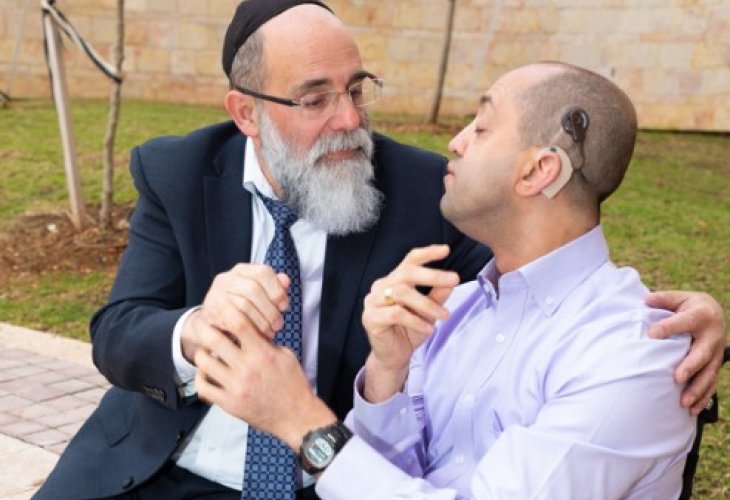 Photo Credit: Jared Burnstein
When Yossi Samuels was born, no one imagined that the sweet baby with the intelligent gaze would, at the age of eleven months, become blind, deaf, and physically disabled because of a faulty vaccine he received.
The vaccine that injured Yossi was without doubt a terrible failure. Later it became clear that there were additional children who had been harmed by it, to the extent that the triple vaccine then in use was discontinued. But for Yossi, it was too late; the damage was permanent.
In a conversation with Kalman Samuels, Yossi’s father, he recalls that dark and dreadful day. “Malki, my wife, went that morning with Yossi to the well-baby clinic to receive the second shot in the series. Already there he had a severe reaction, but despite that he was sent home. From that moment his condition deteriorated. It was expressed mainly in a clouded look. Malki literally saw how the movement in his eyes was decreasing.
“I returned that evening from the kollel at seven p.m.,” Kalman remembers, “and when I entered Yossi’s room my eyes darkened. He was apathetic and his eyes were moving in very small motions. Malki was terrified beyond words, but I asked her not to panic and to wait until morning. Maybe it was a cold or something like that.
“It is not that we ignored the serious signs,” Kalman stresses, “but there was no reason in the world for us to think that something so terrible had happened. We knew Yossi had received a vaccine that morning, but we did not connect the two. In those days the media was not developed, and doctors were regarded with an authority that is hard to describe. How could we even imagine that such a thing could happen? Only the next day, when we arrived at the hospital and the child was referred to a neurologist, she examined him and asked in astonishment: ‘Did he receive the triple vaccine?’ With those words it all began.”
The embodiment of sorrow
Immediately after the doctor identified the situation, she sent the worried parents for a series of tests with an ophthalmologist. “The doctor examined our Yossi, wrote his detailed report, and sent us with a sealed envelope back to the neurologist,” Kalman relates. “As strange as it sounds, we transferred the envelope without even reading the letter inside. Only after about three weeks she invited us for a final update and informed us that ‘everything is fine.’ We did not even have whom to ask about what was not fine. We were coping entirely on our own. We were in darkness.”
Do you think the attitude you received was connected to the fact that they knew this happened because of the faulty vaccine?
“I am sure that is why, but at that stage this terrible failure did not really matter to us. We felt as though the sky was falling on us. Until then we were young parents of two small, sweet children, living routine life. The moment this happened, life stopped at once and nothing that had been continued to be. We began to feel a huge disconnection from the world, loneliness and great confusion because of the contradictory opinions we heard everywhere. For an entire year we tried to clarify and understand what had really happened and what Yossi’s condition was. Finally, we flew to New York, where we met with leading ophthalmologists and neurologists. All of them immediately told us the truth to our faces: ‘This child will never see, because his optic nerve is damaged. Most likely his hearing is also impaired and he is completely deaf.’”
What do you feel in those moments?
“Pain,” Kalman answers in a sorrowful voice, “terrible and dreadful pain for our sweet baby, whom we so much longed to help and improve his life, but we had no idea how to do so. And also pain for ourselves, for our reality that turned over in an instant. Just months before we flew abroad I had received rabbinic ordination and thought that would be my future, but very quickly I understood that my direction in life would be completely different. That is how life is. They do not always lead you where you thought you were going.
“Since it was important to us to treat Yossi, we stayed in the United States for five years, and in the meantime I began to work in the field of computers. We sent Yossi to a special school for the blind, from which he would return every day at twelve-thirty. The moment Yossi entered the house, Malki’s day was over. At that stage we already had another child, but she could hardly manage to devote herself to the new baby, because Yossi needed care and demanded so much. Life became unbearable.”
Were you able to communicate with Yossi in any way?
“The only way to communicate with Yossi was through a hug, a kiss, and touch. Sometimes we would see him wandering around the house, and through touch he would search for things, but we had no way to ask him what he was looking for or to communicate with him on a deeper inner level. He was imprisoned in a jail of silence, with no ability to communicate with his surroundings.”
That sounds so frustrating. How do you move forward from such a place?
“We did not know the answer either, but one thing was clear to us — we do not give up. We never even considered giving up. All along we tried everything anyone suggested that might possibly help. Whether it was a diet that turned Yossi vegetarian for a year, or exhausting physiotherapy exercises. We tried everything, really everything.
“It is not that we deluded ourselves,” Kalman emphasizes. “We both understood that Yossi would not hear and would not see. We were with our feet on the ground, but we believed that even from such a place it was possible to advance him and help him grow. We tried to find the way that would help us do that.”
In the meantime, many acquaintances and kindhearted women came to visit Malki, among them rabbaniyot who had taught her in the past and served as a source of strength and inspiration. “Malki heard again and again how much they admired her, but each one also said that it could not be that she would continue under such impossible strain, and that she had to find a solution before she collapsed,” Kalman says. “One day Malki turned to God in prayer and said from the depths of emotion: ‘Master of the Universe, I will never send my child to an institution outside the home, but I promise You that if we ever succeed in helping Yossi, I will dedicate my life to helping other mothers with their special children.’ It was literally a vow.”
Breaking through the walls of silence
After several years passed and Yossi was about eight years old, the Samuels family returned to Israel. They then had six children, and Yossi was sent to a school for the deaf, where, without any warning, salvation came in a completely unexpected way.
“At the school Yossi had a very special and devoted teacher,” Kalman relates. “One day she placed one of Yossi’s hands on the table and placed his other hand in her palm, and she signed to him the letters of one word: ‘table’. Again and again, over and over. Suddenly Yossi smiled from ear to ear, and the teacher understood — he had received communication. That day when we came to pick Yossi up, she ran toward us in enormous excitement and delivered the news. ‘Yossi’s life will change from today completely,’ she told us.
“The teacher, as it turned out, was one hundred percent right,” Kalman says. “From that day on Yossi began to receive messages from us, and we began to understand that we had a way to communicate with him and to signal to him through the language everything we wanted. At first his vocabulary was limited, but very quickly he progressed further until his language became rich, and there was nothing we wanted to signal to him that he did not understand, whether an object or a word. We discovered a sweet and happy child, full of humor, who very much wanted to connect with his surroundings.
“A few months later another teacher arrived, a speech therapist, who decided to teach Yossi to speak in Hebrew. It was not easy, because Yossi could not hear himself speak, but she tried to work inside his mouth and taught him to move the necessary muscles. After two years we had a child who could speak with us and also signal to us exactly what he wanted. We had full communication with him. It was far beyond anything we had expected. Quite a few professionals later told us that he was practically the Israeli version of Helen Keller, the famous author who was deaf-mute-blind.”
During those days Yossi became a walking wonder. He also met prominent public figures who wished to witness the rare phenomenon, and every day he would hold long and detailed conversations with his parents.
Did you ask him, in your conversations, what he experienced during the years when he could not communicate?
“Of course. We asked him a lot about it. The more we asked, the more we discovered that he actually knew everything about life and about our family. He also told us about many experiences he remembered from when he was three years old. All kinds of things he remembered about his brothers and sisters, that we never imagined he understood so deeply. It turned out that for years Yossi had been imprisoned in a real jail, but inside that jail he knew exactly what was being done with him; he simply had no way to express it.
“By the way, once someone asked him: ‘If they allowed you to see one thing, what would you ask to see?’ He answered in a way that melted our hearts and moves me to this day. Without hesitation Yossi replied: ‘My father and mother.’”
Fulfilling the promise
One day, after Yossi’s condition improved and communication flowed, Malki spoke with Kalman at their home in the Har Nof neighborhood of Jerusalem and said to him: “The time has come to fulfill my promise. I know exactly what I want to do, but I need your help.” She then laid out her plan to establish an organization that would provide afternoon programming for children in special education. The children would receive a hot lunch and many activities, and once a week they would also be able to sleep there.
The program opened in a rented apartment in Har Nof with five children, and already then Malki established the guiding principle that the Shalva center would be designated specifically for children with cognitive disabilities. “We have children who, in addition to cognitive challenges, also suffer from various physical disabilities, but there is always a cognitive impairment as well. If there are children with physical disabilities only, without a cognitive challenge, we are not the right framework for them.”
Kalman emphasizes: “We started from the understanding that when a special child returns home, he essentially freezes the entire world of his parents. They cannot do anything other than care for him. The parents can hardly devote time to their other children and cannot sit with them, talk, or help with homework, because they are busy with the child who has special needs. I once heard from a sixteen-year-old girl who participated in a program we organized for siblings of the special child the following heartbreaking sentence: ‘Until my special brother was born, we were a family — father, mother, and three children. Since he was born, we went from three children to one child. Suddenly they do not see us anymore, only him.’”
And that is exactly where Shalva comes in. “Our goal is to restore these families to being healthy, regular families,” Kalman explains. “Our programs for the special children run all week, and on one day of their choice the child can also stay overnight with friends. This way the family receives quiet hours in which they can devote time to the other children.”
In recent years Shalva has continued to expand. It now provides services to thousands of children and also offers supported-living apartments for adult graduates of Shalva. They receive vocational guidance so they can work in an organized way. “The supported living is not inside the Shalva center but in the community,” Kalman clarifies, “but the great advantage is that we do not have to search for what they will do in the afternoons. They can come to the Shalva center, spend time there, receive a hot meal, and enjoy social life. Shalva today is the largest center in the world for people with disabilities. Also professionally, with God’s help, we are able to provide a complete solution. It is an enormous satisfaction to know that we can help children and families.”
Kalman notes that throughout all the years they have never said “no” to a child who requested to join Shalva and met the criteria. “We are indeed Haredi and understand the nuances of the sector. We provide strictly kosher food and everything Haredi families need. But we host children from all sectors and make special efforts to include everyone. Over the last year we also developed a unique program called ‘Rising a Level,’ intended for young men who want to serve in the army but cannot enlist to regular service. These young men sleep in our center and go out daily to serve in positions adapted for people with disabilities. They then return to our housing system and experience tremendous fulfillment.”
Full and happy lives
Kalman's book, titled “Dreams I Never Dreamed” tells the story of his life, based on events he never imagined he would experience. “It begins with a description of my life as someone born in Canada, very far from Torah and mitzvot. I was supposed to take part in a basketball game in France, and on the way there I visited Israel. In the end I never reached France but became Haredi and even received rabbinic ordination.
“The second dream I never dreamed is that I would have a child with disabilities who would not hear, would not see, and could not communicate. And there is also the third dream — for years my wife and I never believed the day would come when our Yossi would succeed in breaking through the walls of silence. It was something we did not even dare to imagine — and yet, it happened.”
As parents who themselves dealt with the unbearable challenge of a suffering child, how do you feel when you see the children who come to you with difficulties and disabilities?
“Of course we feel great pain for every child who comes to us,” Kalman answers honestly. “When I see a mother arriving with her little special child, I remember what we went through and feel the sharp pain again. But there is also another side. I understand that the world has changed, and today there is help that did not exist thirty years ago. Today a child who enters Shalva receives a good and happy life, and his family is strengthened as well. True, the problems are not simple, but there is light at the end of the tunnel.”
And what about your Yossi today?
“Yossi is now forty-three years old. He does not hear and does not see. Unfortunately he lost the ability to walk and uses a wheelchair, but he lives an amazing and full life, thank God. He works and earns his living. We see how much satisfaction this brings him, because more than anything else he wants to contribute to society. Yossi also works out in a gym and rides horses. Every morning begins with prayer and study. He has friends all over the world and keeps up with news and politics. Just recently he celebrated a birthday and was greatly surprised by very well-known and important people who came to rejoice with him. Thank God, he has an amazing life.”

