

Magazine
Ben Artzi: Life, Faith and Fatherhood in the Shadow of War and Fame
The journey of Shlomo Artzi’s son – from modest fees and deep fatherhood to a new album, Holocaust legacy, and a powerful voice for Israel’s hostages
- Efrat Talia Cohen
- | Updated
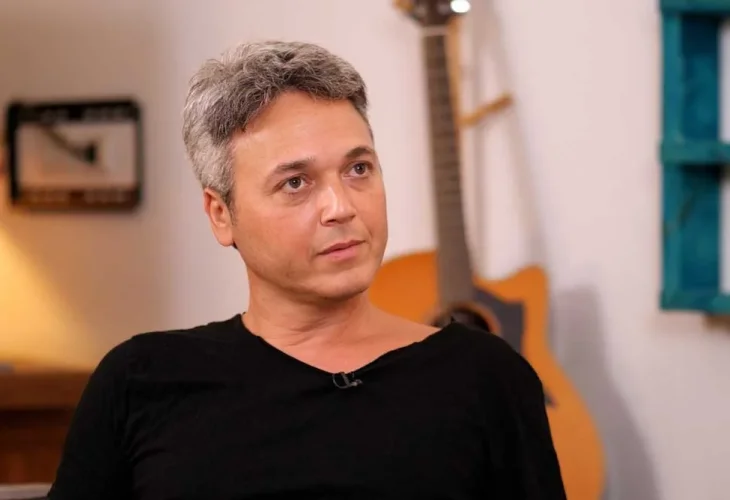 Ben Artzi
Just a few days before a big show that Ben Artzi was invited to perform in, together with other artists, someone from the production team called and asked how much he charges. Without hesitating, Ben answered that they were welcome to pay whatever amount seemed right to them.
Two days later she called back, mentioned a relatively high sum, and asked what he thought.
“I laughed,” he describes. “I told her there was no way I would agree to be paid that amount. She apologized again and said she had tried to get me a higher fee and would make another attempt. I explained to her that it was not what she thought, it was simply that I was not willing to accept such an astronomical amount, that it did not feel right to me, and that I would be happy to settle for half of what she offered. I felt it was just absurd to receive such a high sum. I am a person for whom it is very important to live at peace with myself and to feel aligned with myself, above anything else.”
This story may surprise you, but fits perfectly with the modesty of singer and songwriter Ben Artzi, who is also the son of one of the most famous and successful singers in the country. He is someone who speaks and sings on a very human level, who does not do anything he is not truly aligned with, who is not willing to take inflated fees for shows, and who is also not afraid to expose his own vulnerability, openly and authentically.
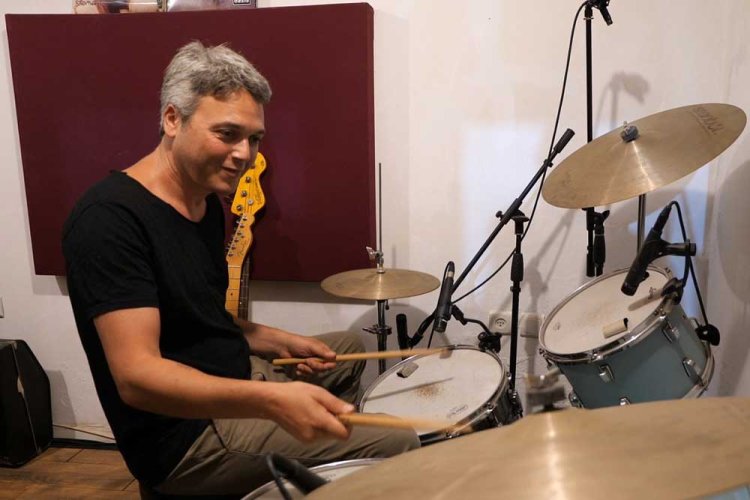
Who are you, Ben Artzi, if I asked you to describe yourself in a few words?
“I feel that I am a person in the world, although in recent years I understand more how the world is in fact inside the person. Above all, I am a father. I am a person whose soul, in many of its parts, is made of music. That is something very essential in my soul, not connected to career or self-fulfillment. It is the frequencies, the energy, this ‘thing’ that exists in music, which is very internal and deep in me.
“I am a searching person, someone who has always searched and will always search, and who also finds. I have a ‘search engine’ inside.
“I am a growing and developing person. I am now just after the halfway point of the journey of my life, and I feel inside me the mileage, the wisdom of the road and of experience. I am full inside myself of many farewells that have happened, I look forward to the meetings that are still to come, and I look at everything as a journey. A journey with a lot of sadness, joy and excitement, and above all a very interesting journey.
“I reflect, on a personal level, about my ‘twilight years’. I am past morning, past noon, I am in the late afternoon, in consciousness toward evening. I am there and in sync with that. I am very busy with it also through the aging of my parents, fully aware that this is our last chapter together, even though once it seemed like it would be forever.
“I have been filming my mother on video for several years now, asking her questions about her life, even though I know most of the answers – about her childhood, about her life story, about old Tel Aviv. It is like a long process of saying goodbye. My mother, Milka, is my best friend. We have a very special and close relationship. She is a very connected and present person, and I already tell her now how much I will miss her when she dies. I really am a ‘mother’s son’.”
Besides his preoccupation with time and age, and even before being a musician and songwriter, if you ask him, Artzi is first and foremost a family man – especially a devoted father. In everyday life he is father to two boys, Lenny and Gidi, to whom he is deeply attached and whom he sometimes raises completely on his own, as he is divorced. When he speaks about them, it is hard not to hear the special excitement mixed into his voice.
“My fatherhood is by far the most meaningful thing I have in my life, and that life in general can offer, on a deep level,” he says. “It is the most interesting and most reflective journey, and it is the main thing to live for. I feel more connected to life since I became a parent. In my personal story, for me, parenthood is really a home I was looking for for myself. I feel like a person with much deeper roots, with belonging, with a home in the world. And I think that if there is something I am good at, it is being a father.
“I also think that this father in me has always been there in my soul. It is something I recognize in myself from when I was a child, and that is why when I was twelve and a half and my little brother Yonatan, was born, I was a bit like a parent to him, and I was active for him sometimes even more than my parents. And when my children were born, it gave them all the space.
“Fatherhood is a relationship that gives you so many reflections. It has taught me to stand more upright, it has taught me the experience of growing up. I had a different kind of childhood, and in many ways I invented my own life from within myself. I am the son of my parents – from the good and less-good experiences, and from the emotional language I grew up in – but I feel that through my parenting I invented myself, just like many of my worldviews and ways of looking at things I found inside myself. Of course I am also influenced by the home I grew up in, but I feel that I am trying to find my own voice and my own path, because it is only mine.
“With their own original language, original ‘zone’, original closeness, ways of behaving that I invented together with the kids – and it is not similar to the parenting I experienced, just like my attitude toward music is not identical to what I absorbed at home. I give them what the child within me would have wanted to grow up in. I try – I am not free of mistakes, and I am now more aware of some of them, but they are not really ‘mistakes’ – there are just things I am less good at, like setting boundaries, or being overprotective.”
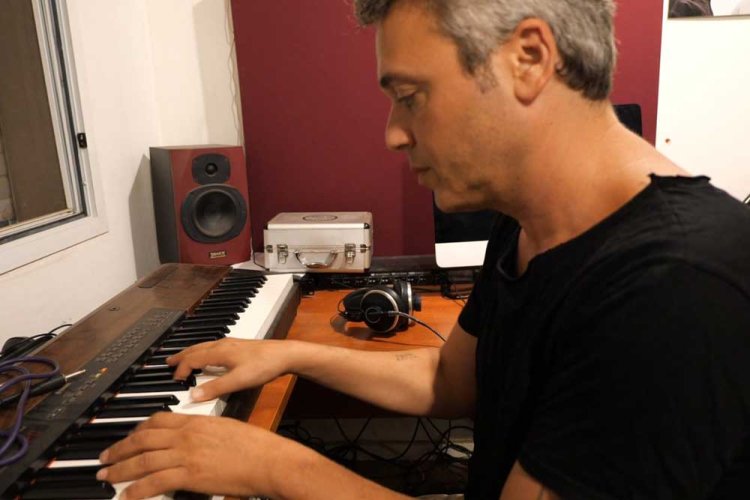
“This album is a closure for me”
Artzi recently released his fifth album, called “Pa’am” (“Once”), eight years after his previous album, after a period in which he felt a bit “disappeared,” having chosen to stop performing even with his father. All the tracks on the album are actually songs of his that are already known (“Ani Efes”, “17”, and others), which he decided to re-record in new arrangements, some of them together with other musicians such as Daniel Salomon. In some of the songs you can even hear his children singing with him. In the versions he chose this time, the songs sound like a collection of a life journey, tracks that have grown and matured along with him.
Since then, he has been performing around the country in a joint show with his brother, Yonatan Artzi, who is also a musician and songwriter. Ben says he is performing more than ever, in front of different audiences, especially since October 7. He also recently released a joint song with a musician he especially loves, Aharon Razel, called “Nipagesh Machar” (“We’ll Meet Tomorrow”).
There is something a bit surprising about your new album. Why did you choose to go back to familiar songs, instead of creating completely new material?
“I am a person who also has obsessive parts and is very occupied with the past, and for many years I felt not at peace with the performances of some of my songs that I released. I felt they deserved more, and it really stayed with me and bothered me, and I knew that at some point I would record them again so that I could be at peace. I felt I had to close that circle in order to manage to let go and make room, and I feel that it really gave me rest. I see how wise a step it was for me, how much it freed me, how I let go of something that the past was pulling on like tugging at my shirt. And since I released it, the past and I parted on good terms.
“It is a bit like a painting that I love what is in it, but I have to choose the colors and the size of the paper all over again, so that I can live well and at peace with it.
“In practice, I worked on this for seven years, not continuously, and from time to time also in parallel with new material. I feel that I did it in a sober and not impulsive way, with a lot of thought, slowly and in depth, and then when the finishing point came, I released it and let go. And I am really happy with it. It is closure for something that was unresolved.
“In general, these recent years, my forties, have been years of many closures: the divorce I went through, the professional work I did with my father and then stopped performing with him, parenthood of course, a teenage love that chased me for many years alongside life, where there was something unresolved and I went and closed it, childhood friends with unfinished stories that I went and closed, and also this album. It is as if in the middle of life I stood in the room and decided to take out what is no longer relevant. Not to throw it away, but to take it out with full seriousness, and make room for new things to come.”
You are telling about your journey in recent years through the new album, and I am also thinking about your name, which symbolically tells something very meaningful about your journey… It is no secret that, in a way, some people mainly see you as “the son of.” Do you also feel that way?
“The truth is that this name really tells a lot of the story of my life. I really am someone’s son. But I am also someone’s son in the sense of being my mother’s child, and I have a very clear and separate identity of my own. My character has been so clear to me since I can remember myself, I am so much ‘me’… If in the eyes of others I am ‘the son of Shlomo Artzi,’ that can be annoying sometimes, because it does not allow a real encounter. It is not truly seeing me and understanding that there is a person under that external stereotype.
“The truth is that I do not even like my name. Sometimes I feel it is a narrow name, limiting, compared to who I am as a person, with movement inside me. Once I even went to a rabbi to consult with him about changing my name, and he suggested that I keep this name and add the name ‘Yisrael’, but I did not connect to that and decided not to do it… I sometimes thought about the name ‘Bena’ – adding the letter hey, the letter of God’s Name, to my existing name.”
You grew up in a home where you are third generation after the Holocaust. Your grandmother Margalit (Mimi) was born in Romania, a Holocaust survivor from Auschwitz-Birkenau, who lost her first husband and son. A truly wondrous story of survival. How was the Holocaust perceived in your home? How present do you feel it is in your life today as third generation?
“It is not something I feel as part of my identity from the inside. It is information that I know intellectually more than emotionally. My grandmother did not share her experiences, so I can more understand the psychology of a person who went through that inferno and rebuilt their life. She never told me her story, neither did my father, and I am not sure how much she shared with him, either. I can more understand my father’s psychology as second generation, though that is also very general – because each person is an individual and each one goes through the particular loss of his life in his own way and according to how it affects him.”
Speaking of your grandmother and the Holocaust – since October 7, in your daily life you are deeply immersed in the story of the hostages and very active for them. You speak about it a lot, you are in touch with some of the families, and you even wrote and composed a song about one of the abducted. Is there a special reason for that?
“It is one of the first things that define my mood, and it is something I recognize in myself even from before the disaster that happened here. For example, I clearly remember when Nachshon Wachsman was kidnapped. I was, I think, 18 or 19. I remember myself – it was a drama of a few days, and on Thursday night they tried to rescue him and did not succeed, and Rabin was prime minister, and a soldier named Nir Poraz was killed in the rescue… I remember that same feeling, years later, regarding Gilad Shalit – how deeply I took it to heart, in worry, in fear, in huge sorrow… Even then I was very active, during the five years he was in captivity. Sometimes alone, sometimes with others, I took part and tried to cry out the cry and the urgent need to bring him home. Day after day, hour after hour.
“I think that for people like me, the elements of helplessness, injustice, extreme misfortune – these are elements that speak to us with a deep identification, and so they pull us out of our houses. They play on something inside of us, and awaken us to cry out. I really live this and feel, like many others, that your breathing, the air you breathe, cannot be full as long as this is not over, and as long as not far from here there are people suffering in a way that cannot be described at all… Whether it is the family members, or even if we do not know them personally, it affects us in a way that goes beyond any feeling of distance. They have faces, names, and it tears my heart, really, and there is not much one can do. I do the little I can: go to rallies, write on Facebook. In my small part, I will always keep standing with a sign.
“I wrote a song about the hostage Matan Angrest. It happened after his mother saw things I had written and reached out to me, and I was very moved to speak with her, as someone in such immense pain. You search for the right words and tone for such a sensitive situation… And our acquaintance awakened in me the need for a song to be written about him, and as soon as that came up from her as well, I went straight to the piano, and in just minutes I managed to translate what I felt into a song, recorded it and put it out there. I relate to it less as a ‘song’ and more as another sign you hold up in the square, another cry…
“Afterward I also went to the Angrest family home, met the whole family, and a warm connection was formed… I am just trying to give a hug, hoping that it somehow conveys what is shouted in the square: we are with you, you are not alone."
You also have quite a special lineage – you are related to Rabbi Meir Shapira of Lublin, founder of the Daf Yomi. Do you feel connected to that part of your identity?
“The truth is that I only know about it on the level of an interesting fact – that he is the one who founded Daf Yomi – and I understand what a big invention that is for someone living in the Torah world. Once I tried to read about it a bit out of curiosity, but I did not manage to delve in; I did not find enough interest in it. Maybe it is also because it was not something present in our family, not like a ‘family pride’ thing that is passed down from generation to generation and talked about. I got to know about it more from religious people who told me about it. I am not sure it was ever even mentioned in our home, but I do remember it sometimes, and I am still curious… Recently I also mentioned it at a show I did in Jerusalem, in front of a partially religious audience, and I felt how that part in my story connected me to them, and that moved me.”
Speaking of Rabbi Shapira – where do faith and Judaism meet you in your life today?
“I am a believing person. I believe in God, in there being meaning to our existence, that our soul is here for a reason, that it came here to do something, that it chose the optimal conditions for its tikkun, and we came to correct ourselves. I speak with God all the time and I find Him in most things. I mainly believe that where our understanding ends, He begins. It is such an enormous wonder that I do not understand how people can not believe… Look at nature – it did not create itself. So my faith is in those areas.
“There was a time in my youth when I put on tefillin, because something in it did me good, and maybe it also gave me security, an emotional anchor. I think it was also a sort of meditation for me, something that placed my soul in good spaces for a moment.
“Beyond that, I am a person who is always in a mindset of giving, but on the day when I feel that my giving is not only within my natural circle – when I help a stranger from nowhere – it feels to me that my humanity is connecting, and those are my ‘mitzvot’ that make me into a human being and justify my existence.
“I also think that every person’s soul speaks, but there is a lot of background noise… Yet there is also guidance; life sends you signs all the time: through songs or art, through conversations, through encounters. You can always hear it if you are in a state of listening, and I think you need to look inward and recognize your essence and your inner core. The guidance is inside you. There are reflections from outside that can bring you back home.”
We are living in a very difficult time – in terms of security, and also in terms of the rift between us, which is so painful… It is like two very heavy poles pulling in different directions. Do you think there is a solution for both of these difficult parts?
“I feel that we are in a time full of sorrow and pain, and in my eyes it is also full of conflict, chaos, life among people who cannot accept each other’s path – something very conflicted and full of pain that is translated into hatred. And there is something in all this that is also discouraging, because I feel like I am in a different world… The world I grew up in as a child in the 1980s is not the world my children are growing up in today.
“But I am optimistic by nature, well trained in seeing what there is and in gratitude. At the same time, I am also realistic, and there is always a streak of sadness in me, though it is not pessimism. I do not know how to ‘write the script’ of what will happen, but I still believe that it will be good, because I think things have become so bad, and I believe in the cyclical nature of things, a bit like the seasons. For me, this has already reached some extreme, and since everything is dynamic and always changing, I have no doubt that this too will change into something else, something better. It has to happen.”

