

Magazine
From Rock Stages to Teshuvah and Chassidut: The Spiritual Journey of Musician Roi Lavi
How a young Israeli artist searched for meaning through music, left the stage for Torah and Chabad, and now creates faith-inspired music
- Avner Shaki
- | Updated
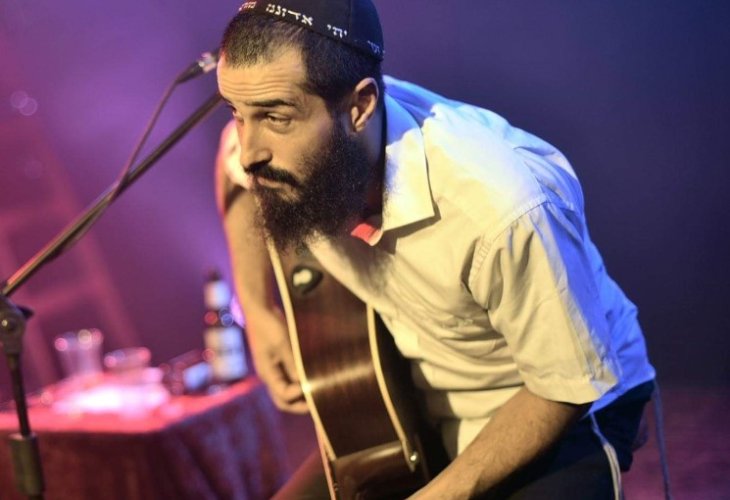 Roy Levi. Photo: Gonen Shmer
Roi Lavi is married and a father who lives in Eilat. He is a creative musician.”
“I was born into a traditional-religious family in Petah Tikva. At home we kept the basics like Shabbat and kashrut. I remember that from a young age I asked my mother why it was forbidden to do certain things, and she told me that this is what is written in the Torah. I asked who wrote the Torah, she said God, and I asked who God is and why we need to listen to Him, and from that point on I stopped getting answers from her and my teachers. I studied in a religious public school, but no one spoke to us about these subjects.
“When I was six we moved to Eilat, my mother, my sister, and I. Two years later we returned for a year to Petah Tikva and then went back again to Eilat. Today I understand that a few difficult things happened because of all those moves. For example, I went through eight different schools, which is a lot — especially considering the fact that I dropped out in 11th grade. When I was eight, I told my mother that I wanted to go back to Eilat — and that is what happened. The truth is that Eilat is the only place where we really feel at home.”
Love at first sight
“My connection to music began at a very young age. I actually remember the first time, the first click. When I was five we went to visit relatives in Netanya. They had a piano at home and its sound captivated me. Someone in the family taught me a simple piece and from then on I never left music. My mother noticed, bought me a guitar, and signed me up for music classes. To this day I owe her a lot for that.”
Spiritual Detour
“The years in Eilat were generally good, but around my bar mitzvah I unfortunately stopped keeping even the few mitzvot I had still been keeping. I did not understand why I could not go to the beach with friends on Shabbat, for example. I was searching for deep answers and did not receive them. My inner urge latched onto that doubt and convinced me to leave everything. I took off my kippah, got a few earrings, and set off on a new path. For ten years I was completely disconnected from Torah and mitzvot.“When I was 17 I left school because I understood that I was going to pursue music. I left Eilat, rented an apartment in Tel Aviv and joined a show that was very successful at the time, together with Guy Zu-Aretz and other artists. I was the youngest musician in the production.”
Truth will grow from the earth
“I was 23. I lived in Tel Aviv but worked in sales in Jerusalem, and there I connected with a group of Messianic Jews. Today I know that most of them are not even Jewish — and beyond that, it is a dangerous cult that believes in Jesus. That group is like a honey trap — you feel a kind of spirituality there, but there is zero truth and zero commitment. After a few months I left them too, without even knowing why. Something there simply felt wrong. Thank God I was saved from the Messianic movement.
“I kept searching for the next step. The questions about the meaning of life continued to bother me — and then, thanks to the Hidabroot organization, the gate to the Torah of Israel opened for me. Twenty years ago Hidabroot was still a relatively small organization, and just before I boarded a service taxi from Jerusalem to Tel Aviv, I came across a booklet by Rabbi Zamir Cohen called ‘Torah and Science, Part 2.’ I didn’t think too much — I just wanted something to read on the ride. So I took it and started reading.
“The first thing that intrigued me was the connection between Torah and science — how these two words even appear in the same sentence. I knew there was Torah, which I did not believe in, and there was science, which always interested me — but I did not understand the connection between them. I began to delve into the booklet, and today it is clear to me that this ride was the most significant turning point in my entire teshuvah journey.”
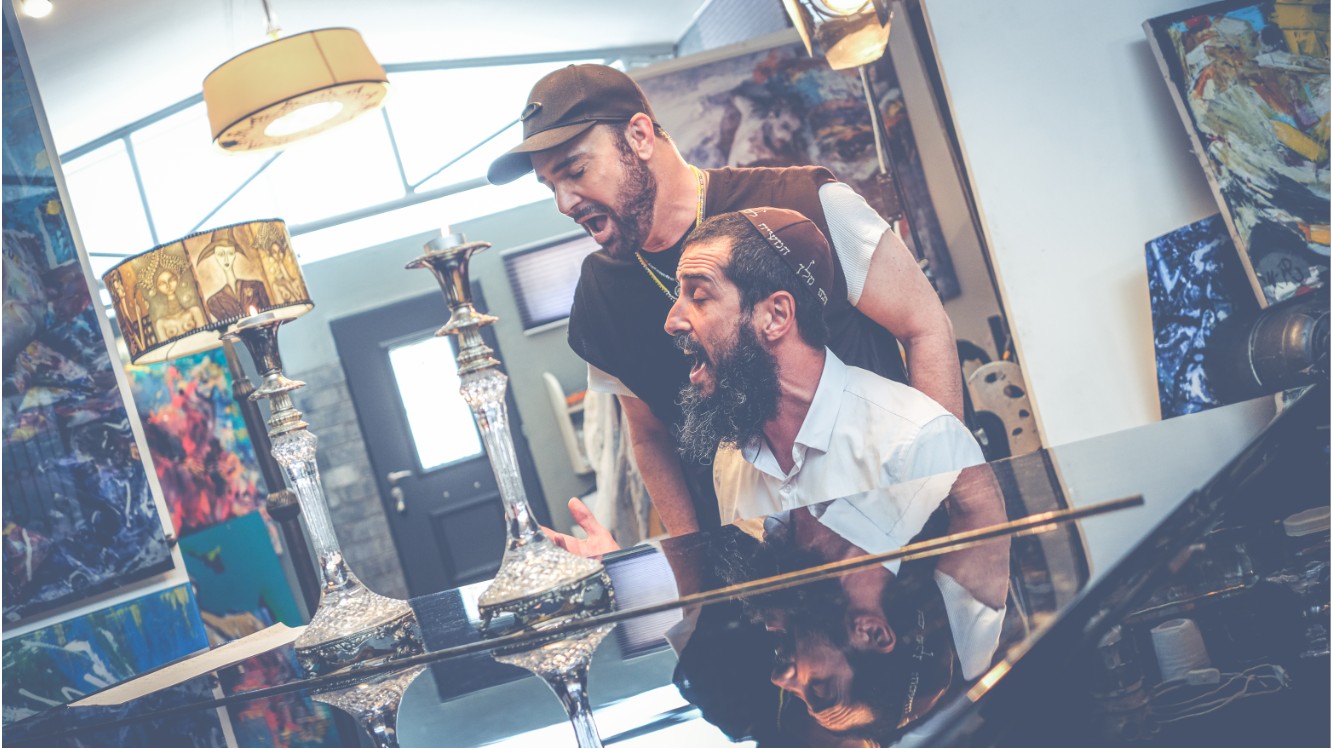 Roy and David. Photo: Shagai Nave
Sweeter than honey
“There are many beautiful things about Rabbi Zamir Cohen’s approach, but I remember that one of the things I loved most about that booklet — the one that brought me back to observance, was that he brought scientific proofs for the truth of the Torah, without trying to directly pressure you to become religious. Things simply happen by themselves.
“There were examples there that shook me. For instance, the fact that NASA discovered only recently how long it takes the moon to orbit the earth — but that exact knowledge already appears in very early Torah sources. Or the scientific explanation discovered only recently — but already written in our tradition, explaining why bee honey is considered pure despite the halachic rule that anything produced by a non-kosher creature is also non-kosher. Thanks to these things I understood that the Torah I had been running away from all my life is absolute truth — and that I had to do something about it.”
“I felt a strong desire to return to mitzvah observance — and intellectually it also seemed like the right thing to do. I started with tefillin, and slowly added more things. In the beginning there were very difficult challenges with not working on Shabbat — but thank God it worked out. I worked in a place where all the employees worked on Shabbat except for me, and I received special permission not to work on Shabbat.”
Shabbat of peace
“After I returned to Eilat I met some friends and together we founded the band ‘HaTavlinim’ (The Spices). We released an album, some of our songs were played on national radio, and in some sense we were living the dream. At the same time I enrolled in a yeshiva in Eilat and continued to strengthen religiously. Most of the lyrics we sang in the band were mine, and I made sure they aligned with my new values as a baal teshuvah. Beyond that, we never performed on Shabbat. Lior Levi, the drummer, and I refused to perform on Shabbat.
“For me it was not always simple, but for Lior it was something unbelievable. He was not religious, and he played regularly in another production. Every Shabbat they would bring in a substitute drummer instead of him. After about a year, the production management changed, and when the new manager saw that a Shabbat show was scheduled and Lior again said he would not come — the manager told him that if he sends a substitute this time, that substitute will replace him permanently.
“Lior was devastated. He understood that he was about to lose his livelihood. Still, despite the risk, he decided that he would not perform on Shabbat no matter what. And indeed, he was fired. A few days later he received a phone call from Idan Yaniv’s production team saying they urgently needed a drummer. Lior accepted, and his income doubled. Idan performed far more often, and in bigger venues.
“That was not the end. Eventually, through another connection, he became the drummer for Shlomi Shabat — and his earnings multiplied fourfold. All because of his self-sacrifice for Shabbat observance. I see it as a clear sign from Heaven — especially because his new job was with someone literally named Shabbat.”
 Photo: Sapir Ben Ami
Spiritual growth
“Our band continued to succeed and we understood that we needed to move to Tel Aviv. After the move I began studying in a Chabad yeshiva in Ramat Aviv — and there I truly became a Chabad chassid.
“At some point, during one of our TV interviews, I mentioned something related to Judaism — as I always did for about thirty seconds in every show, and a woman connected to the production told me afterward: ‘Roi, please keep your Judaism to yourself.’
“I was furious inside, but I did not respond. Instead, I strengthened myself further. This was before Passover. During the Omer we did not perform, and before our first show afterward I went to Bnei Brak and bought ultra-Orthodox clothing. That is how I wanted to look — it felt right. At the next show I arrived dressed completely black and white.
“I continued learning in yeshiva and realized that the style of those performances no longer suited me. I did not want thirty seconds of Judaism — I wanted the entire show to be Judaism. So I decided to leave the band. It may have been the most beautiful exit in music history — everyone understood it was coming, and we remained good friends.”
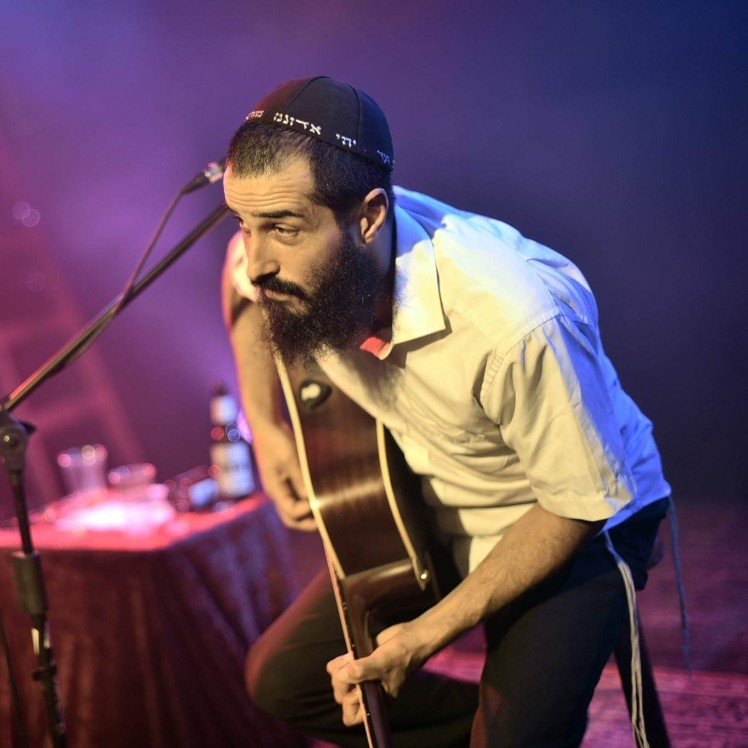 Photo: Gonen Shmer
Made in Israel
“During that time I continued learning and growing, and eventually I began releasing my own independent music. The first song I released was called ‘Ad Eilecha,’ and more recently I released ‘The Nothing, The Being, and The Eternal’ together with David D’Or, inspired by my yeshiva learning.
“Since leaving the band I have released several songs, and now I am gathering them together into one album. The album will even be sold in a unique way — buyers will receive a branded wine bottle with a link to download the album.
“I also perform now on the Eilat boardwalk, and we are planning several quiet desert shows soon. In addition, I have a recording studio where I produce my own music and also for others. Over the years I realized how expensive music production is, so I invested in equipment and learned recording and mixing. People sometimes come for two or three days — and leave with several songs. It is fascinating. Who knows what kindnesses and spiritual awakenings God has hidden for us.”
A dollar for a bride
“When I entered the yeshiva in Ramat Aviv, a friend asked me if I had a dollar from the Lubavitcher Rebbe. When I told that I didn't, he gave me one from his pocket and told me that our agreement was that I return it to him when I get engaged. On the dollar it was written: ‘Received from the holy hand of the Rebbe on Monday, eve of 25 Marcheshvan 5751.’
“Three years later I met my wife, Pninit Chen. After our second date I suddenly received a message from that same friend asking me to return the dollar. I immediately understood that its mission was complete — and that, God willing, she would be my wife. I returned the dollar to him at our engagement — which took place on the 26th of Marcheshvan, exactly 30 years after the Rebbe first gave it. How great are Your deeds and kindnesses, God.”

