

Magazine
Udi Damari: From Behind-the-Scenes Hitmaker to Soulful Jewish Music Creator
The inspiring journey of a leading Israeli producer and composer
- Avner Shaki
- | Updated
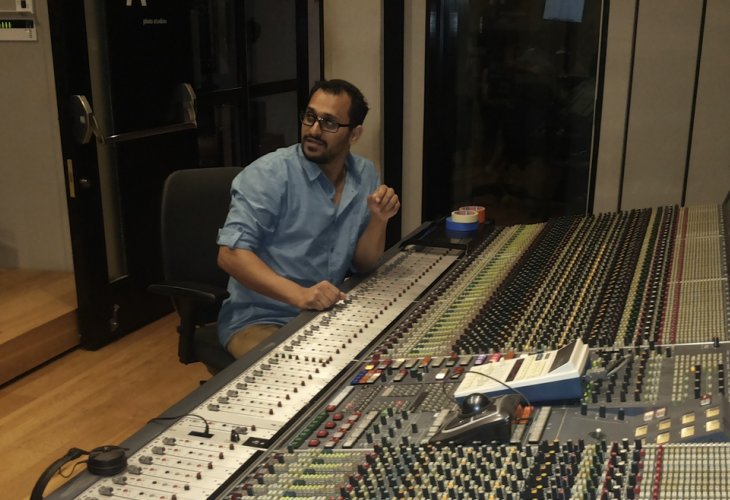 Udi Damari
Udi Damari is married and a father of two. Musical producer, songwriter, composer, and arranger. His clients include Avraham Fried, Yaakov Shwekey, Chaim Israel, Yaniv Ben-Mashiach, Benny Friedman, Avishai Eshel, and many other artists.
Professionally, are you where you imagined you would be?
“I don’t really plan my life. I just let it happen, and hope that the creativity will only continue to grow and flourish. For many years now I’ve been writing, composing, and arranging songs, and then selling them to well-known singers in the music industry. At the first stage I record a demo version and sing it for them, so they’ll know how to perform the song — and almost always the singers tell me that my version feels the most authentic and moving. By the way, my wife and kids think so too. It makes sense — the person who felt the song, thought about it, wrote it, composed it, played it, and arranged it — there’s a good chance he’ll perform and deliver it in the truest way.
“Beyond that, I launched a personal musical project in which I perform the songs myself, in different and varied styles. Thank God I sing well, so I decided to perform several songs and bring them together into one project, in which I present myself, Udi Damari. I don’t really have a way to define the musical style of this project, because it is very diverse — in the lyrics, in the melodies, in the arrangements, and in the singing style.
“People from the industry, and also PR professionals who heard material from the project, told me that I have to focus and build one consistent style so as not to confuse the audience. I didn’t follow that advice — because I truly am not ‘one-style’. Just like I write songs for Avraham Fried that suit him, and also for Yaniv Ben-Mashiach songs that suit him, or produce a large Yiddish album — and all of these come from me, so too, within me there are many styles, and they came to expression in my personal project.”
A childhood story that has stayed with you?
“I had a very musical childhood. Already as a very young child I had a small cassette player in my room, and I would listen on loop to four tapes of foreign singers. When I was seven, I took part in a Chanukah party, and one of my relatives was playing the accordion. Its sound touched me immediately, so I sat beside her and watched her play.
“After a few minutes I asked her to let me try. The accordion was very heavy, so I suggested that I’d press the keys. That was basically how I started playing, with no preparation or practice; it just flowed out of me. My mother, in her wisdom, sensed my love for music and the hidden talent, and the very next day she bought me my first keyboard. Since then — thank God, I’ve never left music.”
A figure from the Jewish world who inspires you?
“My grandfather, Rabbi Shlomo Damari. He was the regional rabbi of Mateh Yehuda and a respected and beloved figure among Yemenite Jews in Israel and around the world. My grandfather was a simple Jew and an immense Torah scholar who never sought honor or status. When he sang Shabbat songs at the table, it felt like a taste of the World to Come. I remember so clearly his love for melody. He truly sang for the sake of Heaven. Sometimes I recall his tunes and it tears my heart in two. I haven't seen such devotion and love for God expressed through song in anyone else in my life.
“Because of that, a picture of my grandfather always stands in front of me in the studio. I never forget where I came from or what my roots are. A very significant part of my musical life I received from him. And no matter whether today I create pop, jazz, rock or Middle Eastern music — the core idea of doing it truthfully and correctly, as I hope I do, comes from the powerful impression he left on me.”
Tell about a meaningful experience you had through a mitzvah you were able to do
“Until a few years ago I had a 1996 Suzuki Baleno. The car had a cracked engine block and many other problems. On top of that, I wasn’t the best at maintaining it. I hardly checked water or oil — only during late services or when strange noises started coming from the car. Even the fuel gauge was usually on the red line.
“Because of all this, there were at least four incidents where the car stopped in the middle of driving. I’d check and discover there was no water in the radiator or tank, or no oil in the burning engine, and so on. It’s not that I wanted to neglect it, but the car was in bad shape, and honestly, so was I. At the time I was finishing the construction of my house and I was just waiting for the car to ‘die’.
“My mechanic couldn’t understand how the car kept going. He said that logically it shouldn’t be possible. And truly, no one understood. Except me. I knew the secret: that car didn’t stop doing mitzvot. Acts of kindness, kindness, and more kindness. For example, several times a week I would drive elderly Torah scholars to and from the grocery store — and the blessings I received from them I will never forget. That car also made many trips to graves of tzaddikim, and I distributed many Torah booklets and pamphlets across the north, Jerusalem, and other places — without hesitation, full of faith that God was with me.
“After more than ten years of this ‘faithful service’ with the old car, I decided to buy a new one. I barely managed to sell the old one for scrap — but the value of the mitzvot I merited to do with that car cannot be measured. Even if I were given every car in the world, it would be only a drop in the ocean of eternity. There is no limit to the reward of a mitzvah — especially mitzvot of kindness.”
What are your dreams?
“I dream of creating positive change in people’s lives around the world — through my words, melodies, arrangements, and performances in my personal project, and also through the music I create for other artists.
How present is God in your life, and in what way does that influence what you do?
“Very present. Most of the day I speak with God — literally. Since most of my clients live abroad, I spend much of the day alone in the studio, and I’ve become accustomed to talking openly with God about everything — even the smallest details. Beyond that, hitbodedut (personal prayer) is a way of life for me.
“I have never thought, and still do not think, that lyrics, melodies, or arrangement ideas come from me or from my intellect. I feel that I am simply an empty vessel that benefits from the infinite divine abundance that passes through me. Since I have no formal knowledge of music theory, it is actually very easy for me to live with that perspective.”
What makes you happiest?
“Hearing that one of my songs has made a positive impact on someone. For example, the song ‘Melech HaOlam’ (King of the World), which I wrote, composed, arranged, and sang as a duet with Chaim Yisrael, reached almost every home in Israel and many radio playlists. The song speaks about God’s presence in the world, and I was so happy to hear that children in secular schools were singing and dancing to those words — which come from the Zohar and Chazal.
“Another powerful example is ‘The Tikkun HaKlali — Special Melody Version’, ten chapters of Tehillim that Rabbi Nachman of Breslov compiled — which I arranged and recorded in a Jewish style for singer Erez Yechiel. This work gained worldwide exposure and suddenly I started receiving a flood of calls: ‘Thanks to the melody you created, I took upon myself Torah and mitzvot.’ There is no greater happiness than that.”
Something you’d want people to know about you that they don’t know?
“I don’t know how to read music, I don’t know chords, and I have absolutely no idea about music theory. A few years ago I wrote a full musical production for a huge show in New York, in front of 18,000 people. An American band performed there, and they wanted sheet music. I couldn’t write it for them — because I have no idea what do-re-mi is.
“I didn’t know what to do, so I went to one of the most talented musicians in Israel, Chaim Hadad, to write the notation for me. He asked who wrote the compositions, and I explained that I arranged and played them, and only needed him to write them in musicians’ language. He was amazed — but I wasn’t. I told him that to create music you don’t need notation or intellect — you need to feel it.
“I also told him that in the book of Bereishit it says: ‘Yuval was the father of all who play the harp and flute.’ Meaning — he was the first musician in the world, and he surely played beautifully — but nowhere is it written that he had a music teacher. He received the talent, connected to the root, and simply played.
“I’m not against learning music, but I believe that anyone who wants to truly play must first connect to their inner spiritual root. That is my life’s work — and every day I pray and try to rise higher and connect to the root of everything — our Father in Heaven, the King of Kings, the Holy One, blessed be He.”

