

Beginners Guide
The Tabernacle: A Dwelling Place for the Divine
Built in the desert and carried from place to place, the Tabernacle stood at the heart of Jewish life. Discover its purpose and meaning.
- Tzuriel Gvizon
- | Updated
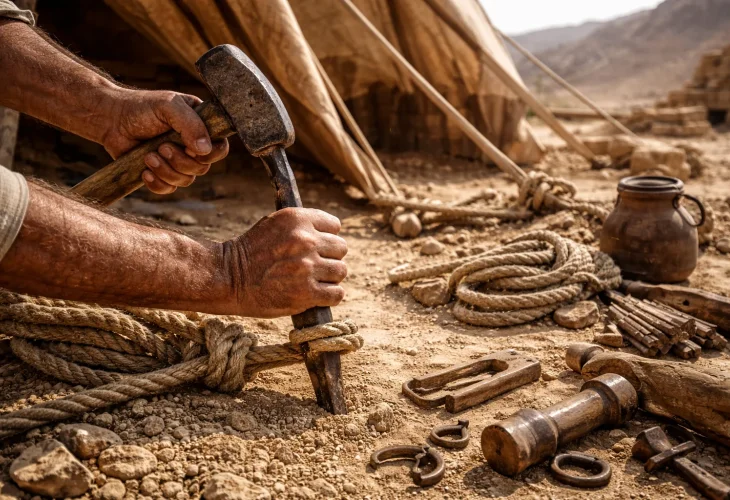
After the giving of the Torah, the Jewish people were commanded to create a physical space where Hashem’s presence could dwell among them. This space was not meant to be permanent or fixed in one location. Instead, it would accompany the nation throughout their journey in the desert and beyond. This sacred structure was known as the Tabernacle.
The Tabernacle, also called the Ohel Moed, was a portable sanctuary established by the Children of Israel while they traveled through the desert. It served as the spiritual center of the nation and was carried with them wherever they went.
Through the Tabernacle, Hashem communicated with Moshe, accepted offerings from the people, and allowed His presence to rest among Israel.
Who Built the Tabernacle?
The Tabernacle was constructed by skilled artisans described in the Torah as “every-wise hearted man,” meaning individuals blessed with both talent and spiritual insight. The work was led by Betzalel ben Uri and Ahaliav ben Achisamach, who followed Hashem’s instructions precisely, as outlined in the Torah portion.
Their craftsmanship reflected not only technical skill but deep intention and devotion.
A Place of Miracles
Many miracles were associated with the Tabernacle. One example taught by the sages involves the tachash, a colorful creature that existed only during that time whose hides were used for the coverings of the Tabernacle. After the construction was complete, this creature disappeared from the world.
These miracles emphasized that the Tabernacle was not an ordinary structure, but a divinely guided one.
The Tabernacle at the Center of the Camp
The Tabernacle was positioned at the center of the Israelite camp. Surrounding it was the camp of the Levites, who were responsible for its care and service. Beyond them were the remaining tribes, forming the outer camp of Israel.
This arrangement reflected spiritual order, with holiness at the center of national life.
The command to build the Tabernacle was given to Moshe while he was on Mount Sinai, even before receiving the Tablets of Testimony. This teaches that creating a dwelling place for Hashem was an essential part of the covenant from the very beginning.
Materials and Levels of Holiness
The construction of the Tabernacle required many different materials, including metals, fabrics, and precious items donated by the people. The Torah’s descriptions reveal an important principle: the closer one comes to the inner areas of the Tabernacle, the higher the quality of the materials.
In the Holy of Holies, the most sacred space, gold was the primary metal used, aside from silver bases for the boards and columns. In the Holy Place, the materials were slightly less precious. In the courtyard, copper was the main metal used, with silver appearing only in limited structural elements such as hooks and clasps.
This progression expressed increasing levels of holiness.
The Tabernacle After Entering the Land of Israel
After the Israelites entered the Land of Israel, the Tabernacle continued to serve as the central place of worship. It was first set up in Gilgal for fourteen years. Later, it stood in Shiloh until its destruction, and afterward it was relocated to Nov and then to Givon.
Only later was it replaced by the permanent Temple in Jerusalem.
The sages teach that the thirty nine categories of prohibited labor on Shabbat are derived from the types of work used to build the Tabernacle. This connection teaches that just as creative work built a space for divine presence, refraining from that work on Shabbat allows holiness to enter time itself.
The Lasting Message of the Tabernacle
The Tabernacle teaches that Hashem desires to dwell among His people, not only in a physical structure but within their lives. Through care, intention, and holiness, even a temporary space can become a dwelling place for the Divine.

