

Magazine
How Many Jews Are There in the World? Assimilation, Growth, and the Future of the Jewish People
From Holocaust survival to global Jewish demographics, a leading Israeli researcher explains current Jewish population numbers, the impact of assimilation, and why Orthodox communities are reshaping the future map of world Jewry
- David Fried
- | Updated
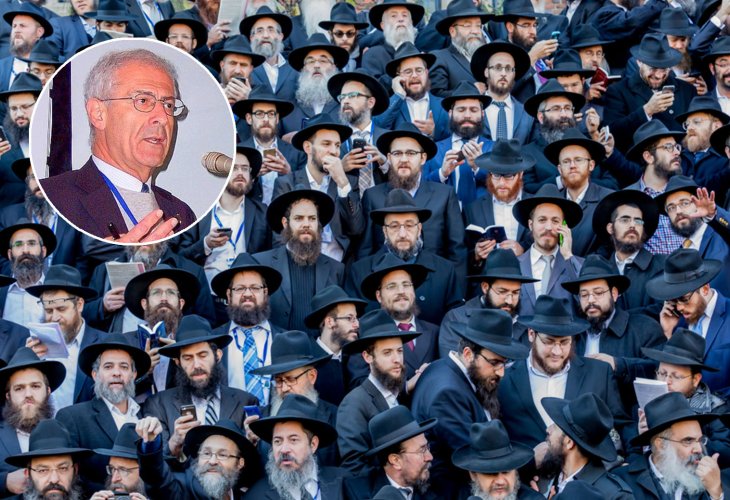 Inset: Sergio Della Pergola (Photo illustration: Shutterstock)
How many Jews are there in the world? How many have we lost through assimilation? What will the size of the Jewish people be in a few decades?
Professor Sergio DellaPergola, an Israeli statistician and demographer, expert on the demography of Jewish communities worldwide and professor emeritus at the Institute of Contemporary Jewry, shares a fascinating, eye-opening conversation.
Childhood in Wartime Italy
Professor DellaPergola was born in 1942 in a picturesque Italian town near Milan. The man who would later become famous throughout the Jewish world as the numbers expert of the Jewish people was born at a time when the Jewish nation was shrinking – during the horrors of the Holocaust.
At that time, Mussolini, Hitler’s ally, ruled his homeland.
“The fear was always in the air,” he recalls. “My father and mother were fired from their jobs because of the racial laws. Because of that, they had to fight for every slice of bread and bit of food. At a certain point, my parents decided to take advantage of the fact that Italy borders neutral Switzerland and flee the country that had become home for the fascists.”
His parents took little Sergio and rushed to leave their home.
“It was during Chanukah,” DellaPergola recalls from his home in Jerusalem. “Good people helped my parents along the way until they reached Switzerland, carrying me in their arms. During Chanukah, Christians celebrate their holiday, and that detail turned out to be very significant for the success of their escape,” he notes.
A Miraculous Escape to Switzerland
The escape itself took place on a freezing night. The parents and their baby had to go along rough, unmarked paths, making their way through the high mountains that mark the border between Italy and Switzerland, wading through snow that soaked them to the bone.
“My parents had to reach a valley that still today serves as the border between Italy and Switzerland. To do so, they relied on four non-Jews who were later recognized by Yad Vashem as Righteous Among the Nations. These non-Jews helped them hide and cross the border through unofficial routes. Then came the moment they feared most, when a patrol of Swiss soldiers stopped beside them with screeching brakes.
“At that time, an order had just come down from the capital, Bern, not to allow any more Jews into Switzerland. On the soil of the neutral country there were already about thirty to forty thousand refugees, and the authorities decided not to accept any more Jews.
“The Swiss told my parents politely but firmly: ‘We’re sorry, but you must go back to Italy.’ But the choice they faced was cruel. If they went back to Italy, they would not remain alive and would be executed on the spot. My parents obviously begged for their lives, and the soldiers decided to ask the captain. The captain, in turn, called headquarters, where he was told that, in honor of the Christian holiday, the refugees would be allowed in. So, by a miracle, my parents were saved from death.”
With obvious pain, the professor adds: “I also know of cases of Jews who reached the Swiss border from Italy or France and the Swiss police told them, ‘We have no room – go back,’ and they had to return and were killed, unfortunately.”
Surviving the War with Help from Above
The DellaPergola family was surrounded by remarkable divine providence that continued to accompany them throughout the darkest period the Jewish people had known in many centuries.
At the beginning of that winter, they were able to receive food from a ration that the Swiss government distributed to Jewish refugees, and so they managed to live in relative peace.
True to his nature as a researcher who spent most of his life conducting groundbreaking studies, DellaPergola did not rest until he investigated his parents’ time in Switzerland. He indeed found, in the local police archives, a copy of their interrogation.
“I also have in my hands a rather chilling document from the time we were in Milan, Italy, before the escape to Switzerland,” he says, “in which my parents are informed that they can receive a food allocation every few weeks, including flour, oil, and sugar, stamped officially by Mussolini’s government. Next to the notice, it states that they belong to the Jewish race. It’s very possible that if a patrol had met them in the street and demanded to see that paper, they would have been deported straight to Auschwitz.”
From Italy to Jerusalem – Academic Path and Recognition
DellaPergola immigrated to Israel in 1966 after earning a master’s degree in political science from the University of Pavia in Italy, and in 1973 he received his doctorate from the Hebrew University.
In 1999 he received the Marshall Sklare Award from the Association for the Social Scientific Study of Jewry for his unique contributions and achievements. In 2013 he received the Landau Prize for Science and Research.
In his research, DellaPergola has focused on:
the demographic history of the Jews,
the Jewish family,
Jewish migrations and their absorption in Israel and Western countries,
population projections for the Diaspora, Israel, and Jerusalem,
and the quantitative aspects of Jewish education.
In the 2000s he was among those responsible for preparing the annual assessment of the state of the Jewish people for the Jewish People Policy Institute. On these topics he has written and edited more than 30 books and monographs and over 100 articles.
Personal Story as Motivation for Demographic Research
Professor DellaPergola’s personal background became an important factor in the young student’s later interest in Jewish life around the world. His family’s journey sharpened in him the deep value of preserving a persecuted people.
“This fact, together with my desire to see the Jewish people alive, led me to study the Jewish world in recent decades. I did this, among other ways, through travels all over the world. I always say I had the privilege of being called up to the Torah on five continents,” says DellaPergola.
Assimilation: A Long-Standing Process
The key question when discussing assimilation and the number of Jews is: what is the scale of assimilation? Is the feeling correct that there has been a jump in the number of assimilated Jews worldwide?
“Unfortunately, assimilation has existed for many generations,” DellaPergola answers. “There were Jews in ancient Alexandria, and they disappeared. There were many Jews in the Middle East who disappeared during the medieval period and before; throughout the generations, Jews converted to Islam and Christianity, in many cases because of persecution and hardship.
“However, even in the modern era, and especially in the last 150 years, assimilation has become a real plague, mainly in Western countries – first in Europe and then in the United States.”
“This process, in which Jews drift away from tradition and disappear from the Jewish people, happens in parallel with an opposite trend, seen especially among the Orthodox public, which preserves Jewish tradition and thus greatly helps keep the Jewish people alive.”
DellaPergola, who is not religious, adds after a moment’s thought: “There is no doubt that this path has proven successful in protecting the wholeness of the Jewish people.”
Reform, Conservative, and Unaffiliated Jews in the U.S.
By contrast, among Reform Jews there is a growing trend of assimilation.
“There is no doubt that assimilation among Reform Jews is especially widespread. At the same time, as I said, assimilation has always existed; Reform is not necessarily the only reason for the assimilation of American Jews. The Reform movement, according to its own claims, tried to create a compromise – to draw closer to the nations of the world through ‘various concessions’ – and so left many Jews in what I call a ‘middle state’: between Judaism and Christianity,” he explains.
“Over the last few decades, Reform has become popular among many American Jews, so that today, objectively speaking, the relative majority of Americans who answer surveys saying they are Jewish associate themselves with the Reform movement. In numbers, that is a bit more than a third.
“The Conservative movement, which goes less far than the Reform and sees Reform as too easy a religion, is identified with about 18% of the Jewish population in the U.S. However, the Conservatives are constantly shrinking. Most of their members leave for Reform or disconnect completely from Jewish life, and a small part moves to the Orthodox community – which also happens.
“Another roughly third of American Jews define themselves as not belonging to any denomination, and they too are assimilating at tremendous speed.”
A completely different picture emerges among God-fearing Jews, the Orthodox community in the U.S., who continue to preserve Judaism in its authentic form. According to DellaPergola, the number of Haredi and religious Jews in the U.S. is small compared to other movements, a bit more than 10% of all Jews in the country.
How Widespread Is Assimilation in U.S. Jewry?
“The Jewish group that does not identify with any denomination is being lost to the Jewish people at the highest speed,” he explains. “Reform Jews are moving in a similar direction, but more slowly. By contrast, in places where Jewish values are passed on to the younger generation, the trend is completely different.
“Overall,” DellaPergola notes, “assimilation in the Reform and Conservative communities together, with the understanding that assimilation among Conservatives is somewhat lower, stands at about 60% (!).”
How Many Jews Have Been Lost to Assimilation Since the Holocaust?
In contrast to various estimates that have spoken of millions of Jews lost to assimilation, DellaPergola estimates the number at around 600,000.
“That’s about a tenth of the Jewish community,” he says.
According to him, “The extensive assimilation among non-Orthodox Jewish communities has a very strong impact on the size and future of the Jewish community in the United States.”
“The Jewish people are constantly losing Jews who disappear through assimilation. Leading the way, as noted, are Jews who do not affiliate with any denomination at all.”
DellaPergola describes the situation of these unaffiliated Jews as “a faucet that pours water into a tub, and the water flows straight out the other side.”
“The situation is not very different among Reform and Conservative Jews, where there is also a slowdown in the number of Jews, even if the figures are somewhat lower.”
The Future of American Jewry
“As part of my work we mapped the Jewish community in the U.S. and tried to project the next few decades. The picture is not good: the number of Jews in the U.S. in a few decades is expected to be smaller by a few hundred thousand than the number of Jews there today.
“If we look more deeply at the data, the Reform community will manage to hold on more than the Conservative community, but obviously it is not expected to grow either,” he explains.
DellaPergola notes that the reason the overall Jewish population in the U.S. will remain as large as it does is that in 30–40 years, most of the American Jews alive today will still be living.
The good news comes from the other side of the Jewish map in America, from those who guard the flame of tradition. There, the picture is completely different.
“In about fifty years, the Orthodox community will be double what it is today,” DellaPergola estimates. “They will number about one and a half million people. So, compared to the current situation, in which the Orthodox community makes up about 10% of American Jewry, in the not-too-distant future the Orthodox will be about 20% of the Jewish community in the U.S.
“The reasons are: high natural growth, no intermarriage, and strong Jewish education, which allows this community to preserve itself and grow. Already today,” he notes, “the percentage of Orthodox Jewish children is approaching about 30% of all Jewish children in the United States.”
“Overall,” he sums up the American chapter, “despite the natural growth among the Orthodox public, the shrinking of the rest of the Jewish population will lead to the loss of about half a million Jews, according to estimates.”
Europe: Assimilation Slowing Down
While the situation in the U.S. – apart from the Orthodox community, is not very encouraging, in Europe, the continent that led the trend of assimilation during the Holocaust era, a slowdown in assimilation can now be seen.
“In Europe, there are differences from country to country,” says DellaPergola. “Unlike in the U.S., where the majority society has been more friendly to Jews – and therefore they assimilated into it – in Europe prejudice against Jews is more blatant. That’s why European Jews are more closed off and more defensive.
“Even though there are assimilated Jews in Europe, the numbers are relatively low. For example, in France and England there is very little assimilation, and in Italy it almost doesn’t exist.”
According to the veteran Jewish demographer, “Anti-Semitism in Europe has effects beyond limiting assimilation. It causes a surprising effect: some assimilated Jews, who are pressured by anti-Semitism, feel a need to ‘come home’ and return to the Jewish community.
“This happens because, despite assimilating, they still face anti-Semitism to one degree or another, as the environment continues to see them as Jews – based on their family name, their profession, or personal knowledge – and this pushes them back to the Jewish people. You can say that in recent years, assimilation in Europe has basically come to a halt,” he adds.
Israel: The Largest Jewish Community and a Stable Majority
Thousands of kilometers away, in Israel – which now has the largest Jewish community in the world, the situation is fairly encouraging.
If in the past the U.S. held the title of the world’s largest Jewish center, the extensive assimilation among young Reform, Conservative, and unaffiliated Jews led to a historic turnaround in the last decade.
“In the State of Israel, the situation is that about 75% of the population is Jewish, and another roughly 5% are people who define themselves as Jewish but are not halachically Jewish – immigrants from Eastern Europe who came under the Law of Return. This situation is not expected to change even in the next fifty years,” he estimates.
How Will Jews Maintain a Majority in Light of Arab Population Growth?
The reason, it turns out, is again the community of those who keep Torah and mitzvot, which is growing significantly relative to all other groups.
“The Haredi community is growing very quickly, much faster than the general Jewish population,” DellaPergola explains, “and this is the reason the Jewish majority in the country will be preserved. It’s also what maintains the demographic balance between Jews and Palestinians.”
He bases this, among other things, on data from Israel’s Central Bureau of Statistics.
“Today, Haredim are about 10% of the Jewish population in the country, and that figure will grow. In numbers: among school-age children (under 18), Haredim currently make up about 20% of the population. By 2050, Haredi children are expected to be about 38% of all Jewish pupils in the school system.
“This will have very significant implications for the education system and for the distribution of schools across the country.
“In total: the number of children in Israel will grow by about two million. The breakdown of that increase will be:
64% will be Jews,
of whom only 26% will be non-Haredi Jews;
10% will be Arabs, who will grow at a rate similar to that of the general population and will continue to constitute about 20% of the total population.
“In about thirty years, the Haredim will outnumber the Arabs, in contrast to the current situation in which the Arab population is double the Haredi population.”
A People That Continues to Live
Decades after the DellaPergola family escaped the Nazis and their collaborators during the years of the great slaughter, the Jewish people continues to thrive across the world and, according to all projections, is expected to continue flourishing far into the future.

