

World News
Maduro Arrives in New York to Face Narco-Terrorism Trial
Captured in a U.S. military operation, Venezuela’s longtime ruler is jailed in Brooklyn and awaits arraignment on federal drug and weapons charges
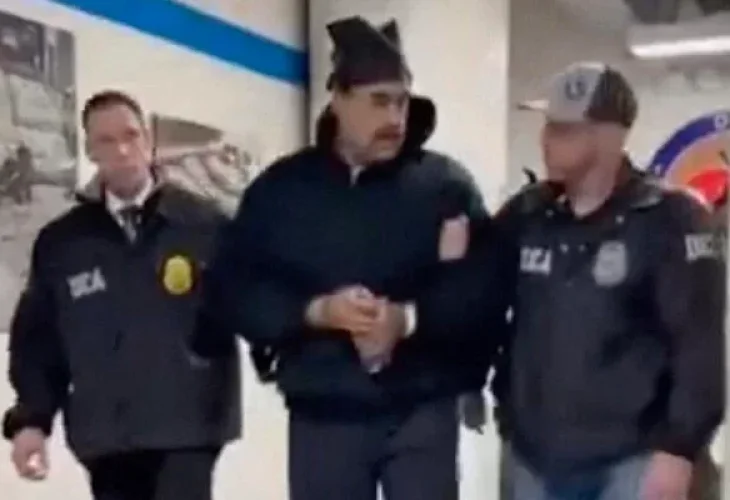 Maduro arriving in Brooklyn (Screenshot)
Former Venezuelan ruler Nicolás Maduro arrived in New York on Saturday after being captured by U.S. forces in Caracas, where he is now in federal custody facing narco-terrorism and weapons charges.
Maduro’s transfer places him directly into the U.S. criminal justice system, where prosecutors accuse him of running a state-backed drug trafficking network for years. He is expected to appear in federal court as early as Monday, a rare case in which a former foreign leader is prosecuted on U.S. soil for alleged narco-terror activity.
Maduro and his wife, Cilia Flores, were seized during an overnight U.S. military operation at their compound in Caracas early Saturday morning. After being taken into custody, Maduro was held aboard the USS Iwo Jima, where he was photographed handcuffed and blindfolded before being flown out of Venezuela.
The plane carrying Maduro and Flores landed at Stewart Air National Guard Base in Newburgh, New York, just before 5 p.n. From there, they were transferred under heavy law enforcement escort to Manhattan. Maduro was taken to the Drug Enforcement Administration headquarters in Chelsea, where he was processed by federal authorities.
Footage released by the White House showed Maduro walking through the DEA facility in handcuffs. As he was escorted by agents, he briefly addressed those around him, saying, “Good night, Happy New Year.”
Later Saturday evening, Maduro was transferred by helicopter and armored motorcade to the Metropolitan Detention Center in Brooklyn, where he is expected to remain pending his initial court appearance. The confinement status of Flores was not immediately clear.
The Metropolitan Detention Center in Brooklyn is New York City’s only federal jail and is known for holding high-profile defendants facing serious federal charges. The facility has repeatedly drawn public attention for its strict conditions and past criticism over detainee treatment.
Federal prosecutors in New York say Maduro led a narco-terror network, charging him with conspiring to traffic cocaine into the United States and illegally possess heavy weapons. The indictment alleges he used the power of the Venezuelan state to protect and support large-scale drug trafficking.
U.S. Attorney General Pam Bondi said the charges follow years of investigation into what prosecutors describe as a criminal network operating from the highest levels of government. “They will soon face the full wrath of American justice on American soil in American courts,” Bondi wrote.
The new indictment builds on cases filed in 2020 and now also names Maduro’s son, Nicolás Maduro Guerra, two former Venezuelan interior ministers, and the leader of the Tren de Aragua criminal group. Prosecutors say the network worked with major Colombian and Mexican drug cartels to move large amounts of cocaine toward the United States.
Outside the Brooklyn detention center Saturday night, hundreds of Venezuelan opponents of Maduro’s regime gathered as word spread of his arrival. Demonstrators shouted chants of “Down with the dictator” and “Shame on you,” celebrating what they described as the downfall of a leader they blame for years of repression and economic collapse.
In Caracas, Venezuela’s vice president, Delcy Rodríguez, condemned the U.S. operation in a televised address. She rejected U.S. claims about a smooth political transition and said Venezuela “will never return to being the colony of another empire.” Rodríguez also called for proof of life for Maduro and Flores and demanded their release from U.S. custody, while leaving the door open to what she described as “respectful relations” with Washington.
U.S. President Donald Trump said Saturday that Washington expects cooperation from Venezuelan officials and claimed the U.S. would temporarily oversee Venezuela’s transition. He said Rodríguez had spoken with Secretary of State Marco Rubio and would “do whatever” the U.S. required. Venezuela has not confirmed that Rodríguez has been sworn in as president, and her current location remains unclear.
U.S. Defense Secretary Pete Hegseth said the operation was a law enforcement action and stressed that Washington would not decide Venezuela’s future alone. “What happens next will be in the hands of Venezuelans to decide,” he said, adding that “you don’t get peace in this dangerous world without strength.”

