

Parashat Haazinu
A Widow's Strength: Remembering Ori Shani
The heartbreaking heroism of Ori Shani, a Golani commander, unfolds through the memories of his wife, Miriam. Even amidst battle, his care for his soldiers and family shone through.
- Moriah Luz
- | Updated
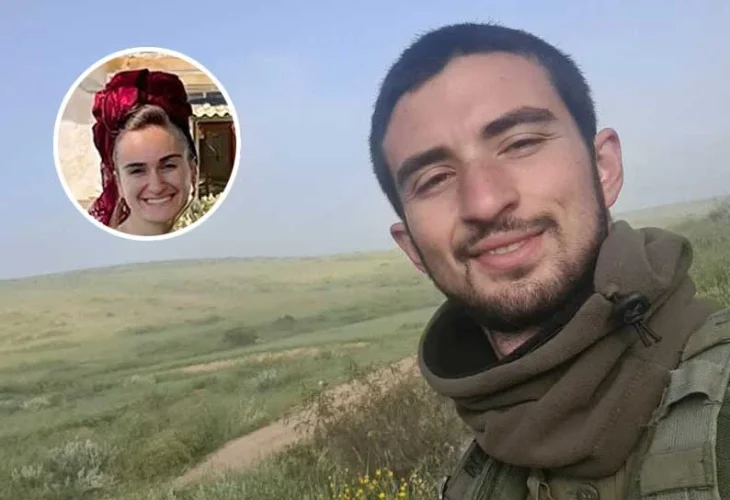 Ori Shani, of blessed memory. Inset: His wife, Miriam Shani
Every morning at roll call, Ori Shani z”l would repeat the same warning to his soldiers. “Do not trust the calm on the border. One day they will break through the fences, and there will be a massacre in the kibbutzim.” His widow, Miriam, recalls how often he shared with her the frustration he felt about what was happening beyond the Gaza border. He watched the boldness with which Gazans approached the fence, confident that nothing would happen to them. Ori repeatedly said that if something were to occur, the IDF was not prepared.
As a platoon commander in the Golani Brigade, Ori trained his soldiers for the worst possible scenarios long before the massacre. On the day of the attack itself, they fought with remarkable determination and courage, saving many lives.
Endless Encounters
Ori and Miriam married when they were both twenty one years old. They were married for only a year and a half before he fell in battle. Their son Roy was about four months old at the time.
“There was something special about Ori,” Miriam says. “A kind of magic. Light on his face and a smile that captivated everyone around him. It was no coincidence that his name was Ori.”
Although Ori returned home only once every two weeks, Miriam says he shared a deep bond with their infant son. “He would not leave him for a moment. He cared for him completely and with great love. Ori would bathe Roy and play with him. They had so many photos together that I created an entire album, even though Ori was hardly ever home.”
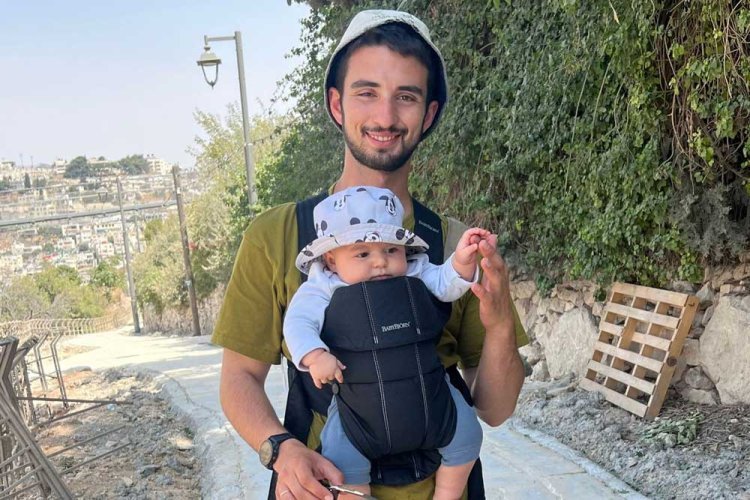 Ori Shani z"l with his son, Roy.
A Final Meeting
On Thursday, two days before Simchat Torah, Ori asked Miriam if she could come visit him near the base where he was serving. Miriam traveled from their home in Kiryat Arba to Kibbutz Kisufim. That visit would be their last.
“We sat together with Roy in the kibbutz, and everything felt peaceful and beautiful. Not for a moment did we imagine that war would break out the next day. I am grateful for that time together. Just before we got into the car, Ori blessed Roy with Birkat HaBanim. Today I regret not taking a photo, but that moment is deeply engraved in my memory.”
Simchat Torah Morning
On Simchat Torah, when reports began to surface about a major incident in the south, Miriam was not worried about her husband. “I was completely certain that Ori was fine and that nothing would happen to him. He always projected calm, confidence, and authority. I felt sure that if it was happening in his sector, everything would be under control.”
What actually happened to Ori was very different.
In the early morning hours, Ori and five of his soldiers went out on what was meant to be a routine patrol near the fence, known in the army as dawn readiness. We now know that earlier that morning, an order had been issued to all soldiers in the sector prohibiting them from approaching the fence, due to intelligence indicating that terrorists were conducting a drill nearby. Tragically, that order never reached Ori.
At 6:29 a.m., as a barrage of mortars and rockets began, Ori and his soldiers exited their military vehicle. Before their eyes, swarms of terrorists poured freely into Israel through a breach in the fence not far from where they stood.
“Ori divided his force into two squads and they began fighting,” Miriam recounts, based on what she later heard from his soldiers. “At first they were encouraged by every successful elimination, but very quickly they understood the scale of what they were facing. They were in constant combat, without pause.”
According to Miriam, Ori and the five soldiers with him eliminated about thirty Nukhba terrorists. Later, numerous outgoing calls were found on Ori’s phone, including some to the Sderot police. “I imagine he did not fully grasp the magnitude of the event. They were close to the fence and may have thought it was localized. To their credit, they prevented the massacre of many people.”
Responsibility Beyond the Battlefield
Ori was focused not only on the fighting, but also on his deep sense of responsibility toward his soldiers. “Ori would always tell me that part of his role was to return his soldiers safely to their mothers. He felt accountable to the mothers who entrusted their sons to him. His soldiers later recalled that he often told them, ‘I need to bring you back safely.’”
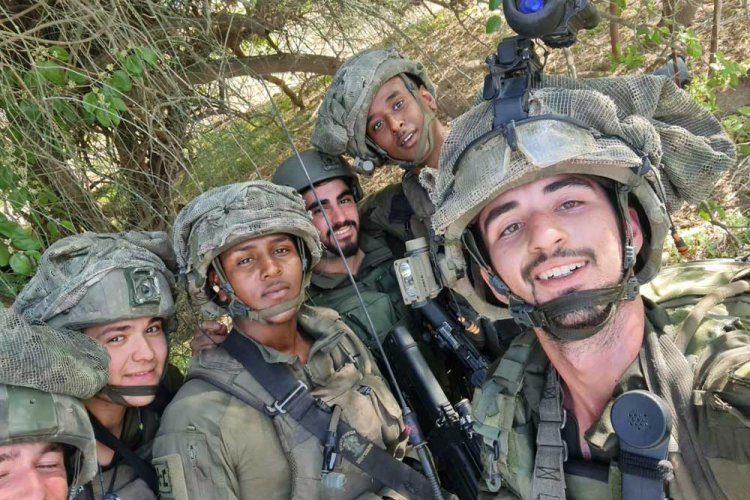 The selfie of Ori and his soldiers, taken during the fighting.
After Ori’s death, his phone was returned to Miriam. She was stunned to discover a smiling selfie in the photo gallery. Ori and several of his soldiers were pictured together, taken on Simchat Torah shortly before ten in the morning.
“We looked at it again and again to make sure the date was correct. October 7, 2023, at 9:56 a.m. There was nothing in the photo to suggest they were in the midst of intense fighting, surrounded by terrorists. Later, when we met his soldiers, they explained the story behind the picture.
“At a certain point in the fighting, they were completely exhausted. Ori sensed it. He gathered them behind a cluster of bushes and spoke to them with encouragement and strength. He reminded them of the privilege they had in defending the people and the land, and how proud their mothers would be of them.”
The photo was taken at that moment and sent to the soldiers’ mothers, both to lift the soldiers’ spirits and to reassure the worried families. Afterward, they continued fighting for several more hours.
“That same week, the mother of one of the soldiers who was with Ori called us,” Miriam adds. “She told us that her son had called her in the middle of the fighting, likely out of panic. Ori took the phone from him and calmly reassured her, telling her not to worry and that her son would return safely.”
The Final Mission
By early afternoon, after hours of combat, the soldiers’ ammunition was nearly depleted, and the six fighters were without water. Only a few bullets remained, forcing them to ration their fire. Ori decided it was time to return to the base and resupply.
“They were about five kilometers away, which is a significant distance. Ori was excellent at navigation. He had a map and carefully planned the safest route back.”
They reached the base around four in the afternoon, all six alive and unharmed. They rearmed, and Ori gave one of the soldiers his credit card, asking him to buy soda cans from the vending machine to lift morale.
“He knew there was fighting at the base as well,” Miriam explains, “but he wanted to raise their spirits a bit.” She adds with a gentle smile that the sodas were never purchased. During the fighting, the electricity went out, and the vending machine stopped working.
At five in the afternoon, after resupplying, they left the base on another mission. They advanced in pairs, with Ori and Raam Bitito leading. Another mortar barrage began.
“Ori managed to shout, ‘Take cover,’ and the soldiers did. Seconds later, a mortar landed directly next to Ori and Raam. Both were killed by the shrapnel.”
“I do not think Ori’s final words were accidental,” Miriam says. “He was someone who cared deeply about the collective, about everyone around him. Those words reflect him perfectly. Always thinking of others.”
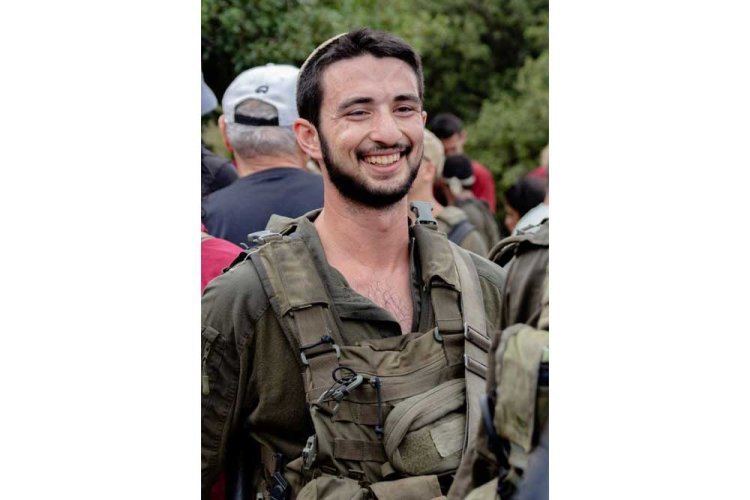 Or Shani z"l. Credit: Renana Tena
“Goodness Will Prevail”
After Ori’s death, the family received recordings from his radio. “We heard his voice, his determination, his leadership. Even the photo with his soldiers shows leadership in the midst of battle, despite being surrounded by terrorists and lacking support.”
Was this composure something she recognized in him?
“Leadership was always a defining trait in Ori,” she says. “But it was leadership at eye level, without arrogance. He was grounded, with a good spirit and a smile toward his soldiers.”
When Ori received the list of soldiers he would command, he sat with Miriam and read the entire list aloud. She was pregnant with Roy at the time. “He said, ‘From now on, besides the son we will have, we have twenty one more children.’”
Whenever Ori came home from the army, he made time for home visits to his soldiers. “Because that was our time together, I traveled with him to their homes across the country. It mattered to him to know what was happening in their lives beyond the base.”
She notes that as an officer, Ori could have delegated those visits, but he insisted on personally getting to know his soldiers.
“I always saw how much he demanded of them, and it was not easy. But in the end, they proved it was worth every moment of training. Ori demanded out of genuine love and truly believed in them. He lived to see the results of his efforts on the day of battle.”
Beyond the five soldiers who fought with him near the fence, the rest of Ori’s platoon fought fiercely in Kibbutz Kisufim. Compared to other kibbutzim, there were fewer killed and kidnapped there. “Of course, every loss is an entire world,” Miriam says. “Sadly, soldiers from his platoon also fell.”
Finding Strength
What gives her strength to cope with the loss?
“First and foremost, Roy,” Miriam answers. “Every day I thank Hashem that we were blessed with him. He forces me to keep going and not remain stuck. I feel that I grow together with him. Every milestone Roy reaches, crawling, walking, speaking, I feel that I am growing alongside him, each in my own way.”
Faith also sustains her. “I truly believe everything is precisely guided from Above. I am a small part of a much larger picture. I believe the Jewish people are going through a great process, and we are part of it.”
Does Roy recognize his father in photos?
“He looks at him and says, ‘Daddy, hero.’”
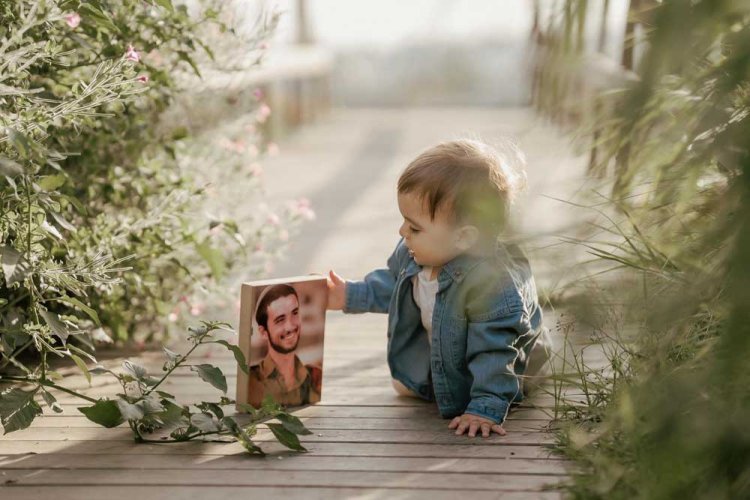 Roy with a photo of his father. Credit: Rinat Turgeman
 Miriam ends with words that continue to guide her. “Once, during a family vacation, I filmed a video, and at the end Ori said, ‘Goodness will prevail.’ I truly believe that goodness will prevail. We are part of something bigger, part of a great process. We do our best to continue with dignity despite the pain. It is not always easy, but we know this is what Ori would want.”

