

World News
Marco Rubio Outlines U.S. Priorities After Maduro Capture
Secretary of State details Washington’s approach in Venezuela, citing drug trafficking, Iran and Hezbollah ties, oil policy, and political transition
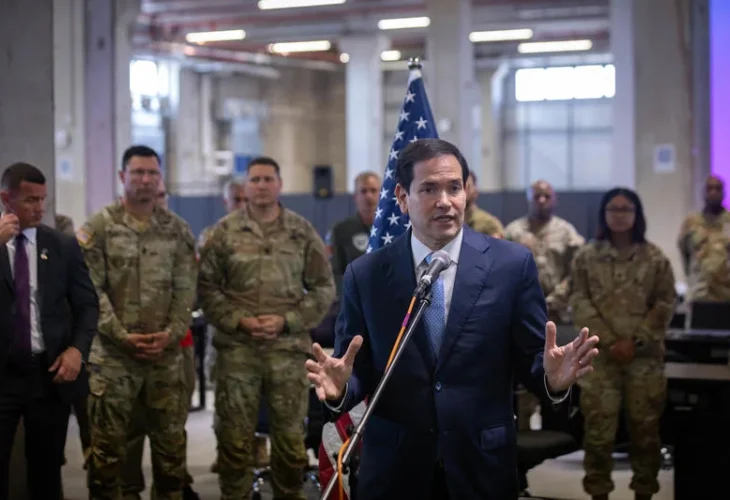 Marco Rubio (Flash90)
Secretary of State Marco Rubio said Sunday that after the capture of Venezuelan leader Nicolás Maduro, the United States is prioritizing national security, with a focus on drug trafficking, Iran and Hezbollah activity, and foreign influence in Venezuela.
Speaking on NBC’s Meet the Press, Rubio addressed a wide range of issues one day after U.S. military forces captured Maduro and his wife, Cilia Flores. Rubio said Washington’s immediate priorities center on U.S. safety and regional stability, while political transition and elections in Venezuela remain longer-term questions.
“We care about elections, we care about democracy, we care about all of that, but the number one thing we care about is the safety, security, wellbeing and prosperity of the United States,” Rubio said. “And that’s what we’re going to focus on first and foremost here.”
Early in the interview, Rubio rejected the idea that the United States is at war with Venezuela, framing the operation as a law-enforcement action aimed at transnational crime. “There’s not a war,” he said. “We are at war against drug trafficking organizations and not a war against Venezuela.”
Rubio said Maduro led a system that cooperated with drug trafficking organizations operating toward the United States. “We are at war against drug trafficking organizations and not a war against Venezuela,” Rubio said, adding that U.S. authorities would continue seizing sanctioned oil shipments and targeting drug boats under court orders.
Asked about President Trump’s statement that the United States would “run” Venezuela until a peaceful transfer of power could take place, Rubio clarified. “It’s not running, it’s running policy with regard to this,” he said, explaining that Washington intends to shape outcomes that align with U.S. interests and benefit the Venezuelan people.
A central theme of Rubio’s remarks was the presence of U.S. troops in Venezuela. “You can’t flood this country with drugs,” he said, adding, “you can’t turn Venezuela into the operating hub for Iran, for Russia, for Hezbollah, for China.” He argued that allowing such activity in the Western Hemisphere posed a direct threat to U.S. national security.
Rubio also addressed questions about elections, saying calls for a rapid vote were premature given Venezuela’s recent history. “The elections should have happened, they refused to count the votes and everyone knows it,” he said. “So all of that, I think, is premature at this point.”
On the scope of U.S. military involvement, Rubio said there are no American forces stationed in Venezuela. He noted that U.S. personnel were on the ground only briefly during the operation to capture Maduro, describing it as a limited mission lasting roughly two hours.
Turning to oil policy, Rubio clarified that Washington does not need Venezuelan oil, saying instead that the administration’s goal is to prevent U.S. rivals from controlling the country’s vast energy resources. He said the United States does not need Venezuela’s oil, but is determined to prevent it from falling under the control of rival powers. “Why does China need their oil? Why does Russia need their oil?” Rubio asked, saying the industry must not be controlled by “adversaries of the United States.”
Rubio also addressed why the United States is currently engaging with Maduro’s vice president, Delcy Rodríguez, rather than opposition leader María Corina Machado. He said Washington is focused on “the immediate reality” in Venezuela, noting that much of the opposition is no longer operating inside the country. “We have short-term things that have to be addressed right away,” Rubio said, adding that the administration is prioritizing security and stability before any broader political transition.
Looking ahead, Rubio said the coming weeks and months would focus on compliance with U.S. demands. “What happens over the next two, three weeks, two, three months,” he said, “and how that ties to the national interest of the United States” will determine Washington’s next steps.

