

Magazine
The Unseen Star of Turkish Music: Avi Cohen's Remarkable Journey
Avi Cohen's life story might resemble a Turkish soap opera, but if you ask him, he's grateful to Hashem for every moment.
- Chaim Gefen
- | Updated
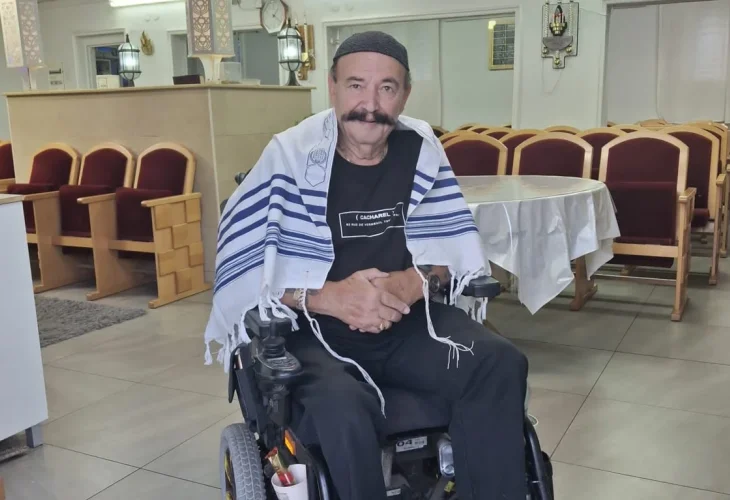 Singer Avi Cohen
Avi Cohen once leaned on crutches and used a wheelchair, yet nothing stopped him from launching a successful career. He would slowly make his way to the stage and belt out a powerful solo backed by an authentic Middle Eastern orchestra, delivering performances that wouldn’t shame even the famous Turkish singer, İbrahim Tatlıses.
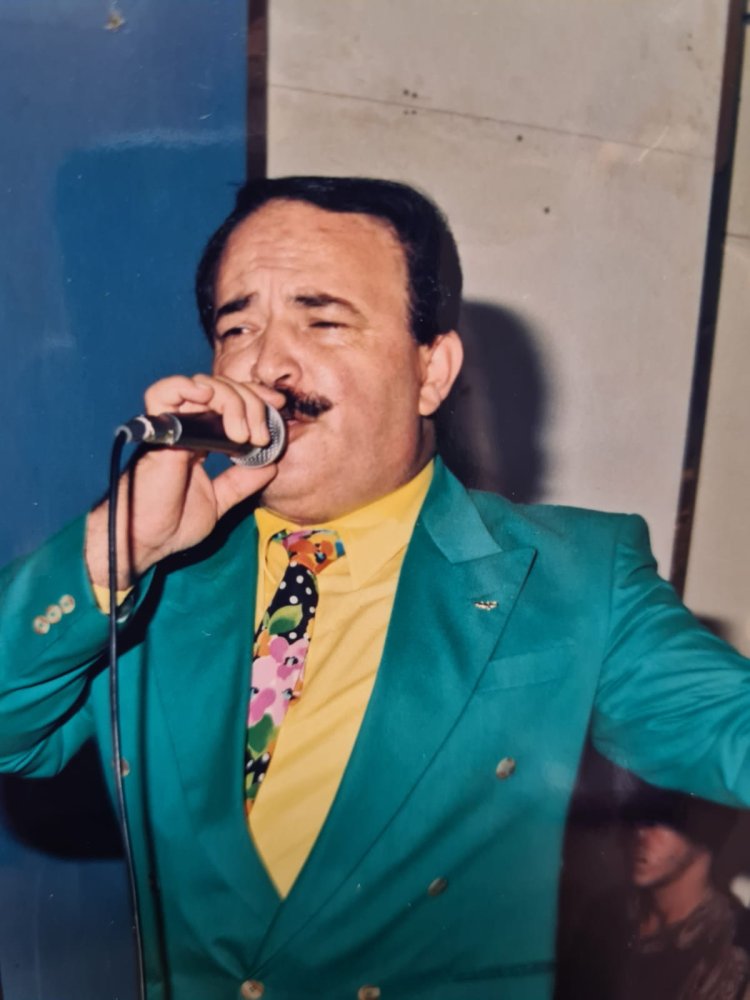
Though the name Avi Cohen might not ring a bell today, in the Israeli streets of the 1980s, his many fans dubbed him the "Star of Turkish Music." His songs became hits without the aid of publicists or media interviews, and he never shared his story publicly. "Even though they wanted to make a TV series about me," he reveals after fifty years in the music industry.
Why agree to an interview now?
"Oh, come on," he chides, "don't compare this to other media outlets. Here, I know my story can strengthen someone, give them hope."
Life in the Institution
Cohen takes a deep breath before sharing his life story. "My life revolves around polio," he begins. "It’s a cruel and dangerous paralysis that affects children. I contracted it at three months old. That's essentially the starting point of my life."
What do you remember from your childhood? Any traumatic experiences?
"Yes, many sad experiences still linger in my mind. My parents admitted me to a hospital for sick children near Shuk HaCarmel in Tel Aviv. It was like a closed institution. The area was completely fenced, and we rarely left. Only when we turned 13 did they open the gates and tell us, 'Alright, go home.'"
That's quite a shocking depiction.
"We were kids; they did whatever they wanted with us. Just in my class, three children died on the operating table. You have to understand one thing: parents back then weren't like today's. They believed every word a doctor said, and doctors exploited that, performing surgeries left and right. Doctors said I wouldn't live past age seven. Today, I'm 70 and still living."
Do you recall any good experiences from that institution?
"I remember one positive experience, and it stays with me to this day. That experience is my wife. I met her at the institution at one year old, and we've been together ever since. Out of all the hardship and pain I endured there, I have plenty to thank Hashem for: my wife and the family we've built together."
Following My Father's Footsteps
When did you decide to enter the music industry?
"I've been drawn to music for as long as I can remember, but it took me time to break out. My mother was the first performer at the Arianna club in Tel Aviv. Though my father didn't like her performing, he too was drawn to music. He used to import records from Turkey and played them in our living room. In the evenings, after he went to bed, I'd take those records and listen to them one after the other, slowly learning the language, absorbing the nuances, imitating the melodies."
Did your family push you toward a musical career?
"Surprisingly, no. My father opposed it. It didn’t sit well with him that his son would perform in clubs like his wife. One day, he even told my wife, 'If Avi starts singing, you’ll have a problem with him.'"
But you decided to go ahead anyway.
"Only after getting his permission. This happened after he had a heart attack, and I feared he might not have much time. I told my wife, 'Let’s go to the hospital, talk to him, ask for his blessing to sing.' If he had passed without granting it, I would never have sung. I would have honored his word until my death. Respecting parents was the most significant commandment to me. I'll never forget standing by his hospital bed, with the machines around, crying and telling him it was my dream. He looked at me, motioned me closer, then quietly whispered, 'Do whatever you want, I'm with you.' That was the only time I left a hospital feeling both sad and happy."
Living on Tips
Cohen began singing in his early twenties, but it wasn't yet a career. "I'd sit drinking in a club on the Bat Yam boardwalk, and between drinks, I'd take the microphone and sing. Just like that, casually. I didn’t earn a cent, but the desire to sing poured out of me. I had a few savings I’d put aside, and that's how I paid for my drinks and meals.
"Then the money started running out. I realized I couldn’t pay for my meals at the club anymore, so I stopped going. After several days at home, almost slipping into depression, I needed to unwind a bit, to return and sing in front of people. I ended up selling my wedding rings, mine and my wife's, just to get back to the club. When I realized that money was also nearly gone, it was too late: it really did run out."
Did you start understanding how dire your situation was?
"Yes, and it crushed me. One day, the most famous Greek singer at the time, Yasso Makis, called me. He had a club in Holon and invited me to come and sing. And let me be clear, I didn't earn a dime from that either. I survived on tips people threw my way."
So that's how you supported your family?
"Yes, I had no other choice. Then suddenly, a friend who had a restaurant on Allenby came and said, 'Come to me, start working.' From then, I performed there for twenty consecutive years, night after night. It was a famous restaurant, a hub for all the who's who. I recall the legendary entertainment trio Gesher HaTzar Hachai, Yaron London, and all the bohemians. One of them took a liking to me and arranged for me to perform on a show the entire country was talking about. That's when everyone began to know me. That's when I broke out."
Avoiding the Spotlight
One of Cohen's biggest hits is the song "Don't Drink More, My Friend." Over time, the song was covered by most Israeli Mizrachi singers, including Avi Bitter and Moshe Cohen. Alongside his musical career, Cohen opened a successful club in Tel Aviv. "Bitter and Cohen frequented my place in their early days."
How do you explain being the source of most Turkish songs in Israel, yet those who covered them became famous, and you didn’t?
"Because I didn't make noise. I didn’t look for it; I didn’t like it. I'll never forget the early days when I started performing. There weren't many Mizrachi singers in the market. There was me, Zohar Argov, and a few others. Even Dee Klong started later. We all sat together, performed together. I used to perform with Zohar across the country."
"I didn’t break through like those other singers because I'm a simple person. Ask anyone who knows me, that’s what they'll tell you. In Turkish, they say, 'Honor isn't bought with money.' I'm a modest man. I don't seek all the noise and spectacle around me."
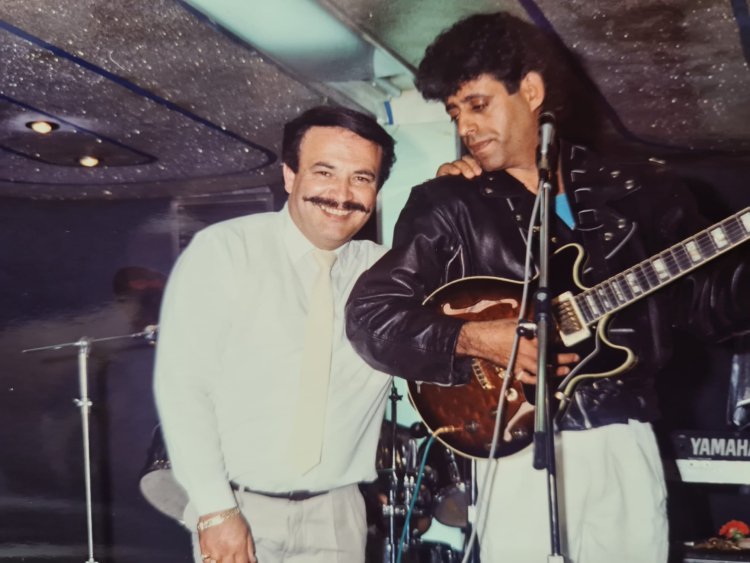 Avi Cohen with singer, Shimi Tavori.
Do you think this is why you didn’t become famous? In a way, did this end your career?
"My career didn’t really end. To this day, I perform. I never worked with a publicist my whole life, and no one ever arranged work for me. I was always alone. All the successes I’ve had in life are thanks to Hashem, not anyone else."
Looking back now, do you feel you missed out on something bigger?
"No, Hashem takes care of me. I'm good; I don't lack anything in life. I have a wife, I have children, I have a family. Who would have believed I’d even achieve that? Hashem protected me, kept me alive, so I have no right to complain."
Always Thankful to Hashem
"I want to tell you one thing: I believe in Hashem so much that I am certain that without Him, I wouldn't have made it in life. I wouldn't be as healthy as I am, I wouldn't have the family I have, and I wouldn’t sing like I sing. You have to understand: Polio isn’t a passing illness. There's no such thing as recovering from it. You carry it with you for life. You remain disabled for life. Now my condition is post-polio. It's a worsening. Once I could walk, now I'm in a wheelchair."
Where do you find the strength to cope?
"Unequivocally from Hashem. He gives me and my wife all the strength. Given all the hardships we endured in childhood, everything we face now is minor. It's nothing compared to what we faced at the start. Every morning I'm fortunate to wake up, I thank the Creator. He's the one who gives me another day, another year. I thank Him that after all I've been through, I am even here. If not for His protection, I wouldn't have anything in this life.
"Sometimes I go out with my wife to beautiful places, and I say, 'Would you have believed we'd come here?' The doctors said of us, 'These kids won’t live past age seven.' I’ll tell you something else. Polio vaccines existed, but we were not given them. They said it wasn’t worth the effort and were willing to abandon us to die."
If you had a chance to ask Hashem one question, what would it be?
"I wouldn’t ask anything. Instead, I’d just say thank you for everything. Thank you for my sight, thank you for my hearing, thank you for my speech. I've always been joyful and will always remain so. I’ve never pitied myself. I’ve always thanked Hashem for everything."
What gives you hope?
"People like my eldest son. His name is Rabbi Leon Cohen. He's a community rabbi in Bat Yam, teaching Torah classes nonstop, and he is my pride. We founded the organization 'Brachot Kohanim' together, and we're helping thousands of needy families. We organize distributions of food, fruits, and vegetables. Doing kindness is the greatest thing in this world."
What is your dream?
"That my wife continues to be healthy, that my children always remain healthy, and that Hashem continues to help me so I can help others. To me, the perspective on life is having everything yet having nothing. Nothing fully belongs to you. All we need to do is thank Hashem for our lives. People think it's a given, but it's really not.
"People wake up with harmful thoughts, who to deceive today, who to take advantage of next. Instead, be grateful that you woke up at all. Whether you earn fifty shekels more or less means nothing. You came into this world, thank the Creator. We can only shorten our lives, not lengthen them. Through good deeds, perhaps we will reach the years allotted to us. Without them, we only cut our own lives short.

