

Magazine
Beyond Borders: Rabbi Yosef Garmon’s Journey into the Unknown
With over a million followers on social media, Rabbi Yosef Garmon is widely known as a modern emissary of Jewish history. In this exclusive interview, he opens a window onto the far less visible moments of danger, uncertainty, and resolve that have shaped his journey.
- Chaim Gefen
- | Updated
 Rabbi Yosef Garmon with Muslim bloggers in Dubai
A cool winter morning dawns in Guatemala as Rabbi Yosef Garmon, the Chief Rabbi of the country, navigates the winding alleys of Antigua. According to the information he received, an ancient central church at the end of the Christian quarter on Oriente Street contains notable Jewish symbols, including a menorah and other elements reminiscent of the Tabernacle.
Rabbi Garmon moves briskly through the maze-like streets. After crossing the main roads and passing rows of colorful houses, he finally reaches the old church. He pauses there for several moments when two priests in black robes approach. Suddenly, they stop at the entrance, raise their arms, and kiss the top of the right-hand doorpost. At that moment, Rabbi Garmon notices a mezuzah hidden among the sculpted stones.
Encouraged, he edges closer. As he listens to the priests murmuring, he is stunned to hear them quoting the verse: “Utterly detest it and utterly abhor it, for it is an object of scorn.”
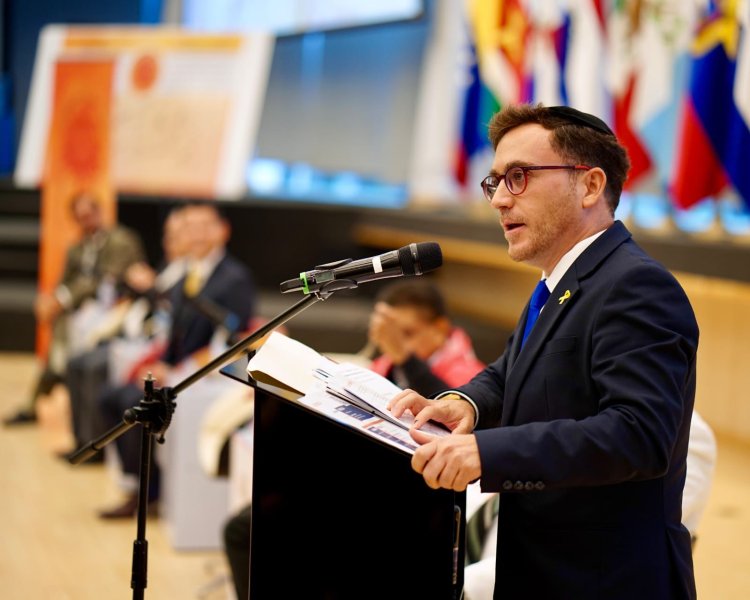 Rabbi Yosef Garmon
Rabbi Yosef Garmon
The Mystery of a Guatemalan Church
The intriguing tale of the Guatemalan church is just one episode in the adventurous life of Rabbi Yosef Garmon, who, as he puts it, divides his time between Israel and constant flights across the globe. At just 37, he has served as Chief Rabbi of Guatemala, visited 142 countries, and amassed over a million social media followers drawn to his lectures on Jewish history and the Torah.
So, what’s the story behind the strange church?
“Back in the 16th century, during the Inquisition, many Jews fled Spain for Guatemala,” he explains. “Even after escaping, they continued to conceal their religion out of fear of the Inquisition’s reach. They integrated with local Christians, likely establishing this church in order to blend in. Upon entering, they whispered the verse ‘Utterly detest it and utterly abhor it,’ reminding themselves that this was a place Judaism regards as impure.”
Let’s rewind. How did you end up in Guatemala in the first place?
“Truthfully, my journey didn’t begin in Guatemala at all,” he recalls. “I first traveled through Europe, with Mexico being the initial Latin country I visited. After working there, I spent two years in Colombia before eventually connecting with the Jewish community in nearby Guatemala.”
The Jewish community in Guatemala is among the smallest in Latin America, numbering fewer than a thousand people. It centers around the Sephardic synagogue Magen David in Guatemala City, where Rabbi Garmon quickly became a central figure. He developed a close relationship with former President Jimmy Morales, studying with him in chevruta. He also maintains strong ties with President Alejandro Giammattei, who left office around 18 months ago. These relationships played a role in Guatemala’s decision to move its embassy to Jerusalem.
While Guatemala is not considered an antisemitic country, it does struggle with street crime and violence. “One Shabbat night, as I was walking alone to the synagogue, I sensed someone following me,” he says. “My instincts were right. In a dark alley, a group of muggers confronted me. Fortunately, it was Shabbat and my pockets were empty. I played the victim and told them, ‘They already robbed me before you did. It’s not fair that all the muggers target me. Try elsewhere.’ To my surprise, it worked. They even offered a few words of comfort before fleeing.”
Did you often venture outside alone?
“Usually, I had community security with me. That particular Shabbat, I had originally planned to be in Honduras following meetings with their president. When I couldn’t find a minyan there, I returned to Guatemala at the last minute, leaving no time for the community to arrange protection.”
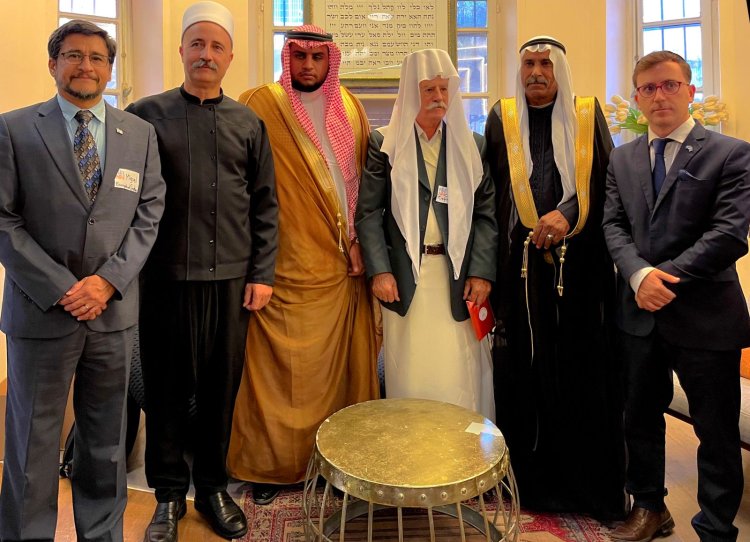 With religious leaders worldwide
Inside the “Lev Tahor” Sect
During his time in Guatemala, Rabbi Garmon encountered the Lev Tahor sect, based in a closed compound near Guatemala City. He met with its founder and former leader, Shlomo Helbrans. “We had a very intense conversation,” he says. “He was articulate and well informed about world events, and at one point I couldn’t stop myself from asking how he could be so extreme.”
Helbrans pushed back, insisting he was not extreme at all. Rabbi Garmon pointed to the visible extremism surrounding the compound. Helbrans remained silent for a moment before replying that Noah, too, had been considered extreme by his generation, yet saved his family from the flood. He argued that the world now faced a spiritual flood and that he was building an ark to save it. Ironically, just two weeks later, Helbrans drowned in an actual flood while immersing in a river in Mexico.
Despite repeated attempts to dismantle it, the Lev Tahor sect still exists. Nachman Helbrans, the founder’s son, assumed leadership and continues to direct the group from prison in the United States, following his arrest in Mexico seven years ago. Rabbi Garmon says he did everything he could to help the children of the sect, ensuring they had access to food, water, and emotional care. These children, he explains, suffer deep trauma, making the story an ongoing tragedy that has yet to find closure.
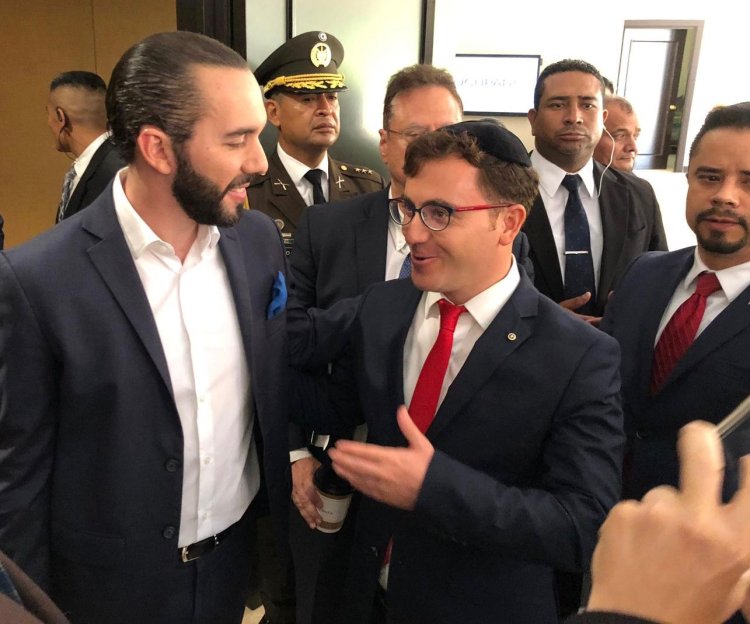 With El Salvador’s President, Nayib Bukele: 'A friend of ours despite his Palestinian roots'
In a Hut with Cannibals
Among Rabbi Garmon’s initiatives in Guatemala was the establishment of the first ZAKA branch in Latin America. After the 2018 eruption of the Fuego volcano, ZAKA medics were among the first responders, providing medical aid and rescuing survivors. He also founded the New Jerusalem village, now home to a thousand families displaced by the eruption, where construction is underway on Beit Sefer Israel, a school for children.
Expanding his humanitarian efforts, Rabbi Garmon later founded the Humanitarian Coalition. Through this organization, thousands of volunteers around the world have launched initiatives such as building free residential neighborhoods in El Salvador and distributing medicine to the sick. Despite President Nayib Bukele’s Palestinian origins, he has been supportive of the work. Rabbi Garmon notes that Bukele expressed amazement that entire communities no longer lacked basic medicines thanks to these efforts. In Africa, the coalition has fought malnutrition by providing food, especially to children suffering from severe dietary deficiencies.
 With children in Uganda
What drives you to do all this?
“If you look at Jewish history, the Book of Genesis itself serves as a manual for humanitarian responsibility,” he says. “Our work flows directly from Torah values, including caring for the world as a whole, not only the Jewish people. Judaism teaches us to respond to global suffering, which is why I feel compelled to help even cannibal tribes in Papua New Guinea.”
What’s it like facing cannibals?
“Terrifying,” he says. During a visit to a remote village of an ancient tribe, he entered a hut where the owner casually remarked that his father had been a cannibal and would have eaten him had he been present. After a long, tense silence, the man added that his father would be arriving soon.
How did you handle those moments and stay calm?
Rabbi Garmon describes standing surrounded by tribespeople, watching the man’s eyes for any signal of danger. He hoped it was a joke, but the seriousness in the man’s tone suggested otherwise. When the father arrived, they exchanged greetings, and he asked where Rabbi Garmon was from. Upon hearing “Israel,” the man’s demeanor changed entirely. He explained that they only consumed their enemies and that Israel had never been counted among them.
Not many assume a cannibal respects one’s heritage.
Rabbi Garmon laughs and suggests that perhaps the man was simply amused by the idea of encountering a Jewish visitor.
It’s Not a Dream
Rabbi Garmon’s travels have included many surreal encounters. In undisclosed Muslim countries, he has spoken with imams inside hostile mosques. In Africa, he participated in unfamiliar rituals, and in Somalia, he narrowly escaped execution after being suspected of espionage.
In Papua New Guinea, his mission to support impoverished tribes took him across remote regions for days. He planned to spend Shabbat in Australia, but on Thursday, after finishing his work in a distant village, he and his guide rode horses to the shore, where a boat waited to take them to Port Moresby.
Unbelievable adventures, one after another.
The boat was unstable, and the journey slow. Upon reaching the airport, chaos ensued when the pilot failed to arrive and could not be located. After searching unsuccessfully, they were told to return the following day and hope he would appear.
Did you have a backup Shabbat plan if there was no flight?
He says there was none. When the pilot finally arrived late, it was already impossible to reach Australia before Shabbat. They spent Shabbat in a rundown hotel arranged by the airline. Despite their frustration, they gathered what they could for a modest street-side Kabbalat Shabbat. In the middle of the prayers, a passerby stopped and greeted them with Shabbat Shalom.
Still stunned, Rabbi Garmon asked how the man even knew the phrase. Instead of answering, the man motioned for them to follow him. On a lower street nearby, they discovered hundreds of locals, dressed festively, singing Shabbat songs and greeting one another in Hebrew.
Rabbi Garmon explains that they were members of an African-descended tribe that identifies as Jewish. Every Friday, they gather from surrounding villages to pray, eat, and sing together, dispersing only after Havdalah, once five stars appear in the sky.
Were you welcomed with excitement?
He says the excitement was overwhelming. The singing and celebration lasted nearly all night. At dawn, the tribe’s elderly leader took him aside, pointed to a distant mountain, and declared that they call it Mount Sinai.
For Rabbi Yosef Garmon, these moments are not curiosities or coincidences, but reminders of how far Jewish history and responsibility extend. From hidden mezuzot in ancient churches to unexpected Shabbat songs on distant shores, his journey reflects a belief that faith, memory, and compassion surface in the most unlikely places, often when they are needed most.

