

Israel News
The Man at the Intersection: Spreading Smiles and Spirit
Many recognize him as the man offering booklets at the intersection, but behind the smile stands a story of faith and purpose. Menachem Lutenberg shares his journey from spiritual searching to building Torah communities, and how a brief moment at a red light became a powerful opportunity to open hearts and spread light
- Michal Arieli
- | Updated
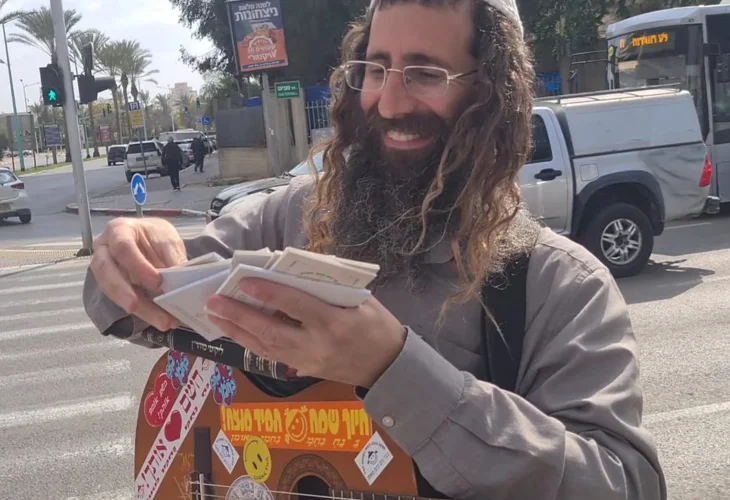 Menachem Lutenberg
“How am I today?” Menachem Lutenberg ponders the question with a broad smile. This familiar smile begins every morning as he stands at an intersection near his home, handing out booklets of hope and faith, trying to lift drivers’ spirits before they begin their workday.
“Some days are better, some less so. Sometimes I feel joy, other times sadness. But I always try to learn from the people I meet. Here’s a recent example. Right after Tisha B’Av, I arrived at the intersection feeling in need of encouragement. A friend stopped by and asked how I felt about the fast. I answered honestly: ‘Some hours were filled with deep longing for the Temple, but other times I felt numb.’
“He responded with a personal story. ‘As you know, my financial situation is difficult. Last Friday, a friend called and asked if I needed money for Shabbat. I was overjoyed and said yes. Even though the money hadn’t arrived yet, I was already happy because I trusted my friend. In the same way, we cannot remain only in sadness and longing in this world. We have faith that the prophecies of redemption will soon be fulfilled. We should rejoice because we are certain it will happen.’”
Journey to Spirituality
Lutenberg is 42, a father of seven as of a week and a half ago, and a new resident of Harish. You might recognize him from intersections around Be’er Sheva, though he grew up in Holon.
“I grew up in a family with an interesting mix. My mother was a warm hearted, traditional Bukharian Jew, and my father was the son of Holocaust surviving kibbutzniks. We observed Kiddush on Shabbat, but I rarely went to synagogue, and there wasn’t much religious observance at home.
“At 17, a friend told me he was going to synagogue, and I thought, ‘Why not try?’ It felt Jewish and natural. That’s how I started praying in synagogue on Shabbat. Later, another friend mentioned he was putting on tefillin and said it brought blessings into his life. After leaving my tefillin in the closet following my bar mitzvah, as many do, I decided to start wearing them regularly.
“When I traveled abroad after my army service, I took them with me everywhere and tried to put them on daily. I may not have done everything perfectly according to halacha, but I certainly did it with all my heart.
“During that trip, something else happened. My heart opened, and I began exploring Judaism more deeply. I learned about Shabbat and Jewish law, discovered things I had never known, and grew stronger in faith. When I returned to Israel, conversations with friends suddenly felt empty. Gossip and joking no longer interested me, so I searched for spiritual paths to fill my life.
“Around that time, Rabbi Zamir Cohen’s Hidabroot channel began, offering high quality Jewish content. Still, I continued living my regular life, since outreach organizations were far less available then, and I wasn’t sure how to move forward with my desire to connect more.”
Meanwhile, Lutenberg began studying in various yeshivot and married his wife, who was also on her own spiritual journey. Together, they moved to Bat Ayin in Gush Etzion.
Spreading Faith
Lutenberg emphasizes that everything in his life is part of a larger journey guided by Hashem.
“One day, after immersing in the Bat Ayin spring, I met a friend who seemed frustrated. He shared that his planned trip to the Jewish center in India might not happen. I asked him why not go, and right there I offered to join him. We planned to spend what we jokingly called a ‘month of reserve duty’ at the Jewish home, strengthening Jewish souls and bringing hearts closer. We actually flew there.
“When I returned to Israel and reflected on the journey, I realized Hashem had given me essential tools for outreach. I believe it comes from sincerity and from trying not to speak arrogantly. Sometimes life feels perfect. The house is calm, my daughters cook, my sons study Mishnah. Other times it’s difficult. There are arguments with my wife, and nothing seems to work. But I believe the Torah gives us tools to overcome challenges, and that’s the message I try to share.”
Lutenberg then searched for another place to contribute faith and inspiration. Together with his friend from the Jewish home, he decided to establish a Jewish hub in Eilat.
“We explored the city and identified three main groups: students, hotel workers, and local residents. Eventually, I brought my family there, and together with other families, we built a religious community devoted to outreach and strengthening faith.”
It became a unique and intense endeavor. They rented a special home known as Baruch’s House and hosted evenings filled with food, stories, drum workshops, desert outings, and more. They also worked closely with the Jewish Soul organization.
“During this nonstop activity, whenever I had a free moment, I would take my guitar and go out to the streets. I stood at intersections, played music, and tried to bring joy to as many people as possible. Over time, I realized that although Eilat may seem distant from Judaism, it has a strong community of people deeply connected to tradition and to Hashem. I often felt humbled by them and learned a great deal.”
He also began standing at intersections around Be’er Sheva, distributing booklets, smiling at passersby, spreading faith, and sharing books he loved in hopes of bringing light and joy.

Moments of Open Windows
Today, as a resident of Harish, Lutenberg continues his work at intersections.
“I look for busy intersections, sometimes standing alone, sometimes with a friend. Over the years, I’ve met many people there, some struggling physically or mentally, some battling addictions. I’ve learned how to speak their language and coexist peacefully without disturbing one another.
“Occasionally, people arrive who aren’t familiar with the unspoken rules of intersections, like the idea that whoever arrives first claims the spot. Sometimes there are tough characters who feel compelled to explain those rules in their own way.”
What do you do at the intersection besides standing there?
“I come prepared with materials to distribute: Rabbi Nachman of Breslov booklets, Psalms, and other books that touch people’s hearts. I stand there smiling and say, ‘I connect myself to Rabbi Nachman of Breslov and all the tzaddikim.’
“Each red light lasts exactly one minute and thirteen seconds. When something special happens, car windows roll down, and so do hearts. People share their struggles, their pain, their successes, and their failures. I’ve met grooms on their way to the chuppah who blessed me, and mourners on their way to funerals.
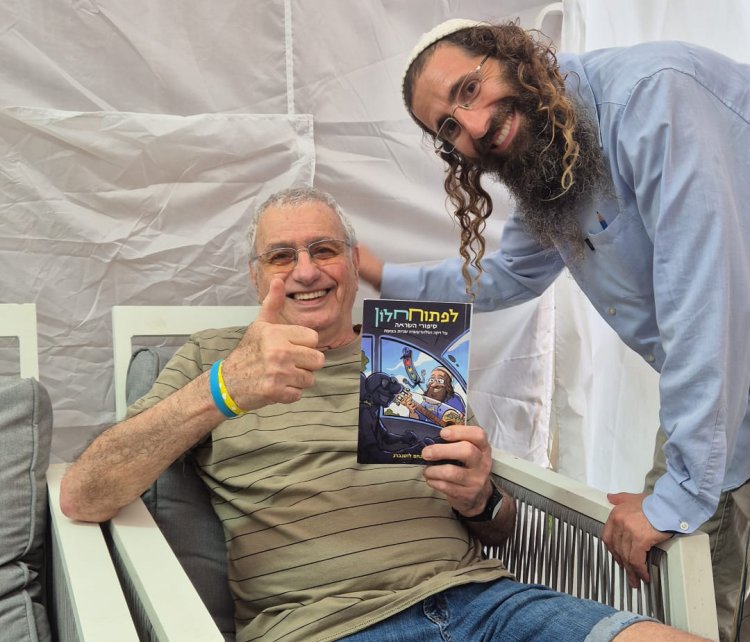
“There isn’t time for long conversations, but sometimes people pull over to continue talking. Those moments were so powerful that I eventually compiled them into a book called Opening a Window.”
Are you aware that some people see figures like you as eccentric?
“Eccentric?” he laughs without offense. “That’s putting it mildly. Some see us as parasites, unemployed, or a nuisance. Almost every day someone rolls down a window and shouts, ‘Drop the harmful stuff and get a job!’ What can I explain in one minute and thirteen seconds? That I work two jobs and stand here because I care about his soul?
“One driver even wished me harm. It hurts, but I remind myself each time not to count those voices. Who are they, really? Just children who haven’t yet seen the light.
“But there are also days that remind you why you’re here. Someone tells you they’ve been searching for a book to strengthen themselves. Someone takes a book of Psalms and promises to read it for the first time. Others step out of their cars just to shake my hand and thank me.
“That minute and thirteen seconds at the red light is a remarkable opportunity. Some of the people I meet, I see every day. They’ve become part of my routine, and I’ve become part of theirs. With every ‘good morning’ we exchange, I know we would never have met if not for that chance to open a window at the intersection.”

