

World News
Finding Resilience Through Music: Yarin Naktalov's Journey
From schoolyard struggles to faith, war, and healing, Yarin Naktalov opens up about her life journey and the strength she discovered through music.
- Moriah Luz
- | Updated
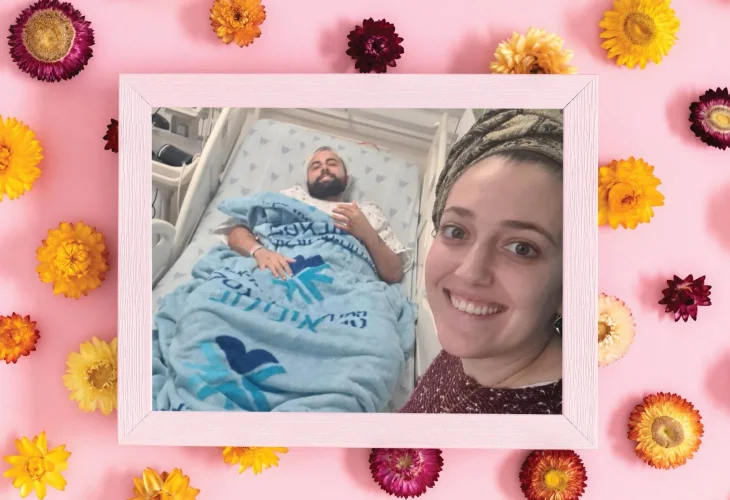 Yarin Naktalov with her husband Yohanan at the hospital
When singer Yarin Naktalov speaks about her childhood, she recalls a traumatic episode that left a lasting mark. A classmate once brought a ham sandwich to school and deliberately ate it in front of her while other children giggled. “He made sure to eat it right in front of me,” she says. This moment became part of a broader life journey marked by social isolation, a return to faith and connection with Hashem, coping with her husband’s injury during the war, and discovering inner strength through music.
Born in Kfar Saba, Yarin was the eldest child in a religious family. “My early childhood was very good and happy,” she says. When she was seven, her parents divorced. “The divorce shook us all. Both of my parents became secular, and my younger brother, who was five at the time, and I moved with our mother to Hod Hasharon.” Although geographically close, she explains, the mentalities of Kfar Saba and Hod Hasharon were very different.
After the move, Naktalov began attending a secular school. “I entered third grade in a class that was already formed, and I didn’t fit in. It started well but quickly turned into social isolation. Coming from a home with a connection to tradition, I became ‘the religious kid.’” She had a few friends, but many classmates mocked and teased her. After the incident with the ham sandwich, the teacher reprimanded those involved, but the years remained socially difficult.
Whispering Prayers to a Box of Dolls
“My extended family was a source of warmth and stability, but socially I dealt with my struggles alone,” she says. “Music became my outlet, and today I understand it was also my prayer.” As a child, she kept a box of porcelain fairies and whispered heartfelt requests into it during moments of distress.
When it came time to choose a middle school, she asked her mother to send her to a religious school. “Not because I was particularly religious, but because I remembered having a good experience in the religious school in Kfar Saba.” There was no such option in Hod Hasharon, so she returned to Kfar Saba, where she flourished socially.
At school she lived a religious routine, wearing a skirt and praying, while at home observance was absent. Despite the contrast, she felt socially secure. The real turning point came when she joined a religious youth movement almost by chance. For the first time, she encountered Shabbat songs sung during the third meal. “Those holy melodies lit something in my soul. I realized that mitzvot weren’t just customs, but gateways to a deeper world.” Gradually, she began observing Shabbat and kashrut and dressing modestly even outside school. “I felt that I needed Hashem with me. After everything I had been through, I was no longer alone.”
How did your family react to the changes?
“They respected it overall,” she says. “But I still traveled on Shabbat, because that was the reality at home and I was too young to change it alone.” This inner contradiction weighed on her deeply. One Shabbat, passing her youth group by car, she ducked so no one would see her. “I thought to myself, ‘What am I doing in a car? I want to be there.’”
“I Just Want You”
One Friday night at Kiddush, an aunt asked why she always wore a skirt. Her mother answered, “Don’t you know? Yarin is religious.” Then her grandfather remarked, “How can she be religious if she drives on Shabbat?” The comment pierced her. That night she declared she would no longer travel on Shabbat.
The following Friday, when Shabbat arrived and the family still had not left, she broke down in tears. Alone in her room, she cried out to Hashem: “I just want You. Why is it so hard?” When she finished praying, she felt a deep inner calm. Moments later, her mother entered and promised it would be the last time she would drive on Shabbat. And it was.
From there, her observance deepened. She completed high school, performed national service in Jewish education, and studied at a religious seminary. “The seminary strengthened me immensely. I learned what a Torah life really looks like.” During that period she met her husband, Yohanan. They married and later had three children.
When the war broke out, Yohanan, a combat engineering officer, was called to reserve duty in the north. A week and a half later, during their first phone call, she suddenly heard him shout that they were under anti tank missile fire before the call disconnected. “That moment shook me completely.” Sleepless nights followed, filled with Psalms. Out of that fear was born her first song, Ein Laila (No Night). “Music became my lifeline.”
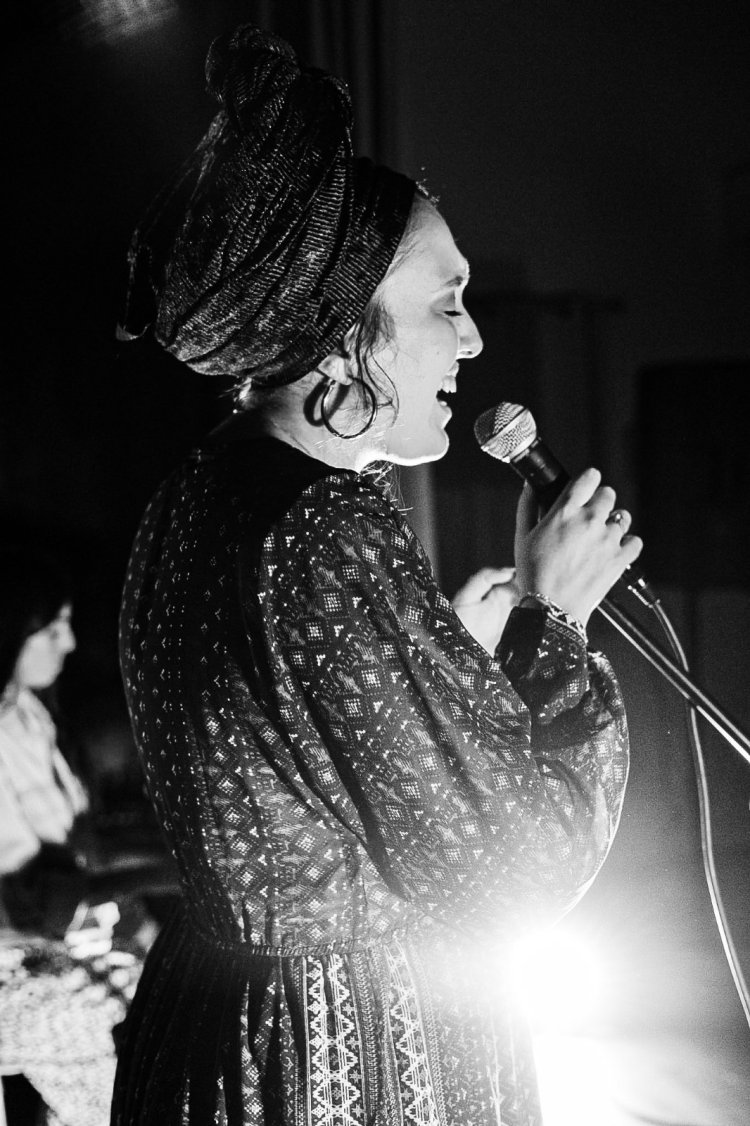 Performing for women (Credit: Koreen Shira)
One night, as Naktalov returned from a women’s event in Beit Shemesh, the city where they lived, she had a strong internal feeling that she should pray for her husband. "I heard a virtue from Rabbanit Rachel Bazak, saying that when you want to pray for a soldier in battle, you can imagine him surrounded by the letters of Hashem’s name."
An hour later, she was informed of her husband's injury. In retrospect, she says her prayer was exactly at the time he was injured. "Hezbollah terrorists targeted my husband and his soldier, and fired two anti-tank missiles at them in succession. By great miracles, the missiles hit five meters away from him. The terrorists filmed the launch, and the video clearly shows the hit so close and the smoke rising around. It’s unbelievable they survived such an attack."
Yohanan was injured by shrapnel all over his body, his condition was classified as moderate to severe, and he was airlifted to Rambam Hospital in Haifa. Naktalov adds that during the evacuation, another missile was fired at the rescue teams, which, with Hashem’s help, did not hit anyone.
"Not Alone"
"When the army called me to tell about the injury, I immediately said 'I knew it.' I couldn’t go to the hospital right then because I was home alone with our three small children. I talked to my brother-in-law, who reassured me and said: 'I’ll go to Haifa now, meanwhile, you sleep and come tomorrow morning.' Of course, I didn’t sleep that night," she laughs.
"The next day, I dropped off the kids and went to him. I saw Yohanan lying swollen and injured all over his body, but breathing and alive. The first words I said were 'A Psalm of Thanksgiving.'
Yohanan's healing process was accompanied by great miracles. A large shard of shrapnel was removed from his abdomen, which had nestled near vital organs but did not damage them. "Everything with him was 'almost': the shrapnel almost entered the intestine, almost tearing an important nerve. But just 'almost,' nothing was damaged completely." Two days after the injury, he was transferred to Ichilov Hospital in Tel Aviv, and Naktalov cannot find enough words to praise the devoted medical staff there, who enveloped them with endless care and dedication.
"At first, I stayed by his side constantly, while my mother helped care for the children. After a few days, she gently pointed out how hard my absence was for them. Throughout the months of his reserve duty, I had been their anchor and primary parent, and we realized it was important for me to be with them when they were home. So each morning I took them to school, drove from Beit Shemesh to Ichilov, accompanied Yohanan through his treatments, and by two in the afternoon I would leave and return to the children."
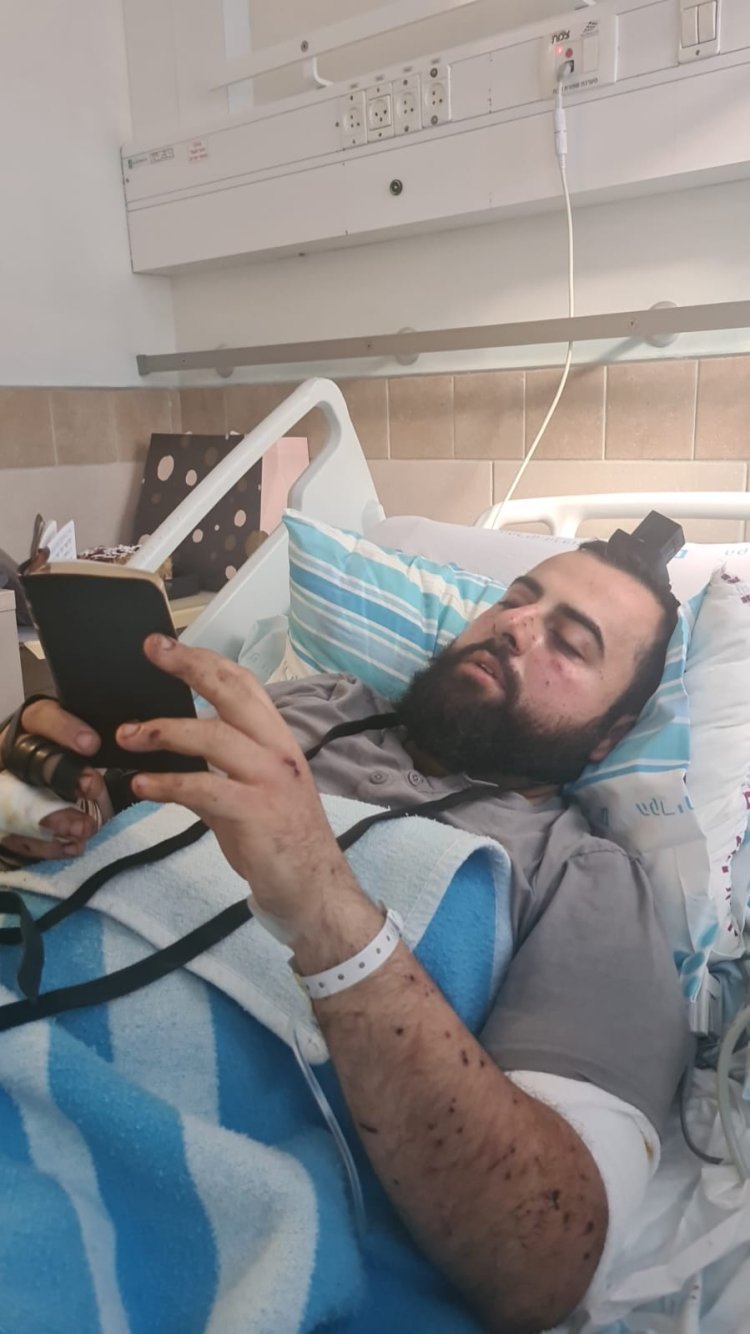 Yohanan after the injury
What gave you strength during this time?
"Music, unequivocally. I recorded 'Ein Laila' at this time; it's also my first song. Every time I entered the studio, I felt like I could breathe again."
About a month later, Yohanan was discharged home and began his rehabilitation at Hadassah Hospital on Mount Scopus. "From the day of the injury, every morning when I arrived at the hospital, I recited the 'Psalm of Thanksgiving.' On the fortieth day, he was discharged for rehabilitation." Since their home had a staircase that made it difficult for Yohanan, the couple decided to move to another apartment. Meanwhile, Naktalov left her job and began driving her husband daily to rehab in Jerusalem.
Five months after the injury, while still in rehabilitation, Yohanan received another call-up notice, this time to Gaza. "To me, it was clear that he wouldn’t go, but he immediately clarified that there’s no way he wouldn’t join his soldiers entering Gaza. That’s the spirit that accompanies the soldiers in rehab; they have one goal: to succeed in returning to battle."
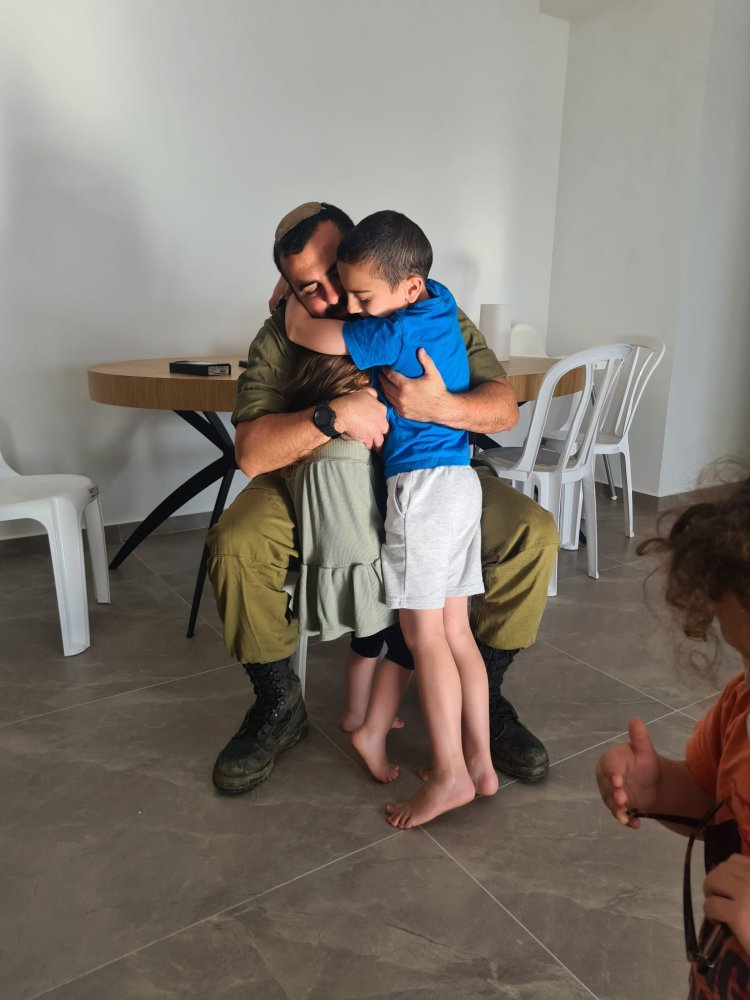 Yohanan heading to Gaza, five months after the injury
Was he medically fit to return to combat?
"Medically, no, but for him, definitely," she laughs. "It wasn’t easy for me to return to that stress again. We were a week after moving house, and after five intense months of hospitalization and rehabilitation, but I’m proud of him."
Today, over a year later, Yohanan’s condition has improved significantly. Following his injury, Yarin recorded another song, You Are Not Alone. “It reflects my entire journey,” she says. “From childhood loneliness to faith, to war and healing. I want every woman to know what I learned: you are not alone. There is Someone above who walks with us.”
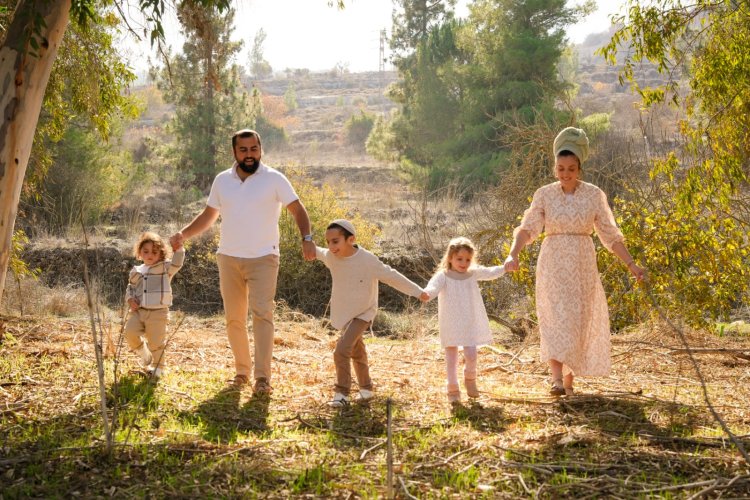 The Naktalov Family (Credit: Avishag Buskila)
