

Magazine
The Secret Life of Roni Insaz: A Double Agent Who Saved Lives
Under the noses of the Iranian regime, former Revolutionary Guards officer Roni Insaz saved Jewish lives by destroying legal charges against them. "If I had been caught, I would have been executed in two days."
- Chaim Gefen
- | Updated
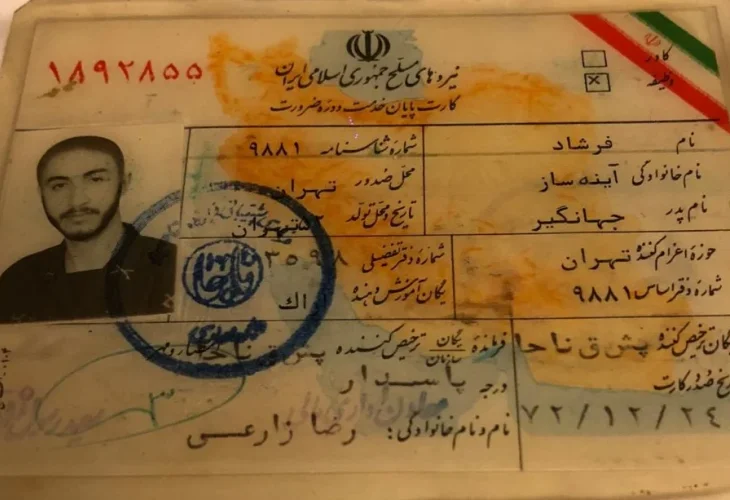 Insaz’s military ID from the Iranian army
It was late in the evening when the Iranian Ministry of Justice building in Tehran began to empty. As the last employees headed home, Roni Insaz kept a watchful eye on the corridors, waiting for the moment they would be completely deserted. Once the final door slammed shut, he quietly returned to his office.
Insaz sat at his desk and began sifting through files. Heavy folders filled with ominous indictments were stacked high. He searched specifically for files bearing Jewish names and, when he found them, stuffed them deep into his personal bag. Then he slipped out into the dark streets of Tehran.
Double Agent
The story of Israeli businessman Roni Insaz, now 51, reads like a daring tale of espionage. Born in Tehran, Insaz was drafted into the military justice unit of the Iranian Revolutionary Guards.
“Of course, they didn’t know I was Jewish,” he recalls. “My Iranian ID listed my given name, Parshad, which is very common among Muslims in Iran.”

After extensive training, Insaz joined a special police unit of the Revolutionary Guards. “At first, I worked as a clerk in the national court in Tehran, but I was later promoted to assistant investigator, a position reserved for particularly loyal soldiers.”
Before long, Insaz became the personal assistant to Ahmad Mohagheghi. “He served as both a judge and an investigator, and I accompanied him to special case scenes. There were nationalistic murder cases handled only by senior investigators, and he was one of them. I was with him day and night.”
Did he know you were Jewish?
“Absolutely not. If he had found out, at best I would have been sentenced to death. At worst, I shudder to think what he might have done to me.”

Planted in the Ayatollahs’ Stronghold
Despite maintaining absolute discretion, rumors began circulating within the Iranian Jewish community that Parshad was actually Jewish.
“That’s when I began receiving requests for help,” says Insaz. “The most dangerous cases involved Jews caught at the borders while trying to escape Iran. The Revolutionary Guards patrolled constantly, arresting anyone attempting to flee. I made those files disappear out of sheer fear, because the regime viewed escape attempts as severe national crimes.”
Were all these files kept in one place?
“No. Just locating each file required serious detective work. I gathered information through hallway conversations with investigators and prosecutors, learning where the Jewish files were kept. Late at night, after everyone had left, I went from room to room and made each file disappear.”
Is there one case you remember especially well?
“One file involved my own father in law. He planned to escape Iran while smuggling an ancient Torah scroll, but he was caught at the last moment. Because he was already under arrest, making the file disappear wouldn’t stop the trial, so I used my high level court connections to help him. His expected sentence was extremely severe.”
“Another case involved a Jew in Tehran who was charged after a Muslim accused him of lending money with interest,” Insaz recalls. “The judges planned to sentence him to life in prison. One night, I made the file disappear. Later, I even helped him repay the loan.”
Daring Escape
Night after night, Insaz risked his life to save Jews from brutal sentences.
“Fear was my constant companion,” he says. “Every day I walked the courthouse corridors, wondering if they had noticed how many files were vanishing.”
Only after a year and a half did judges begin to sense that something was wrong. “They realized there was a hidden hand systematically removing Jewish files.”
It took them that long to notice?
“This was the late 1980s,” Insaz explains. “There were no computerized systems. The Tehran court worked entirely manually, with files scattered across dozens of rooms. It took time to connect the dots.”
Shortly after Insaz was discharged from the army, Revolutionary Guards agents raided his business.
“They came looking for me, but luckily I wasn’t there,” he recalls. “I knew the noose was tightening. If they caught me, I would have been hanged in the city square. That night, I shut down the business and fled home.”
Why did they suspect you?
“It may have been a tip off. I never told anyone about what I was doing, not even my family. But I once invited a Muslim friend from the army to my home. He pointed at the mezuzah and asked what it was. I tried to brush it off, saying Jews had lived there before me. I don’t think he believed me.”
Despite the manhunt, Insaz managed to escape Iran.
“They didn’t have time to issue a travel ban, which required a court order. I boarded a flight to Turkey and from there made my way to Israel.”
Did the search for you continue?
“It never stopped. According to reports I’ve received, it continues to this day. Not long ago, senior members of Iran’s Jewish community were interrogated during Israel’s military operation against Iran. One of the questions they were asked was, ‘Where is Parshad Insaz?’”

After settling in Israel, Insaz built a successful business network. Yet he reveals a lesser known side of himself.
“I volunteer with the burial society and with ZAKA,” he says. “Emergency response work in daily life is worth more than any business. To be honest, it’s the best business I have.”

