

Magazine
Surviving the Unsurvivable: A Family's Brush with Tragedy
Atarah Elkaim recalls a terrifying moment that forever changed everything: the seconds that saved her family from disaster, their overwhelming challenges with a destroyed home, and their unwavering hope for the future.
- Michal Arieli
- | Updated
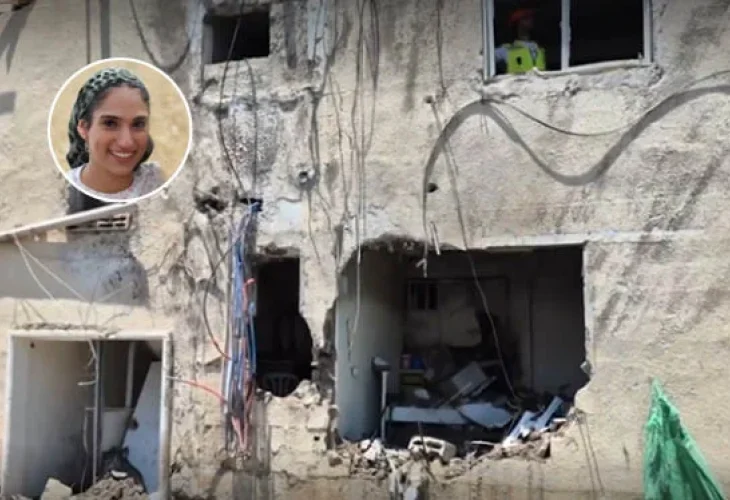 Atarah Elkaim in front of the ruined building
The moment the deafening explosion echoed and the shelter shook, Atarah Elkaim knew she'd never forget it. It wasn't just the chilling realization of how close the impact was; the "boom" had shattered their world, leaving her family without a home, faced with a daunting new struggle and countless questions about their future.
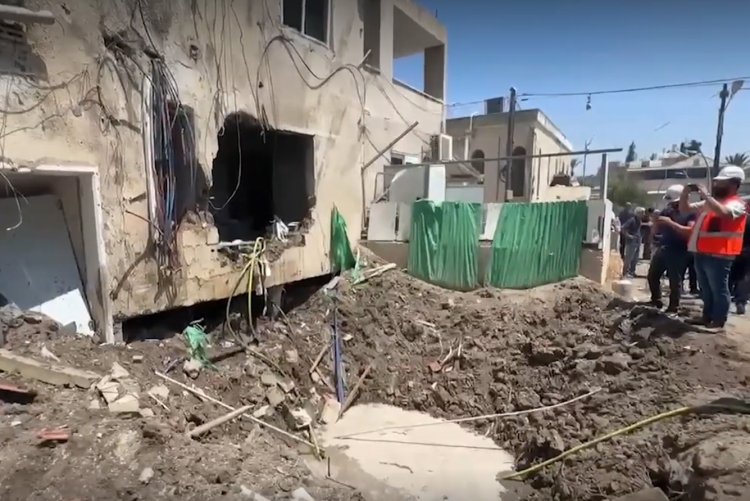 The crater left by the missile strike at the apartment entrance
“Suddenly, there was a boom”
“We live in Beit She’an, and it happened on Shabbat,” Atarah recounts. “In the week before, we barely slept because our apartment doesn’t have a safe room. Every siren sent us running with our two year old daughter, Tamar, to the shelter outside our building. Eventually, we decided it was easier to sleep in the shelter altogether, which is what we did that Shabbat.”
“With neighbors talking late into the night, we fell asleep around three in the morning and woke at nine to a siren. My husband, Netai, went to pray, and I went upstairs with Tamar to set the Shabbat table. I assumed there would be no more alarms, since the Iranians had mostly been launching missiles at night. After setting the table, Tamar was exhausted and we both went to sleep.”
“About forty minutes later, the Home Front Command alert on my phone woke me. It’s a miracle I heard it, since I’m a heavy sleeper, and even more miraculous that Tamar heard it too.”
Atarah pauses. Since the Hamas attack on Simchat Torah, she always locks the door and keeps shoes ready for a quick escape. “This time, I couldn’t find Tamar’s other shoe and ran around the house looking for it. When the siren sounded, I grabbed her and ran out. I remember standing at the door, hesitating over whether to lock it. I didn’t, and thank G-d I didn’t.”
“We reached the shelter, and seconds later there was an enormous roar followed by a terrifying boom that shook everything. I was certain the shelter itself had been hit. People screamed, panic filled the room.”
“Minutes later, a neighbor came in to calm us and said there had been a drone crash, but not here, it hit the Abukassis family’s home. When I heard that, I started shaking. They live above us, so if their home was hit, ours was too. People kept saying, ‘It’s not your apartment,’ trying to calm me.”
“Then my aunt, who lives nearby, rushed into the shelter, pale as a sheet. When she saw me, she hugged me tightly in relief. She told me she had gone first to another shelter where we usually go, and when she didn’t find us, she ran to our building. Seeing our door unlocked, she went inside calling, ‘Atarah, Tamar.’ When no one answered, she was terrified until she realized we must be here.”
“I asked her about the apartment, and she told me Tamar’s room was destroyed and on fire. I was shaking, unable to believe this had happened to us. All I could think about was my husband, still at synagogue, unaware of everything.”
What was happening with your husband at that time?
“He was praying at a synagogue down the street. When the siren sounded, the congregation moved to a nearby shelter and then returned to prayer. At some point, a friend ran in asking about us. When my husband said we were at home, the friend urged him to check, saying he had seen police and fire trucks near our building.”
“My husband ran the entire way, calling our names. When he reached the shelter and saw us, he broke down in tears from relief. I was crying too, completely overwhelmed.”
“They took us to a nearby apartment belonging to my grandmother, where medics checked us. That night we went to my parents’ home, and the next day we were relocated to a hotel in Tiberias.”
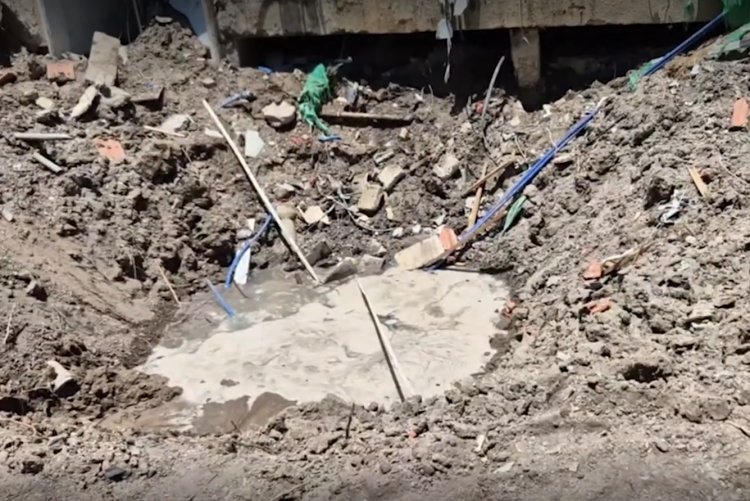 The extensive damage caused by the drone strike
“A tremendous miracle”
“The magnitude of the miracle is impossible to describe,” Atarah says. “It only truly hit me when I later saw the apartment. We weren’t allowed inside, but since the outer wall collapsed, we could see Tamar’s room completely destroyed, toys scattered everywhere.”
“It became clear how different the outcome could have been. Tamar often plays in her room when we’re resting, and she could easily have been there. The fact that we made it to the shelter in time is nothing short of a miracle. It was all a matter of seconds.”
Does Tamar understand what happened?
“Yes, very much. At first she struggled to talk about it, but now she talks constantly about our broken home and how, thanks to Hashem, it didn’t fall on us. When sirens sound, she tells me, ‘Don’t worry, I’m protecting you.’ She seems cheerful on the outside, but we’re very attentive to her so this doesn’t leave deep scars.”
You’re left without a home. How do you move forward?
“Alongside overwhelming gratitude, there’s also deep uncertainty,” Atarah admits. “The feeling is one of emptiness. We left with nothing but the clothes we were wearing. People across the country have helped us generously, but relying on others is not easy.”
“The government gave us two weeks in a hotel or guesthouse. After that, we’ll need to rent a place. They’ll cover the rent for three months and half of it for the following three. At the same time, we’re still paying a mortgage on an apartment that may never be livable again. I’m a teacher, my husband is a Torah scholar. It’s overwhelming.”
Are there plans to renovate and return?
“They told us there are three categories: green for livable, orange for unlivable but repairable, and red for demolition. At first, they said we were red because the building’s foundation was hit. Later, they suggested repairs might be possible. Nothing is clear. The building is visibly crooked, full of cracks, and Tamar’s room collapsed. Even if it’s repaired, it will take a long time.”
“At first, my nightmares were about the drone hitting us. Now they’re about where we’ll live. And still, I’ve had to return to school, hand out report cards, and keep functioning.”
Atarah concludes quietly, “We saw Hashem’s protection in the moment of impact, and we know He is with us every step of the way. All of Israel is facing hardship, and I want to thank everyone for the love and support. In moments like these, you see the extraordinary strength of the Jewish people.”

