

Magazine
Faith Under Fire: How Tzitzit Saved My Life
43 years after the Battle of Sultan Yaakov, Rabbi David Turgeman recounts the moments that defined his life, the return of Tzvi Feldman z”l, and how a simple mitzvah became a lifeline in war.
- Moriah Luz
- | Updated
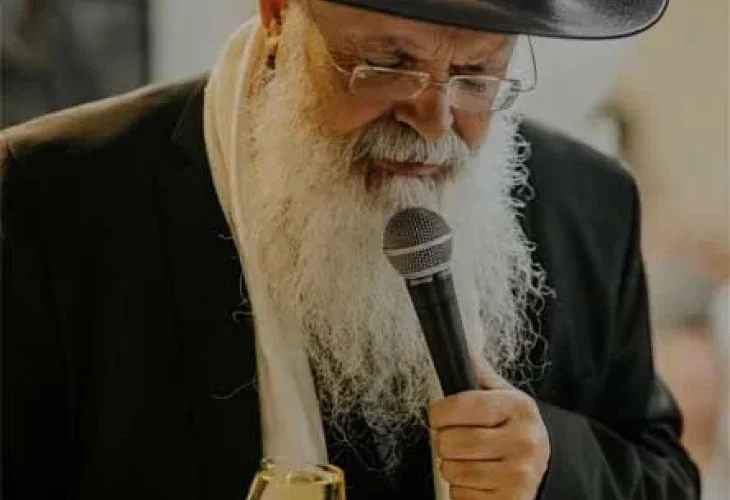 Rabbi David Tourgeman
“At nine in the morning, the tank of our friend Tzvi Feldman z”l was hit, and its crew was taken captive.” With these words, Rabbi David Turgeman opens a special interview following the return of the body of fallen IDF soldier Tzvi Feldman z”l. Feldman fell in the Battle of Sultan Yaakov during the First Lebanon War 43 years ago. For decades he was considered missing, and last month, in a joint operation by the Mossad and the IDF, his body was brought back to Israel from a cemetery in Syria where he had been buried. Rabbi Turgeman was by Tzvi’s side in the final battle of his life, and despite the many years that have passed, Tzvi remains vividly engraved in his memory.
 Tzvi Feldman z"l
“Tzvi Possessed Noble Character Traits”
Rabbi Turgeman is the founder and head of the Hesder Yeshiva in Dimona. He also established the city’s religious high school and girls’ ulpana, leading them for many years. In addition, he serves as acting city rabbi. For Rabbi Turgeman, the current war and the self-sacrifice revealed within it recall another war that took place more than forty years ago.
“When the First Lebanon War broke out, we were rushed north,” he recalls. “I remember the line from the Gemara as we left the yeshiva.” The battle in which he nearly lost his life took place five days later. “My battalion was tasked with reaching the road leading to Damascus. The battalion commander received intelligence reports stating the area was already ‘clear.’ Those reports turned out to be wrong, but they caused us to become complacent,” Rabbi Turgeman says with a sigh.
“When we entered in a column of tanks, we came under massive fire from the mountaintop, and for a long hour a heroic battle took place there. The Syrians had a significant height advantage and had carefully prepared the ambush. Many of my comrades in the battalion were killed that night. At two in the morning, the tank I was in was hit by a Syrian shell, and we, the tank crew, were forced to jump out and hide in the shelled area under cover of darkness. A few hours later, at nine in the morning, the tank of Tzvi Feldman z”l was hit, and its crew was taken captive.”
The fierce battle Rabbi Turgeman describes would later be known as the Battle of Sultan Yaakov, in which 22 soldiers fell heroically. Four of them, along with two soldiers who were still alive, were taken captive.
“I had the merit of fighting shoulder to shoulder with Tzvi during the two days preceding his fall. He was several years older than me and my friends, yet his noble presence was unmistakable. We encountered a man of great humility and refined character, who spoke little but carried himself with quiet dignity. When I heard about the return of his body, I felt deep pain for his parents, who had waited for decades for the moment he would be brought home, but did not live to see it. At the same time, I felt joy that Tzvi merited to reach rest and inheritance, and to be buried in a Jewish grave, close to his parents z”l.”
Rabbi Turgeman pauses, then continues softly. “And still, we are waiting for my study partner Yehuda Katz z”l, the last fallen soldier from that battle who has not yet merited to be brought to burial in Israel.”
 Rabbi David Turgeman at a Torah scroll dedication ceremony
“If I Survive, I Will Dedicate My Life to Torah”
Rabbi Turgeman returns to the battle, describing how for hours they were forced to hide in the shelled area after their tank was disabled.
“I prayed in my heart to the Master of the Universe and promised that if I emerged alive, I would dedicate my life to Torah,” the rabbi reveals. “I hope I am not disappointing Him today. At the same time, my father, back in our home in Dimona, stayed awake that entire night, pouring out his heart in prayer. He did not know where I was or what was happening, but since my brothers and I were all mobilized for the war, he felt compelled to pray at that moment. Indeed, we received special protection from Heaven, and the Syrians did not identify me or my fellow crew members, despite the many hours we hid in the open. My tank mate Yehuda Kaplan whispered to us in our hiding place that if we had survived until then, it must be that Someone Above wanted us to stay alive.”
The battle continued until noon, when a ceasefire was declared and the area suddenly fell silent. Rabbi Turgeman and his companions emerged from their hiding place and began walking toward Israel. At a certain point, they noticed figures moving along the ridge above them and, through binoculars, identified them as IDF soldiers.
“Very quickly, the relief turned to fear,” Rabbi Turgeman recounts. “From their body language, we understood that they thought we were Syrian soldiers advancing toward them. After surviving enemy fire, we suddenly faced the danger of being shot by our own forces. We began shouting that we were Israelis, but they could not hear us. I removed my helmet so they could see the large blue knitted kippah on my head. I also pulled my tzitzit out and waved them continuously.”
 Rabbi Turgeman
On the day of Tzvi Feldman’s funeral, Rabbi Turgeman met Iveri, another soldier from that war, who revealed that he had been among the soldiers on the ridge.
“We were moments away from shooting,” he told the rabbi. “The tzitzit you were waving actually strengthened our mistaken assumption that you were Syrians, since we interpreted it as a white flag of surrender. At the very last moment, one of the religious soldiers looked through the binoculars, recognized the fringes and the kippah, and shouted for us not to fire. Only then did we realize you were IDF soldiers.”
“Prayer Is Stronger Than Anything”
In the current war, the mitzvah of tzitzit has gained renewed momentum, even among soldiers who are not religious in their daily lives.
“Every Jew, regardless of affiliation, possesses a Jewish soul,” Rabbi Turgeman explains. “The Holy One, blessed be He, loves that soul, and the tzitzit worn on the body are another testimony to the soul within.”
He adds, “This also reflects the long and positive journey we have made as a people over the past sixty years. Today, even nonreligious soldiers connect to this mitzvah. But as a young boy returning from my religious school wearing a tallit katan, I often endured mockery from children I met along the way. Despite the humiliation, I did not give up. And now,” the rabbi smiles, “I merited that this very mitzvah saved my life.”
Asked about the issue of the captives, as someone whose study partner Yehuda Katz is still held by the enemy, Rabbi Turgeman responds, “There is one thing the entire Jewish people, across all outlooks, can unite around, and it is also the thing that will help most: prayer. Prayer is stronger than all other efforts, important as they may be. The Gemara teaches that if a person sees that he has not been answered, he should pray again, for perhaps the prayer was not yet complete. Is it difficult for the Holy One, blessed be He, to rescue captives or defeat Hamas? Certainly not. We must unite in prayer, all of Israel, and ask for this.”
He adds that “such prayer belongs at the Western Wall. That is the fitting place for the prayer of the entire nation.”
In the current war, many of your yeshiva’s students have gone out to fight. With what message do you send them?
“We never educate students toward war,” Rabbi Turgeman says. “Our educational mission is to live lives of spiritual greatness, to strengthen faith, to know God, and to establish permanence in Torah. When students grow in this way, we witness their immense heroism in battle. Sadly, we also witness this heroism among all those who have fallen since that Shabbat of Simchat Torah, who fought like lions against overwhelming odds.”
He offers examples. “One of our graduates Ishi Slotki z”l left his home on Simchat Torah armed only with a handgun to fight terrorists and defend Kibbutz Alumim. Another graduate Uri Shani z”l was a platoon commander who, together with his soldiers, stopped the massacre at the Kissufim outpost. His soldiers describe how he fought with faith and devotion, focused solely on the mission. These are not isolated cases. The examples are many.”
“We are living in a great generation,” Rabbi Turgeman concludes. “The heroism we are witnessing today is not ordinary. We may have seen such courage in the days of King David’s warriors. For this heroism alone, we must know how to thank God every single day.”

