

Magazine
A Father's Message of Unity and Resilience After Tragedy
Rafi Avers lost his son, Shai, in a military tragedy. Since then, he has transformed grief into action, visiting bereaved families across the country and drawing strength from faith, memory, and a call for unity beyond politics.
- Michal Arieli
- | Updated
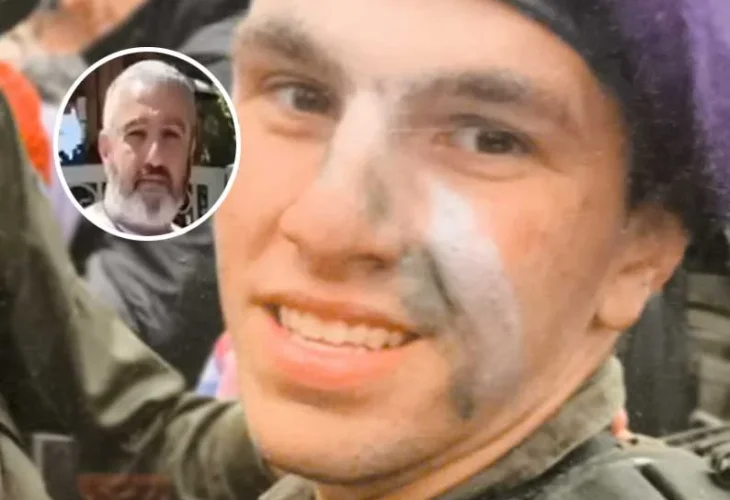
"To my beloved Adar, my dear mother, the best father in the world, all my brothers, and our close family,
Know how much I miss you and love you. And the truth is, I was happy doing what I was doing, saving people and protecting the country, because it’s something I always wanted."
Rafi Avers reads the words, his voice breaking. In his darkest nightmares, he never imagined he would lose his youngest son, Shai, who fell during the Iron Swords War in the Namer incident, about a month after the war began.
“Shai wrote us several messages in his will, but the main thing he emphasized was that he had a happy life and that he asks us to continue living and to be joyful. He wants us to remain a united family.”
Rafi lifts his eyes.
“It’s not easy to fulfill Shai’s will,” he admits. “But since he fell, I’ve done everything I can to commemorate him in every possible way, and also to support other bereaved families. I don’t rest for a moment. My life has changed completely. And despite what people say, that time does its work, I can say personally that the longing is always there. A father will forever remember his son.”
Life Changes
Nearly all bereaved families know Rafi Avers, Shai’s father, as he has visited the homes of more than 750 fallen soldiers and continues to stay in touch with many of the families long afterward.
How do your lives look since Shai was killed?
“Life has changed completely, and nothing remains as it once was. Friday night kiddush is no longer the same kiddush. Even the holidays we observed recently, Rosh Hashanah, Sukkot, and Simchat Torah, felt different than before, because the absence is palpable and the void that was created is enormous.
“Shai’s room has become one large memorial, because we feel the need to honor his memory. Since he left home on Simchat Torah 5784, we haven’t changed the sheets or opened the closet. Everything remains exactly as it was. But as I said, we try very hard to ensure that alongside the mourning and pain, there is also commemoration. From our experience, that’s the only thing that gives strength. The more we act in Shai’s merit, the more we know we are fulfilling his wishes. And when we manage to feel joy despite the difficulty, we understand that this, too, is carrying out his will.”
As someone who meets bereaved families regularly, Rafi notes that the ways of coping vary widely.
“I usually meet them for the first time during shiva, when most are in a kind of flight mode. They don’t truly process what has happened. There’s a feeling that at any moment the son will knock on the door and say, ‘Why are you sitting shiva? I’m alive.’ But after shiva, or at the latest after the thirty days, everyone lands, and then there is usually a kind of crash. That’s why I make a great effort to accompany them throughout the entire journey, not only during shiva itself. Coping with bereavement is very gradual, and it stays with you for life.”
Rafi adds,
“One thing I see is that bereavement doesn’t distinguish between rich and poor, right wing or left wing, religious or secular. It strikes everyone, and when it arrives, the feelings are the same for all.
“That’s why this past Rosh Hashanah, in my city Holon, I set a table for thirty fallen soldiers. I placed chairs around it with names on them, and I posted a video saying, ‘Hello, my name is Rafael and I’m Shai’s father. At this table sit Ethiopians, Russians, religious and ultra Orthodox, right wing and perhaps also left wing, because in war no one asked questions about who was right or left, who keeps Shabbat and who doesn’t. Therefore, I ask the people of Israel to stop the rift among us. This is my only request. Only when we are united can we truly prevail.’”
“Simply Do Good”
How do you manage to help and give strength to the families you meet?
“I’ll never be able to give strength to a bereaved family,” Owers emphasizes. “But I come to give a hug and to share in the pain. I also always arrive with a plastic bag containing a photograph of the fallen son, a high quality, designed canvas print meant for the parents and family.
“But before I give them the picture, I ask where the parents are, sit them down in front of me, show them the shirt I’m wearing with Shai’s image on it, and only then do I hand them the picture, along with a Book of Psalms and a small booklet that includes the Friday night kiddush. I promise them, ‘You’ll see, these things will give you strength.’ Every single family takes them and is deeply moved. As I’ve said, you don’t have to be religious to draw strength from sacred texts, and I see this again and again up close.”
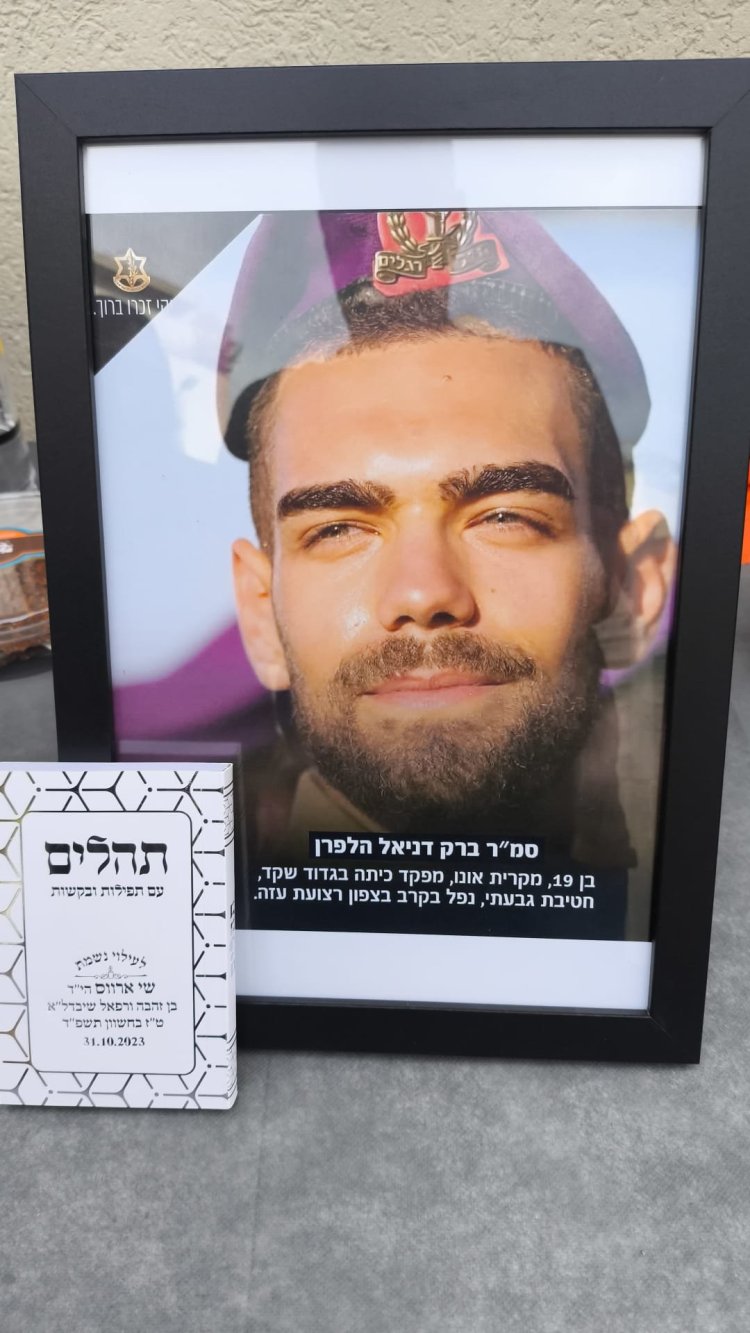 Raphael gives a Book of Psalms and a photo of the fallen son to each family
He adds,
“By the way, I’m a person of faith but I don’t observe Shabbat. Still, I chose to establish, among other things, thirty tefillin stations in Shai’s memory, brought in two Torah scrolls, and I’m advancing many additional projects. From close familiarity with bereaved families, I can say with certainty that in most cases, people of faith find it easier to cope. It’s not that they don’t feel pain, but the strength of faith helps precisely at moments like these. The understanding that there is something beyond, that we part from the body but not from the soul, gives them tremendous strength.”
He also has a message for anyone who hasn’t encountered bereavement up close, yet still faces difficulties in life.
“Anyone who feels weighed down by troubles should go to a military cemetery, even for a single visit. There, the mortgage deficit disappears, the annoyance at a spouse fades, and all one’s troubles turn into trivialities. It simply gives perspective. And until then, try asking yourselves, when was the last time you did something good for someone else? When did you knock on an elderly neighbor’s door and say, ‘We’re going shopping, do you need anything?’ When did you check in on a friend just because, with no agenda, or thank someone in a special way for something they did for you? Try padding your path with small acts, just like our Shai used to do, and you’ll see how much good it brings you.”

