

Magazine
Raising Ten Teens: A Family Built Beyond Biology
For more than two decades, Odia Sabari and her husband, Rabbi Pinchas, have raised children removed from their families as house parents in a community home in Jaffa. Step inside their daily lives, where care, patience, and shared routines slowly grow into a family beyond biology.
- Moriah Luz
- | Updated
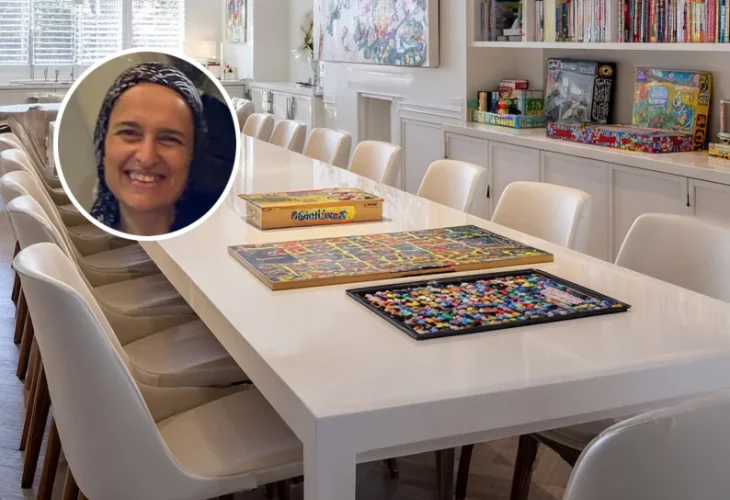 Illustrative Image (Inset: Odia Sabari)
Odia Sabari and her husband, Rabbi Pinchas, are the biological parents to three grown children. At the same time, for many years they have served as “house parents” in a residential family home for children who were removed from their own homes. When Odia walks with her children to the pool or the community center in the afternoon, the family often get curious looks from those who don’t yet know them. One mother surrounded by ten children, all of school and high school age, with a striking variety of facial features, hair colors, and skin tones.
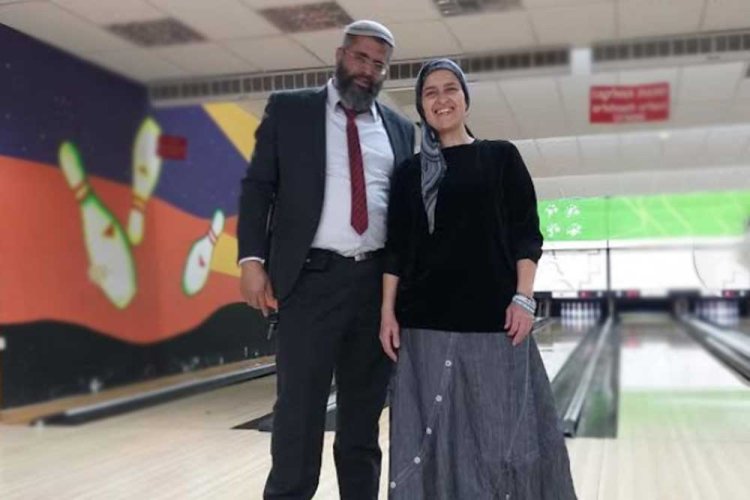 Rabbi Pinchas and Odia Sabari
A Home in Every Sense
“For the past 26 years, my husband and I have served as house parents in a community family home in the city of Jaffa,” Odia explains. “The framework operates under the Ministry of Welfare and is currently affiliated with the ‘Or Shalom’ association, under the supervision of the Ministry of Welfare and Social Security. It is intended for children who were removed from their homes by court order because their parents are unable to care for them, and an alternative family setting was required.
“We function as parents in every sense for the children in our care,” she continues. “We take care of all their needs, from basic necessities like food, help with schoolwork, and medical care, to emotional needs, warmth, and love. In addition, through Or Shalom the children receive a comprehensive support system that includes a social worker, emotional therapy, national service volunteers, teachers, and a psychologist, all to help them cope with the challenges they have experienced. We, as house parents, also receive guidance and professional support.
“For 24 years we worked under the Association for the Advancement of Education in Tel Aviv–Jaffa, founded by Dr. David Portovitch. The people there became like family to us, and we feel deep gratitude for the long road we traveled together and for the support we received over the years.”
“We serve as an extended family for the children and fulfill the parental role in many areas,” Odia adds. “When schools reach out, or when there are medical matters, we are the address. We never imagined we would do this for so many years, but for us it’s simply a calling that entered our hearts. It’s not a job, it’s our way of life.”
How Did This Begin?
“Both of us grew up in families involved in education, so naturally we went on to study in that field as well,” Odia recalls. “When we got married, we knew we were drawn to education, but we wanted to do something a bit different from teaching in a classroom.
“The idea of foster parenting came up, and we jumped in without fully understanding all the implications. We started at the Talpiot Children’s Village in Hadera as a young couple with a baby girl. We were there for a year and liked it very much, but the distance from our parents on both sides was difficult, which is how we ended up in our current place in Jaffa. During that time, two more of our children were born here, so they grew up from infancy alongside the children in the family home.”
Sabari explains that the children in the family home were removed from their homes by court order and often come from families that faced significant hardships. Some come from single-parent households, others from families where parents struggle with addiction. They come from all sectors and communities in Israeli society. Their biological families usually live in nearby cities, which allows for ongoing contact. She notes that maintaining contact with biological parents is a significant part of the work, and the professional approach sees strengthening that bond as an important part of the child’s treatment.
“Every two weeks, the children go home for Shabbat. Some children, sadly, don’t have a family to return to, and for them we’ve found permanent host families for those weekends. During holidays and long school breaks, those children participate in activities and summer camps organized by Or Shalom.”
Most children arrive at the family home in the early school years and leave after several years. Sabari recalls a particularly moving case in which a child was removed from home and placed with them, and later the mother successfully rehabilitated herself from addiction and the child was able to return home. At the same time, there are children who remain in the family home until they reach the maximum age of eighteen.
What does a typical day look like in the family home?
“Like any home,” Odia replies. “We wake the children in the morning, they sit down for breakfast, and get ready for school. The younger children, in elementary school, take organized transportation, while the older ones, in middle and high school, use public transportation. In the afternoon they return home and eat lunch together.”
According to Odia, family homes usually receive a cleaner and a cook through the association, but she makes a point of doing the cooking herself, both on weekdays and for Shabbat, as a matter of principle. “That way I can prepare dishes and vary them according to each child’s tastes. I believe cooking creates a true sense of home. After lunch, the children play and do homework. In the afternoon, our wonderful national service volunteers join them as well.
“On certain days, teachers come to provide academic support. At the beginning of the year, we go together to the community center, and each child chooses an extracurricular activity they enjoy. Overall, we build a weekly afternoon schedule for each child, which also includes emotional therapy once a week. Toward evening, it’s time for showers, dinner, and bedtime.”
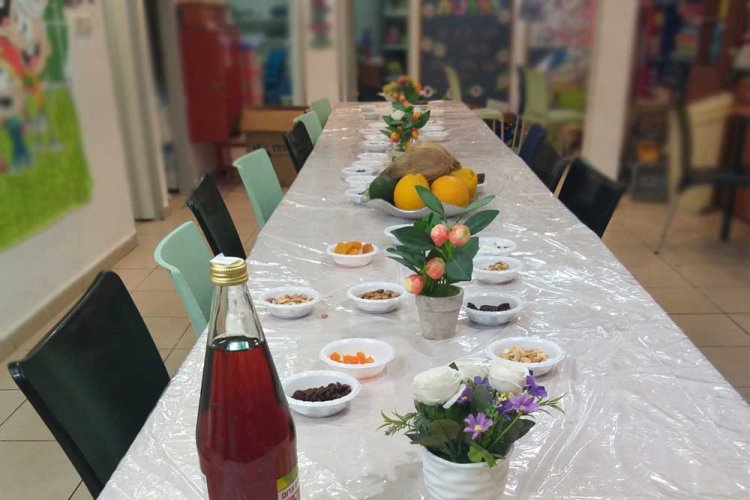
What are the challenges in this mission?
“There’s no shortage,” Odia says with a smile. “There are, of course, the usual challenges of raising children, and on top of that comes the background they bring with them. Often the emotional baggage from their early childhood accompanies them and is expressed in difficult behaviors such as anger outbursts, violence, breaking objects, and sometimes even self-harm.
“It’s not easy,” she adds. “Preventing and dealing with these situations is challenging, and it’s also hard to be exposed to the pain that drives them. Our responsibility as house parents is, on the one hand, to provide each child with the emotional support they need, and on the other, to maintain a safe environment through clear boundaries.
“Once a week I meet with a professional supervisor, where we discuss treatment approaches and dedicate time to thinking about educational strategies for each child. In addition, we hold staff meetings with all those involved in the children’s care: the social worker, the national service volunteers, the cluster manager, and the treatment coordinator.”
Are there conflicts between the family home and raising your own children?
“When our children were younger, my husband used to say that our eldest daughter was the indicator for whether the family home was integrating properly with our private family,” Odia says. “Thank G-d, she’s now a mother herself, but throughout her upbringing she was a wonderful child, and we saw how she benefited from it. Looking back now, with two daughters married and our youngest son in the army, I can say they gained a great deal from this way of life.
“One of my children went through periods when he wanted us to move into a home of our own and struggled with the combination. Today, as an adult, we sometimes have heart-to-heart conversations, and he tells me that because of the family home, he knows how to get along with a wide range of people. He has friends from many different circles and knows how to move comfortably between different worlds while staying true to himself.”
Once a year, onLag BaOmer, a gathering is held for all alumni of the family home from all the years, along with the national service volunteers from different generations. The Sabaris’ biological children also participate, enjoying the chance to share memories. “In the end,” she says, “they gained friends for life.”
When asked whether the biological family’s living quarters are separate from the family home, Odia explains that usually different floors are designated for this purpose. “In our case it’s a bit different. The house is built on a single level. A glass partition separates the family’s living space from the rest of the house, so in practice there isn’t much separation. I think the degree of separation depends on the character of the house parents. By nature, I’m not someone who can retreat into private space and disconnect. We usually place the children who need us most in the rooms closest to us.”
What are your anchors of strength in such intensive and challenging work?
“My main anchor is my husband,” Odia says. “Even in times of crisis, he has an extraordinary ability to contain the difficulties and be strong for both of us.”
“The Teachers of Life”
Rabbi Pinchas Sabari wears several hats in addition to his role in the family home. Among other things, he serves as the head of a kollel in the city, a synagogue rabbi in the neighborhood, and is active in an organization that distributes fruits and vegetables weekly to those in need, as well as food packages before holidays.
“Despite all his responsibilities, my husband is always there when needed and very involved in what happens at home,” Odia emphasizes. “We’ve learned to organize our week efficiently, so if there’s a need to accompany a child to therapy or buy medication, he can make time for it. We also have the support of our national service volunteers, who help wherever needed. Above all, time and experience do their part, and we’ve learned how to integrate everything.
“My husband is very active in the community, and that’s meaningful for us. People see him as someone they can turn to and pour out their hearts to, and couples come to him for guidance. Once a week, on a fixed day, the organization he works with distributes fruits and vegetables. The teenage children in the family home accompany him as part of their school-mandated community service hours.”
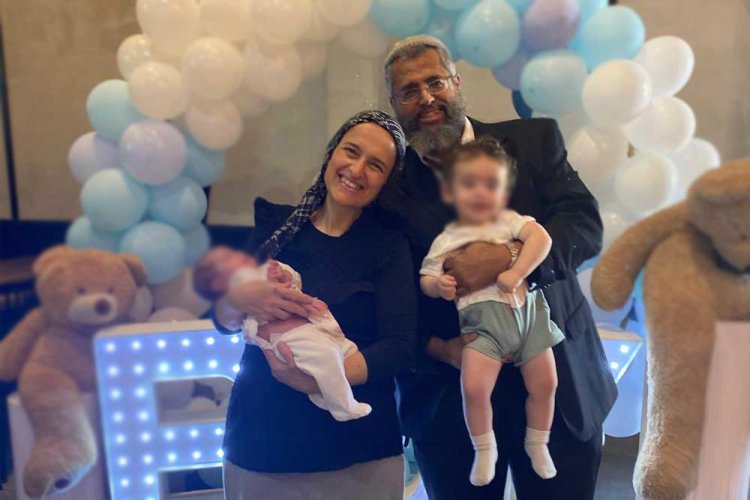 Rabbi Pinchas and Odia with their grandchildren
When do you find time for your relationship within such an intensive reality?
“In the family home schedule, there’s one evening a week that’s free and dedicated solely to the family,” Odia explains. “Today, since our biological children are grown, we devote it to quality time as a couple. It’s a very meaningful evening, and I recommend it to every couple. We know in advance that it’s ‘ours,’ and we always find something to do, at home, out, or visiting extended family.
“In addition, every two weeks the children in the family home spend Shabbat with their biological families, and then we also have private time. The most important thing is to make the most of those moments.”
At the end of the interview, Sabari reflects, “Children are the teachers of life. They can always surprise you, and there is so much to learn from them. What fills me with the most strength is seeing their progress. In the midst of the work itself, it’s not always easy, and their reactions can be unpleasant. That’s true of children in general, and especially of the children in the family home. Because it’s important to them to maintain good relationships with their biological families, they often direct their anger toward us.
“The understanding and kind words come later, when they return as adults and fondly recall situations that even I have already forgotten.
“At one point I stopped to think about what our next station might be, but I couldn’t think of anything as meaningful as being involved in the lives of children. We don’t succeed in breaking the difficult cycle for every child, but when there are children who get back on track and move forward, the feeling is ‘You have labored and found, believe it,’ a great happiness.”

