

Magazine
Is AI Coming for Your Job—and Your Identity?
While AI can draft your emails and plan your life, it can never replicate the uniquely human spark that makes you irreplaceable
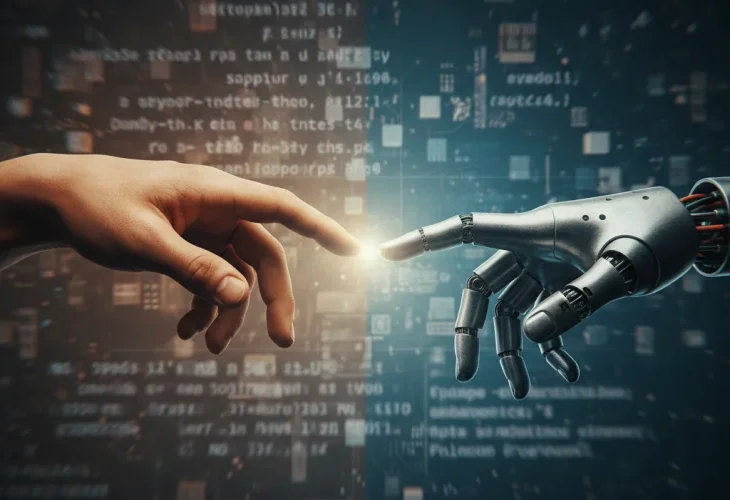
It probably happened to all of us at some point: an AI engine planned our vacation, told us what to pack, found the hotel at a discount, organized the boss's spreadsheets in Excel so we wouldn't waste precious packing time, decoded a weird rash on the kid's arm, and—for dessert—gave us a therapy session during our late-night existential crisis.
Everything was wonderful, until we stopped and realized: if this thing is such a superhero, who needs us? How long until my boss reaches the same conclusion and I’m out of a job?
If you’re a young professional looking for an intellectual anchor in this sea of silicon, you need to know Rabbi Lord Jonathan Sacks. He wasn't just a former Chief Rabbi of the UK; he was a global moral philosopher, a member of the House of Lords, and a man who looked at a line of code and saw a theological challenge.
Long before Chat GPT made us all question our career paths, Rabbi Sacks was a pioneer in identifying the "soul-crushing" potential of AI. He saw that the danger wasn't just robots taking our desks, but robots taking our identity.
The Answer: "By Being What Only I Can Be"
Sacks’ response to the AI panic wasn't to hide in a bunker with a typewriter. It was to double down on what he called "The Dignity of Difference." Rabbi Sacks argued that AI thrives on "bland, plastic, synthetic universals." Logic is mass-producible; soul is not. In his famous interview with Krista Tippett, he noted that our "particularity"—our weird quirks, our unique histories, and our non-logical instincts—is what makes life interesting. He famously said, "By being what only I can be, I give humanity what only I can give." An AI can be a million things, but it can never be you.
He also emphasized the difference between intelligence and love: He reminded us that "Human’s uniqueness is not in intelligence which can be artificial, but in loving and being loved." Chat GPT or Gemini might give you sympathetic therapy-speak when you are unravelling, but can they hold your hand? Look deep into your eyes? Make you feel that another human shares your burden? Of course not. Because intelligence is not love, and love is what makes us human.
It is easy to be impressed by the advances of AI technology, but years ago Rabbi Sacks already warned that when we worship the "work of our hands," we become slaves to it. If we value things (however intelligent) over people, we are on the road to ruin. He saw AI as a 21st-century version of the golden calf—a shiny object we built that now threatens to define our worth. And he believed we could resist. While futurists like Yuval Harari suggested we are just "algorithms" and "strings of genomes," Sacks insisted on the sanctity of life. We are moral agents with spiritual power that no LLM can possess.
The TL;DR: Your Job vs. Your Spark
So, will AI take your job? It might take the part of your job that involves "mass-produced logic" (sorry, junior analysts). But it can’t take the part where you navigate a tense meeting with empathy, or the way you bring a specific, "weird" creative spark to a project that no LLM could ever simulate.
The Sacks Summary:
- AI is a tool, not a deity. Use it to fix your spreadsheets, but don't let it tell you who you are.
- Embrace your "Glitch." The parts of you that aren't perfectly logical are the parts that are perfectly human.
- Love wins. You can’t outsource a relationship, and you can’t automate Chesed (loving-kindness).
The robots are here to do the boring stuff. You’re here to be the only version of yourself that has ever existed. As long as you keep doing that, you’re irreplaceable. Now, go do something a robot can't do—like having a genuinely awkward conversation at the water cooler.

