

Magazine
Faith After Infertility: Efrat Nili on Acceptance and Growth
After years of infertility and the painful realization that motherhood would not be part of her life, psychotherapist Efrat Nili shares how she learned to live with absence, return to faith, and build meaning beyond what never came.
- Michal Arieli
- | Updated
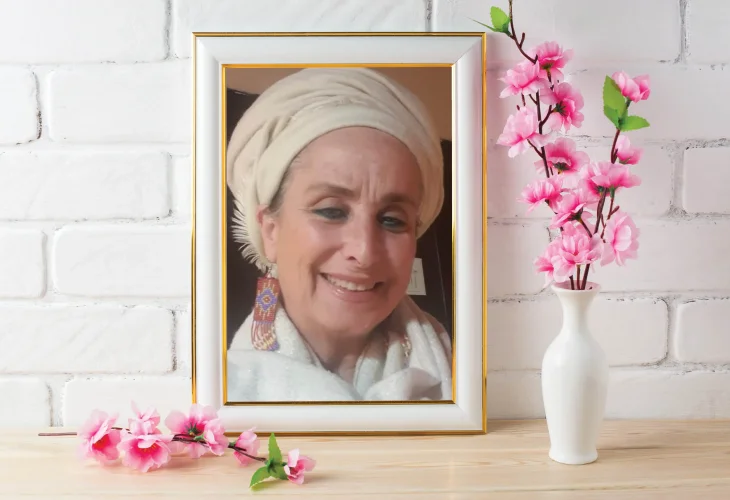 Efrat Nili
When women and girls consult therapist Efrat Nili or take part in the groups she leads, they are often unaware of the personal struggle she carries with her. Efrat, with extensive experience working with both body and soul, is a multidisciplinary body psychotherapist who integrates conversation, movement, expression, and breathing work in her practice. She also facilitates personal growth processes through movement and color.
“I have always worked in the therapeutic field, because the psyche has always fascinated me,” she shares. “I believe this fascination eventually led me back to faith. The more deeply you uncover what exists within a person, the more you recognize the truth inside them and the layers beneath the surface. Still, it was a long journey. My return to faith did not happen overnight, just as the struggles I faced did not resolve instantly. It took a very long time for me to internalize the reality that I do not have children, and that it is very likely I never will.”
The Unbearable Pain
“When we got married, we were completely secular,” Efrat recalls about the early years of her marriage. “We lived in a suburb near Karmiel and led a fairly routine life. At that stage, I had not yet entered the therapeutic world and was mostly involved in art, teaching creative courses to women and children. Over time, I realized how much depth it contained, and it gradually became a therapeutic tool that brought light out of darkness.
“As the years passed after our wedding and we still had no children, it initially did not trouble us deeply. We believed time would do its work. But as more time went by, the emptiness grew heavier. This painful encounter with having no children forced me into a confrontation with the void inside me, with the darkness of absence. I discovered that even something that does not exist can echo loudly in unexpected ways. I felt a deep lack, and the pain was unbearable.
“At a certain point, my husband and I decided to travel the world, as if to keep life moving forward. When we returned, we were renewed, but also clearer about something important. I wanted to learn how to live with pain, both for myself and for other women. That was when I began studying holistic body psychotherapy, specializing in Yemima’s method of conscious thinking.”
Did you feel that studying helped you?
“Honestly, not at first,” Efrat admits. “I could not disconnect from my surroundings. Imagine living in a community where everyone is in their thirties and everyone has children, often one after another. These were people close to us, whose lives we saw clearly, and they were aware of our ongoing waiting. I had never been someone who compared herself to others, but during that period the feelings surfaced against my will. I felt shame, jealousy, comparison, and many difficult emotions. I was angry at myself for feeling them, which only added another layer of anger."
“Today, as a professional, I understand that these feelings did not originate in the situation itself. They existed within me long before. A crisis simply acts as a trigger, bringing buried emotions to the surface and confronting us with pain that feels unbearable.”
It sounds like you accepted the absence, and only the emotions troubled you.
“Not at all,” she says firmly. “We never reached acceptance. There was not a single month in which we did not hope, expect, and pray with full faith that this time it would happen. On a practical level, we did everything. We underwent fertility treatments, tried spiritual remedies, and explored complementary medicine. We exhausted every option, and still nothing happened.”
A Process of Acceptance
“The questions continued to cry out from within me,” Efrat recalls. “Sometimes I literally shouted them in prayer. I would lie in bed crying and asking, ‘Why don’t I have children? Why am I not meant to be a mother?’ I longed for answers, but none came. Slowly, through a gradual process, my husband and I were drawn closer to Hashem and fully returned to faith. At that point, the question of ‘why’ transformed into a question of ‘for what purpose.’”
Did that ease the pain?
“It was not a magical transformation,” Efrat emphasizes. “Observing mitzvot did not suddenly make everything easier. At times, I was even angrier at myself, asking how I could complain when everything is for the best. But the more I studied and understood the psyche through the lens of faith, the clearer it became that the only way forward was to allow myself to meet the pain as it was, with all its messiness. Only then could I make peace with myself and learn to appreciate what I do have, and thank God there is so much.
“It was a long journey, but looking back, I understand that I had to go through every one of those emotions consciously. Eventually, I was able to stand on stable ground and say to myself, ‘This is Hashem’s will for you, exactly as He wants you to be. He can bring life from emptiness, and He can also choose not to. Both are His will.’”
How did the community respond?
“There was almost no response,” she says. “After we moved into a religious community, I constantly heard stories of miracles. Even today people tell me they are praying for me. But in the secular environment we lived in before, no one spoke to us about it. I had one close friend who also struggled with infertility and later became a mother. She was the only person I spoke to openly. The deeper pain, however, I kept to myself.
“Only later did I agree to meet with a therapist who became both a mentor and a friend. That was when things truly began to open up for me.”
She recalls a moment early in her religious journey. “I once attended a communal meal where a woman shared a miracle story about a friend who had given birth after many years. She asked everyone to thank Hashem for the miracle. Suddenly a thought struck me. If she gave birth, it is a miracle. If I did not, does that mean no miracle happened for me? I began to understand that perhaps unanswered prayers are also a form of divine guidance, and that maybe this reality itself was my miracle.”
Giving Birth to Myself
Over the years, Efrat came to understand that biologically, motherhood would not be part of her life. “That realization was deeply painful,” she says. “Even after failed treatments, we continued to hope. And then you suddenly understand that the fertile years are over. Strangely, that was also the moment when something softened inside both of us. We knew Hashem could still perform a miracle beyond nature, but we also understood that life would continue as it was meant to be, just the two of us. Faith grounded us completely.”
She addresses adoption and foster care with sensitivity. “Many couples choose that path, but for us it was not right. The treatments and the strain on our relationship required all our attention. For years, we carried guilt over that decision. Only after deep inner work did we understand that this too was Hashem’s will. There was no place for regret or shame. First came peace with myself, then peace with Hashem, and eventually gratitude for the journey that shaped who I am.”
What still remains difficult today?
“Even at 63, I sometimes find myself singing, ‘I miss my child,’” she says softly. “There is still longing for the child I never had, imagining what they might have been like. When we visit friends on Shabbat and see children and grandchildren, it touches a sensitive place. When you have no children, the sense of family is different, and the absence becomes more pronounced over time. Still, we have learned to create family in other ways and to love ourselves deeply.
“Today, women without children sometimes come to my clinic. It is more common than people think, but rarely discussed. I also meet women who have lost children and ask how they will go on. I cannot give easy answers, because each person must walk their own path. But I share my story and show them my full life, the light I have been given. I may not have been blessed to give birth to children, but I have been blessed to give birth to myself.”

