

World News
Vance Says Antisemitism Has No Place in Conservative Movement
Vice president responds to criticism over AmericaFest remarks, defends coalition unity, and invokes Christian principles as critics press for clearer red lines
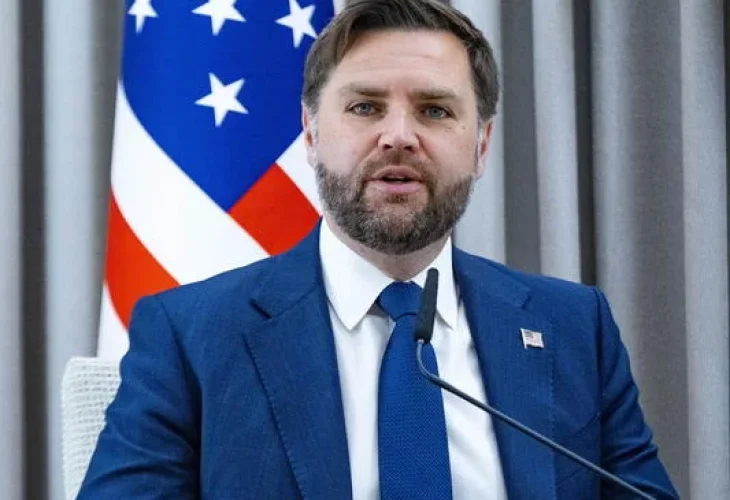 JD Vance (OLIVIER FITOUSSI/POOL/Flash90)
U.S. Vice President JD Vance said antisemitism has no place in the conservative movement, addressing mounting criticism following his recent appearance at Turning Point USA’s AmericaFest and a broader debate over boundaries within the political right.
Vance addressed the issue in an interview yesterday with CNN commentator Scott Jennings, after drawing criticism for his Dec. 21 AmericaFest speech, in which he stressed unity but avoided drawing firm lines against antisemitic figures.
Asked directly whether the conservative movement should tolerate antisemitism, Vance replied: “No, it doesn’t, Scott. I think we need to reject all forms of ethnic hatred, whether it’s antisemitism, anti-black hatred, anti-white hatred.”
The vice president framed that rejection as a core conservative value, arguing that the movement is “fundamentally rooted in the Christian principles that founded the United States of America,” including the idea that individuals should be judged by their actions rather than their background. “Every person is made in the image of God. You judge them by what they do, not by what ethnic group they belong to,” Vance said.
Vance added that maintaining that principle is essential for conservatives, saying it is “something we’ve got to hold onto in the conservative movement because God knows the left abandoned it a long time ago.”
The exchange followed continuing fallout from Turning Point USA’s AmericaFest, an annual gathering that has highlighted growing internal disputes within the conservative movement. Vance drew criticism there for defending a broad political coalition and opposing what he called ideological “purity tests”, meaning efforts to exclude individuals or groups over specific views, a position some Jewish and pro-Israel conservatives say leaves antisemitic rhetoric insufficiently challenged.
Online reaction to Vance’s Jan. 6 remarks was swift. On X, critics said his answer lacked specificity and echoed Democratic-style responses that condemn antisemitism while grouping it with other forms of hatred. Among those critics was Daniel Flesch, a senior policy analyst at the Heritage Foundation, who wrote that Vance needs a “better answer on why the conservative movement should not tolerate antisemitism than what is effectively the equivalent of the Democrats’ ‘and Islamaphobia’ response.”
The controversy has also revived scrutiny of Vance’s relationship with media figures such as Tucker Carlson, whose influence within parts of the conservative movement has drawn sharp criticism from Jewish organizations and pro-Israel activists.
While Vance did not name specific individuals during the interview, the interview showed the widening rift within the conservative coalition over how to confront antisemitism. As election season approaches, that debate is expected to intensify, placing added pressure on Republican leaders to clarify where they draw the line.

