

World News
Celebrating Quietly: Venezuelan Jews on Alert After Maduro’s Capture
Explosions near Jewish neighborhoods, synagogue closures, and regime-linked intimidation leave a small community relieved in private but wary in public
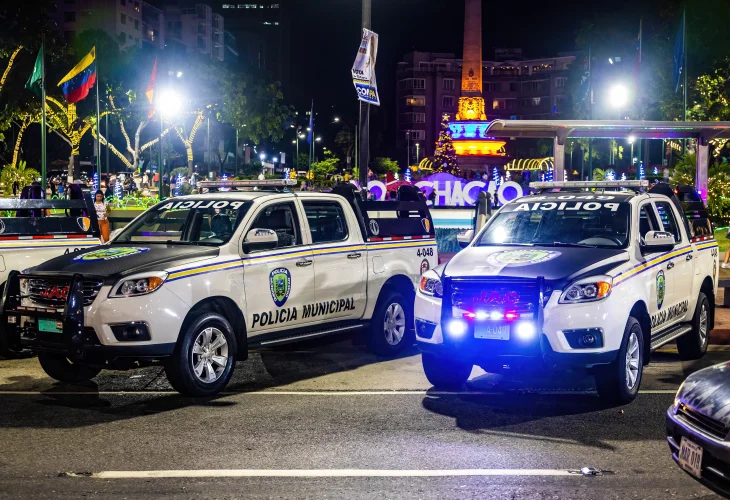 Venezuela Police (Shutterstock)
Members of Venezuela’s Jewish community are expressing relief following the U.S. military operation that led to the capture of former president Nicolás Maduro, but that relief is being felt almost entirely behind closed doors. Public celebrations have been avoided as the country enters a volatile political transition and the future of the regime remains uncertain.
For many Jews in Caracas, the moment carried a deeply personal and even religious meaning. Community members say people had prayed for years for Maduro’s fall. Yet fear, not triumph, has shaped daily life since the operation. With state institutions still operating and Venezuela officially under a state of emergency, Jewish community leaders are urging caution and heightened awareness.
That caution was reinforced when loud explosions were heard across parts of the capital on Friday night. Around 3 a.m. on Shabbat, Jewish families in Caracas reported being jolted awake by powerful blasts that shook homes and rattled windows. Some of the U.S. strikes were reported near the La Carlota military airbase, an area located close to Jewish residential neighborhoods.
Residents described confusion and anxiety as the events unfolded. While news of the operation spread quickly abroad, many Venezuelans initially received no official information. State television channels remain under government control, and several Jewish residents said they only learned what had happened through social media and private messaging groups.
In an effort to safeguard the community, its leadership acted quickly. Most synagogues remained closed the following day under instructions relayed by a local security firm. Prayer services were held quietly in private homes, while security around Jewish institutions was reinforced due to concerns over looting and break-ins during the unrest.
Leaders also instructed community members to adopt a strict low-profile policy. Residents were told not to speak publicly about events, not to draw attention to themselves, and to leave their homes only for essential needs such as buying food. Jewish residents speaking on condition of anonymity said fears of possible retaliation remain high.
“People are afraid to go out,” one resident said, describing concerns about armed motorcycle gangs believed to be loyal to elements of the old regime. Others said the sense of relief was real but carefully contained, with celebrations limited to homes and private spaces. “No one dares to celebrate outside,” another resident said.
At the same time, the community has emphasized preparedness rather than panic. A Jewish emergency operations center has been activated and is operating around the clock, providing security coordination, medical assistance, and logistical support. The community remains in continuous contact with Jewish organizations in Mexico, Argentina, and the United States, which have expressed readiness to assist if conditions deteriorate. While some community members are currently abroad, the majority remain in Venezuela and are following the established guidelines.
Despite its reduced size, Jewish communal life in Venezuela remains highly organized. There are an estimated 18 synagogues in the country, along with Jewish schools and community institutions. Leadership is divided between Ashkenazi and Sephardi councils, alongside a joint communal body that coordinates responses during crises. Community representatives say ties with Israel remain strong, even though Israel does not currently maintain an embassy in Venezuela.
Uncertainty has been heightened by statements from Delcy Rodríguez, who was sworn in after Maduro’s removal. Rodríguez described the U.S. operation as “Zionist in character,” a phrase that raised concern among Jewish leaders but was also viewed as familiar political signaling rather than a new escalation.
The Jewish population in Venezuela has shrunk dramatically over the past two decades, originally numbering around 30,000, but now it is down to roughly 4,000 people, most of them living in Caracas.The decline has been driven mainly by political repression and economic collapse, rather than by antisemitism on the street. Community figures say hostility toward Jews has largely come from political leaders and state media, often linked to anti-Israel rhetoric, rather than from Venezuelan society at large.
For now, daily life continues under careful watch. Schools are expected to reopen gradually, and institutions remain operational, though with reduced visibility. Jews in Caracas say they are grateful for the moment but remain aware that Maduro’s arrest does not mean the system he built has disappeared.

